

Real AZ-304 are Uploaded by Pass4sureCert provide 2021 Latest AZ-304 Practice Tests Dumps.
All AZ-304 Dumps and Microsoft Azure Architect Design Training Courses Help candidates to study and pass the Microsoft Azure Architect Design Exams hassle-free!
NEW QUESTION 129
You have an app named App1 that uses two on-premises Microsoft SQL Server databases named DB1 and DB2.
You plan to migrate DB1 and DB2 to Azure.
You need to recommend an Azure solution to host DB1 and DB2. The solution must meet the following requirements:
* Support server-side transactions across DB1 and DB2.
* Minimize administrative effort to update the solution.
What should you recommend?
- A. two Azure SQL databases on different Azure SQL Database servers
- B. two Azure SQL databases in an elastic pool
- C. two Azure SQL databases on the same Azure SQL Database managed instance
- D. two SQL Server databases on an Azure virtual machine
Answer: D
Explanation:
When both the database management system and client are under the same ownership (e.g. when SQL Server is deployed to a virtual machine), transactions are available and the lock duration can be controlled. Reference: https://docs.particular.net/nservicebus/azure/understanding-transactionality-in-azure
NEW QUESTION 130
Your company deploys several Linux and Windows virtual machines (VMs) to Azure. The VMs are deployed with the Microsoft Dependency Agent and the Log Analytics Agent installed by using Azure VM extensions. On-premises connectivity has been enabled by using Azure ExpressRoute.
You need to design a solution to monitor the VMs.
Which Azure monitoring services should you use? To answer, select the appropriate Azure monitoring services in the answer area.
NOTE: Each correct selection is worth one point.
Answer:
Explanation:
Explanation:
Box 1: Azure Traffic Analytics
Traffic Analytics is a cloud-based solution that provides visibility into user and application activity in cloud networks. Traffic analytics analyzes Network Watcher network security group (NSG) flow logs to provide insights into traffic flow in your Azure cloud. With traffic analytics, you can:
Identify security threats to, and secure your network, with information such as open-ports, applications attempting internet access, and virtual machines (VM) connecting to rogue networks.
Visualize network activity across your Azure subscriptions and identify hot spots.
Understand traffic flow patterns across Azure regions and the internet to optimize your network deployment for performance and capacity.
Pinpoint network misconfigurations leading to failed connections in your network.
Box 2: Azure Service Map
Service Map automatically discovers application components on Windows and Linux systems and maps the communication between services. With Service Map, you can view your servers in the way that you think of them: as interconnected systems that deliver critical services. Service Map shows connections between servers, processes, inbound and outbound connection latency, and ports across any TCP-connected architecture, with no configuration required other than the installation of an agent.
References:
https://docs.microsoft.com/en-us/azure/network-watcher/traffic-analytics
https://docs.microsoft.com/en-us/azure/azure-monitor/insights/service-map
NEW QUESTION 131
You have an on-premises file server that stores 2 TB of data files.
You plan to move the data files to Azure Blob storage in the Central Europe region.
You need to recommend a storage account type to store the data files and a replication solution for the storage account. The solution must meet the following requirements:
* Be available if a single Azure datacenter fails.
* Support storage tiers.
* Minimize cost.
What should you recommend? To answer, select the appropriate options in the answer area.
NOTE: Each correct selection is worth one point.
Answer:
Explanation:
Explanation
Box 1: Blob storage
Blob storage supports storage tiers
Note: Azure offers three storage tiers to store data in blob storage: Hot Access tier, Cool Access tier, and Archive tier. These tiers target data at different stages of its lifecycle and offer cost-effective storage options for different use cases.
Box 2: Zone-redundant storage (ZRS)
Data in an Azure Storage account is always replicated three times in the primary region. Azure Storage offers two options for how your data is replicated in the primary region:
* Zone-redundant storage (ZRS) copies your data synchronously across three Azure availability zones in the primary region.
* Locally redundant storage (LRS) copies your data synchronously three times within a single physical location in the primary region. LRS is the least expensive replication option, but is not recommended for applications requiring high availability.
References:
https://cloud.netapp.com/blog/storage-tiers-in-azure-blob-storage-find-the-best-for-your-data
NEW QUESTION 132
You have an on-premises application named App1 that uses an Oracle database.
You plan to use Azure Databricks to load data from App1 to an Azure SQL Data Warehouse instance You need to ensure that the App1 data is available to Databricks.
Which two Azure services should you include in the solution? Each correct answer presents part of the solution.
NOTE Each correct selection is worth one point.
- A. Azure Data lake Storage
- B. Azure Import/Export service
- C. Azure Data Box Edge
- D. Azure Data Box Gateway
- E. Azure Data Factory
Answer: A,E
Explanation:
Automate data movement using Azure Data Factory, then load data into Azure Data Lake Storage, transform and clean it using Azure Databricks, and make it available for analytics using Azure Synapse Analytics. Modernize your data warehouse in the cloud for unmatched levels of Note: Integrate data silos with Azure Data Factory, a service built for all data integration needs and skill levels. Easily construct ETL and ELT processes code-free within the intuitive visual environment, or write your own code. Visually integrate data sources using more than 90+ natively built and maintenance-free connectors at no added cost. Focus on your data-the serverless integration service does the rest.
Reference:
https://azure.microsoft.com/en-us/services/databricks/#capabilities
https://azure.microsoft.com/en-us/services/data-factory/
NEW QUESTION 133
You have an Azure subscription that contains the SQL servers shown in the following table.
The subscription contains the storage accounts shown in the following table.
You create the Azure SQL databases shown in the following table.

Answer:
Explanation:
Reference:
https://docs.microsoft.com/en-us/azure/sql-database/sql-database-auditing
NEW QUESTION 134
You are designing a network connectivity strategy for a new Azure subscription. You identify the following requirements:
* The Azure virtual machines on a subnet named Subnet1 must be accessible only from the computers in your London office.
* Engineers require access to the Azure virtual machine on a subnet named Subnet2 over the Internet on a specific TCP/IP management port.
* The Azure virtual machines in the West Europe Azure region must be able to communicate on all ports to the Azure virtual machines in the North Europe Azure region.
You need to recommend which components must be used to meet the requirements. The solution must minimize costs and administrative effort whenever possible.
What should you include in the recommendation? To answer, drag the appropriate components to the correct requirements. Each component may be used once, more than once, or not at all. You may need to drag the split bar between panes or scroll to view content.
NOTE: Each correct selection is worth one point.
Answer:
Explanation:
Explanation
NEW QUESTION 135
You have an Azure Active Directory (Azure AD) tenant named Contoso.com. The tenant contains a group named Group1. Group1 contains all the administrator user accounts.
You discover several login attempts to the Azure portal from countries administrator users do NOT work.
You need to ensure that all login attempts to the portal from those countries require Azure Multi-Factor Authentication (MFA).
Solution: You implement an access package.
Does this meet the goal?
- A. No
- B. Yes
Answer: A
Explanation:
Explanation
Instead implement Azure AD Privileged Identity Management.
Note: Azure Active Directory (Azure AD) Privileged Identity Management (PIM) is a service that enables you to manage, control, and monitor access to important resources in your organization.
Reference:
https://docs.microsoft.com/en-us/azure/active-directory/privileged-identity-management/pim-configure
NEW QUESTION 136
You have an Azure Active Directory (Azure AD) tenant named contoso.com that has a security group named Group'. Group i is configured Tor assigned membership. Group I has 50 members. including 20 guest users.
You need To recommend a solution for evaluating the member ship of Group1. The solution must meet the following requirements:
* The evaluation must be repeated automatically every three months
* Every member must be able to report whether they need to be in Group1
* Users who report that they do not need to be in Group 1 must be removed from Group1 automatically
* Users who do not report whether they need to be m Group1 must be removed from Group1 automatically.
What should you include in me recommendation?
- A. Create an access review.
- B. implement Azure AU Identity Protection.
- C. Implement Azure AD Privileged Identity Management.
- D. Change the Membership type of Group1 to Dynamic User.
Answer: D
NEW QUESTION 137
You have an on-premises network that uses on IP address space of 172.16.0.0/16 You plan to deploy 25 virtual machines to a new azure subscription.
You identity the following technical requirements.
* All Azure virtual machines must be placed on the same subnet subnet1.
* All the Azure virtual machines must be able to communicate with all on premises severs.
* The servers must be able to communicate between the on-premises network and Azure by using a site to site VPN.
You need to recommend a subnet design that meets the technical requirements.
What should you include in the recommendation? To answer, drag the appropriate network addresses to the correct subnet. Each network address may be used once, more than once or not at all. You may need to drag the split bar between panes or scroll to view content.
NOTE: Each correct selection is worth one point.
Answer:
Explanation:
NEW QUESTION 138
Your company has the divisions shown in the following table.
You plan to deploy a custom application to each subscription. The application will contain the following:
* A resource group
* An Azure web app
* Custom role assignments
* An Azure Cosmos DB account
You need to use Azure Blueprints to deploy the application to each subscription.
What is the minimum number of objects required to deploy the application? To answer, select the appropriate options in the answer area.
NOTE: Each correct selection is worth one point.
Answer:
Explanation:
Explanation
Box 1: 2
One management group for East, and one for West.
When creating a blueprint definition, you'll define where the blueprint is saved. Blueprints can be saved to a management group or subscription that you have Contributor access to. If the location is a management group, the blueprint is available to assign to any child subscription of that management group.
Box 2: 1
One definition as the you plan to deploy a custom application to each subscription.
With Azure Blueprints, the relationship between the blueprint definition (what should be deployed) and the blueprint assignment (what was deployed) is preserved.
Box 3: 4
One assignment for each subscription.
Reference:
https://docs.microsoft.com/en-us/azure/governance/blueprints/overview
NEW QUESTION 139
You need to recommend a solution for data of the historical transaction query system.
What should you include in the recommendation? To answer, Select the appropriate or options in the answer area.
NOTE: Each correct selection is worth one point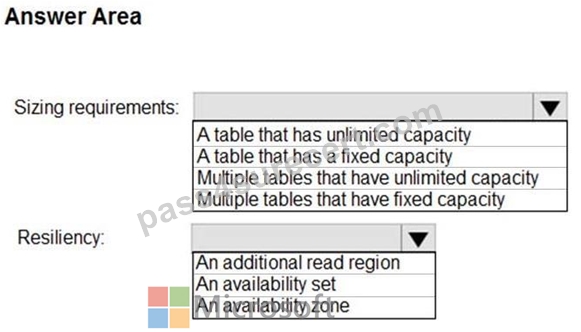
Answer:
Explanation:
Explanation
NEW QUESTION 140
Your company wants to use an Azure Active Directory (Azure AD) hybrid identity solution.
You need to ensure that users can authenticate if the internet connection to the on-premises Active Directory is unavailable. The solution must minimize authentication prompts for the users.
What should you include in the solution?
- A. password hash synchronization and Azure AD Seamless Single Sign-On (Azure AD Seamless SSO)
- B. an Active Directory Federation Services (AD FS) server
- C. pass-through authentication and Azure AD Seamless Single Sign-On (Azure AD Seamless SSO)
Answer: A
Explanation:
With Password hash synchronization + Seamless SSO the authentication is in the cloud.
Incorrect Answers:
Pass-through Authentication and federation rely on on-premises infrastructure.
Reference:
https://docs.microsoft.com/en-us/azure/active-directory/hybrid/choose-ad-authn
NEW QUESTION 141
You manage an Azure environment for a company. The environment has over 25,000 licensed users and 100 mission-critical applications. You need to recommend a solution that provides advanced user threat detection and remediation strategies. What should you recommend?
- A. Azure Active Directory (Azure AD) Connect
- B. Azure Active Directory (Azure AD) Identity Protection
- C. Azure Active Directory Federation Services (AD FS)
- D. Microsoft Identity Manager
- E. Azure Active Directory (Azure AD) authentication
Answer: B
Explanation:
Reference:
https://docs.microsoft.com/en-us/azure/security/fundamentals/threat-detection
NEW QUESTION 142
You have an Azure subscription that contains 300 Azure virtual machines that run Windows Server 2016.
You need to centrally monitor all warning events in the System logs of the virtual machines.
What should you include in the solutions? To answer, select the appropriate options in the answer area.
NOTE: Each correct selection is worth one point.
Answer:
Explanation:
References:
https://docs.microsoft.com/en-us/azure/azure-monitor/platform/data-sources-windows-events
https://docs.microsoft.com/en-us/azure/azure-monitor/platform/agent-windows
NEW QUESTION 143
You have an on-premises network that uses on IP address space of 172.16.0.0/16 You plan to deploy 25 virtual machines to a new azure subscription.
You identity the following technical requirements.
All Azure virtual machines must be placed on the same subnet subnet1.
All the Azure virtual machines must be able to communicate with all on premises severs.
The servers must be able to communicate between the on-premises network and Azure by using a site to site VPN.
You need to recommend a subnet design that meets the technical requirements.
What should you include in the recommendation? To answer, drag the appropriate network addresses to the correct subnet. Each network address may be used once, more than once or not at all. You may need to drag the split bar between panes or scroll to view content.
NOTE: Each correct selection is worth one point.
Answer:
Explanation:
1 - 192.168.0.0/24
2 - 192.168.1.0/28
NEW QUESTION 144
You have the application architecture shown in the following exhibit.
Use the drop-down menus to select choice that completes each statement based on the information presented in the graphic.
NOTE: Each correct selection is worth one point.
Answer:
Explanation:
References:
https://docs.microsoft.com/en-us/azure/traffic-manager/traffic-manager-routing-methods
https://docs.microsoft.com/en-us/azure/traffic-manager/traffic-manager-monitoring
NEW QUESTION 145
You need to recommend a solution for the users at Contoso to authenticate to the cloud-based services and the Azure AD-integrated applications.
What should you include in the recommendation? To answer, select the appropriate options in the answer area.
NOTE: Each correct selection is worth one point.
Answer:
Explanation:
NEW QUESTION 146
You need to implement the Azure RBAC role assignment. The solution must meet the authentication and authorization requirements.
How many assignment should you configure for the Network Contributor role for Role1? To answer, select appropriate in the answer area.
NOTE:
Answer:
Explanation:
NEW QUESTION 147
You are designing an Azure resource deployment that will use Azure Resource Manager templates. The deployment will use Azure Key Vault to store secrets.
You need to recommend a solution to meet the following requirements:
Prevent the IT staff that will perform the deployment from retrieving the secrets directly from Key Vault.
Use the principle of least privilege.
Which two actions should you recommend? Each correct answer presents part of the solution.
NOTE: Each correct selection is worth one point.
- A. Create a Key Vault access policy that allows all list key permissions, list secret permissions, and list certificate permissions.
- B. Assign the Key Vault Contributor role to the IT staff.
- C. From Access policies in Key Vault, enable access to the Azure Resource Manager for template deployment.
- D. Create a Key Vault access policy that allows all get key permissions, get secret permissions, and get certificate permissions.
- E. Assign the IT staff a custom role that includes the Microsoft.KeyVault/Vaults/Deploy/Action permission.
Answer: C,E
Explanation:
B: To access a key vault during template deployment, set enabledForTemplateDeployment on the key vault to true.
D: The user who deploys the template must have the Microsoft.KeyVault/vaults/deploy/action permission for the scope of the resource group and key vault.
Incorrect Answers:
E: To grant access to a user to manage key vaults, you assign a predefined key vault Contributor role to the user at a specific scope.
If a user has Contributor permissions to a key vault management plane, the user can grant themselves access to the data plane by setting a Key Vault access policy. You should tightly control who has Contributor role access to your key vaults. Ensure that only authorized persons can access and manage your key vaults, keys, secrets, and certificates.
Reference:
https://docs.microsoft.com/en-us/azure/azure-resource-manager/templates/key-vault-parameter
https://docs.microsoft.com/en-us/azure/key-vault/general/overview-security
NEW QUESTION 148
You have an Azure App Service Web App that includes Azure Blob storage and an Azure SQL Database instance. The application is instrumented by using the Application Insights SDK.
You need to design a monitoring solution for the web app.
Which Azure monitoring services should you use? To answer, select the appropriate Azure monitoring services in the answer area.
NOTE: Each correct selection is worth one point.
Answer:
Explanation:
Explanation
NEW QUESTION 149
You need to recommend a solution for the user at Contoso to authenticate to the cloud-based sconces and the Azure AD-integrated application. What should you include in the recommendation? To answer, select the appropriate options in the answer area.
NOTE: Each correct selection is worth one point.
Answer:
Explanation:
Explanation
NEW QUESTION 150
Your on-premises network contains a file server named Server1 that stores 500 GB of data.
You need to use Azure Data Factory to copy the data from Server1 to Azure Storage.
You add a new data factory.
What should you do next? To answer, select the appropriate options in the answer area.
NOTE: Each correct selection is worth one point.
Answer:
Explanation:
Explanation:
Box 1: Install a self-hosted integration runtime
The Integration Runtime is a customer-managed data integration infrastructure used by Azure Data Factory to provide data integration capabilities across different network environments.
Box 2: Create a pipeline
With ADF, existing data processing services can be composed into data pipelines that are highly available and managed in the cloud. These data pipelines can be scheduled to ingest, prepare, transform, analyze, and publish data, and ADF manages and orchestrates the complex data and processing dependencies References:
https://docs.microsoft.com/en-us/azure/machine-learning/team-data-science-process/move-sql-azure-adf
NEW QUESTION 151
......
Valid Way To Pass Microsoft's AZ-304 Exam with : https://www.pass4surecert.com/Microsoft/AZ-304-practice-exam-dumps.html
Free Test Engine For Microsoft Azure Architect Design Certification Exams: https://drive.google.com/open?id=1IHksl4s6rWntQsCXpgWLS_TVh-u4XZ8w