

Guaranteed Success in Microsoft Azure AZ-120 Exam Dumps
Microsoft AZ-120 Daily Practice Exam New 2024 Updated 230 Questions
Microsoft AZ-120 certification exam is designed for professionals who are interested in planning and administering Microsoft Azure for SAP workloads. Planning and Administering Microsoft Azure for SAP Workloads certification exam is ideal for individuals who have experience working with SAP applications and want to expand their knowledge of Azure cloud services. By passing the AZ-120 exam, candidates can demonstrate their proficiency in implementing, managing, and monitoring Azure resources for SAP workloads.
NEW QUESTION # 12
You plan to migrate an SAP ERP Central Component (SAP ECC) production system to Azure.
You are reviewing the SAP EarlyWatch Alert report for the system.
You need to recommend sizes for the Azure virtual machines that will host the system.
Which two sections of the report should you review? Each correct answer presents a complete solution.
NOTE: Each correct selection is worth one point.
- A. Database and ABAP Load Optimization
- B. Hardware Capacity
- C. Hardware Configuration under Landscape
- D. Patch Levels under SAP Software Configuration
- E. Data Volume Management
Answer: B,C
Explanation:
Reference:
https://wiki.scn.sap.com/wiki/display/SM/Hardware+Capacity+Checks+in+EWA
NEW QUESTION # 13
You have an SAP production landscape on Azure that contains the virtual machines shown in the following table.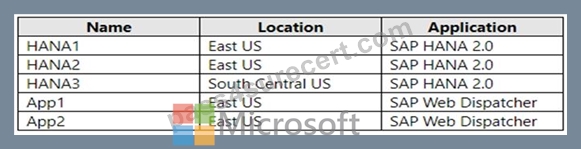
You configure HANA system replication as shown in the following table.
You configure two load balancers as shown in the following table.
For each of the following statements, select Yes if the statement is true. Otherwise, select No.
NOTE: Each correct selection is worth one point.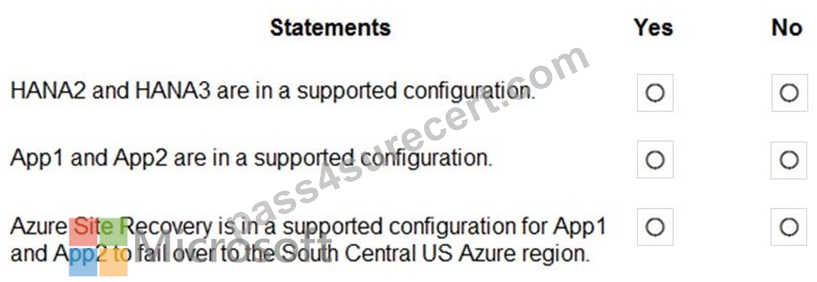
Answer:
Explanation: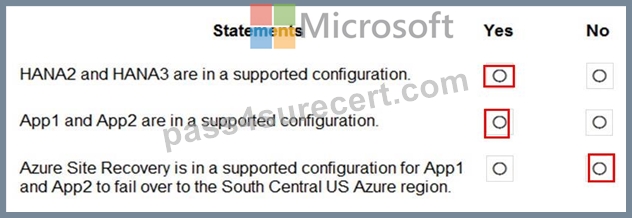
Reference:
https://help.sap.com/viewer/6b94445c94ae495c83a19646e7c3fd56/2.0.02/en-US/f730f308fede4040bcb5ccea6751e74d.html
https://docs.microsoft.com/en-us/azure/virtual-machines/workloads/sap/sap-hana-high-availability
NEW QUESTION # 14
You deploy an SAP environment on Azure.
You need to grant an SAP administrator read-only access to the Azure subscription. The SAP administrator must be prevented from viewing network information.
How should you configure the role-based access control (RBAC) role definition? To answer, drag the appropriate values to the correct targets. Each value may be used once, more than once, or not at all. You may need to drag the split bar between panes or scroll to view content.
NOTE: Each correct selection is worth one point.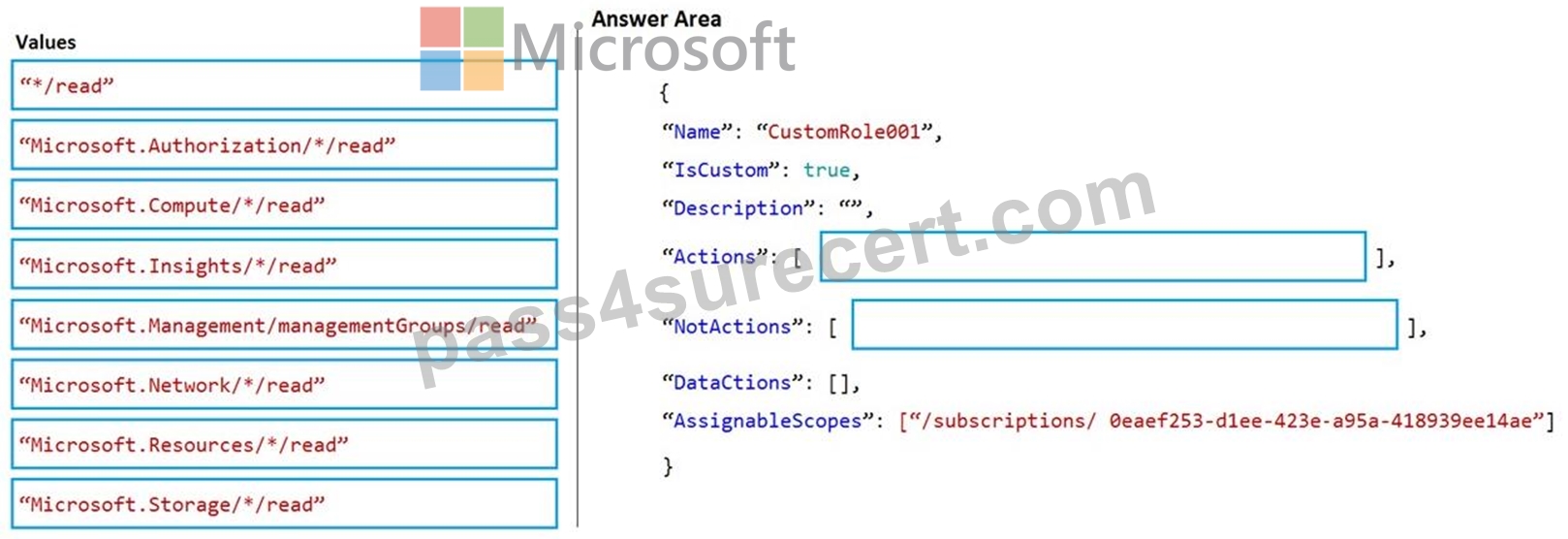
Answer:
Explanation: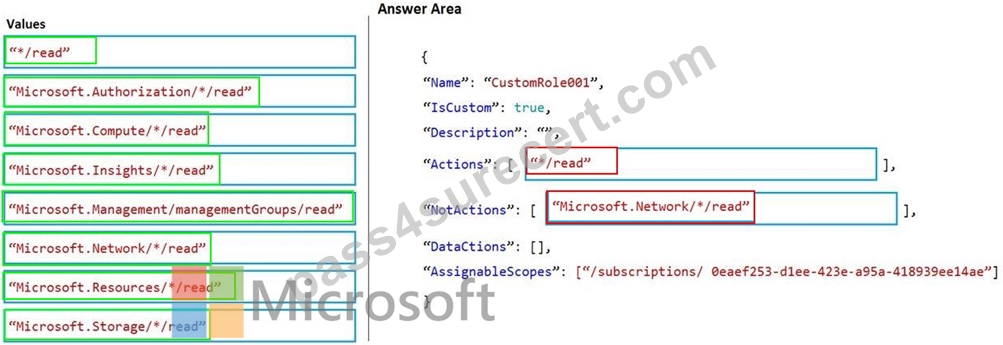
NEW QUESTION # 15
You are deploying an SAP environment across Azure Availability Zones. The environment has the following components:
* ASCS/ERS instances that use a failover cluster
* SAP application servers across the Azure Availability Zones
* Database high availability by using a native database solution
For each of the following statements, select Yes if the statement is true. Otherwise, select No.
NOTE: Each correct selection is worth one point.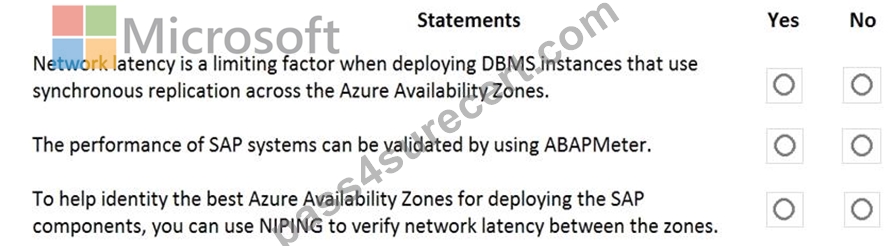
Answer:
Explanation: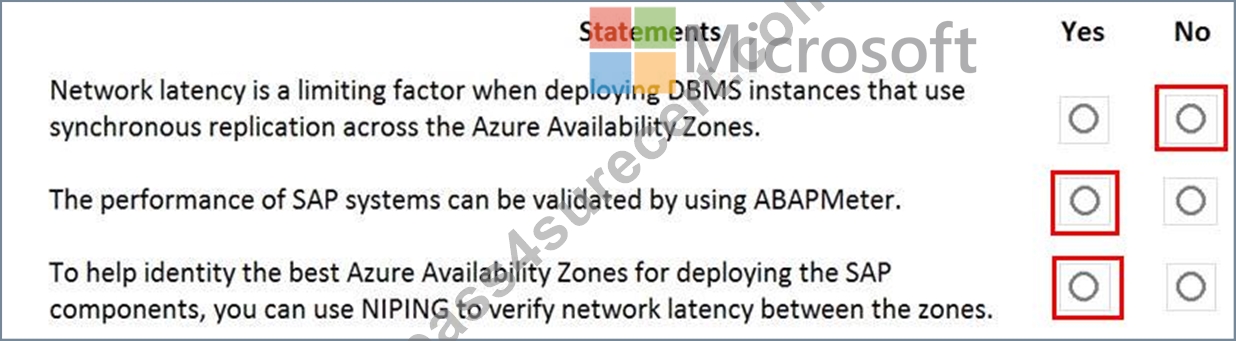
Explanation:
Box 1: No
Azure Availability Zones are physically separate locations within an Azure region protecting customers' applications and data from datacenter-level failures. It is good for applications that require low-latency synchronous replication with protection from datacenter-level failures.
Box 2: Yes
AAP application server to database server latency can be tested with ABAPMeter report /SSA/CAT.
Box 3: Yes
To analyze network issue or measure network metrics you can test the connection using SAP's NIPING program. You can use NIPING to analyze the network connection between any two machines running SAP software.
Reference:
https://azure.microsoft.com/sv-se/blog/azure-availability-zones-expand-with-new-services-and-to-new-regions-in-europe-and-united-states/
https://azure.microsoft.com/en-us/blog/sap-on-azure-architecture-designing-for-performance-and-scalability/
https://wiki.scn.sap.com/wiki/pages/viewpage.action?pageId=360974069
NEW QUESTION # 16
This question requires that you evaluate the underlined BOLD text to determine if it is correct.
You are planning for the administration of resources in Azure.
To meet the technical requirements, you must first implement Active Directory Federation Services (AD FS)
.
Instructions: Review the underlined text. If it makes the statement correct, select "No change is needed". If the statement is incorrect, select the answer choice that makes the statement correct.
- A. No change is needed
- B. Azure AD Connect
- C. Enterprise State Roaming
- D. Azure AD join
Answer: A
Explanation:
AD connect, it's not mandatory to have AD FS, you can use Password HAsh Synch or Passthrough Authentication, but AD Connect is mandatory to synch you on-promises accounts to Azure AD References:
https://docs.microsoft.com/en-us/azure/active-directory/saas-apps/sap-hana-cloud-platform-identity-authenticatio
NEW QUESTION # 17
You have an Azure alert rule and action group as shown in the following exhibit.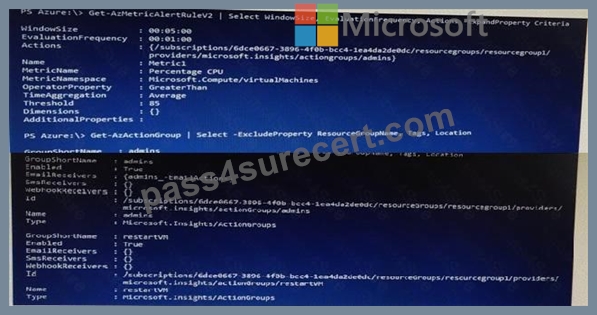
Use the drop-down menus to select the answer choice that completes each statement based on the information presented in the graphic.
NOTE: Each correct selection is worth one point.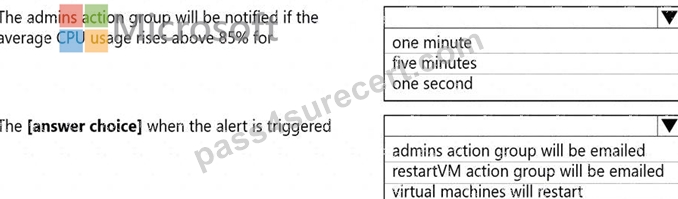
Answer:
Explanation: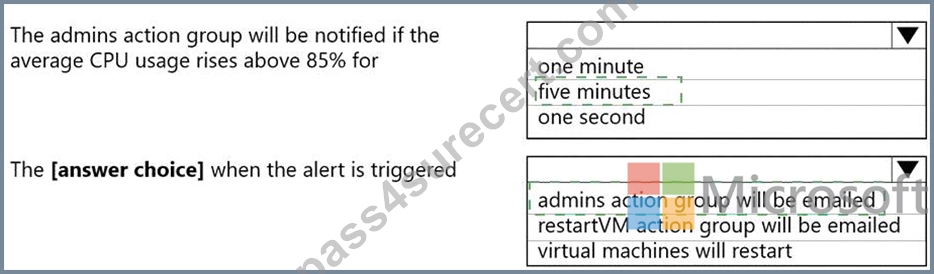
Explanation:
Graphical user interface, text, application Description automatically generated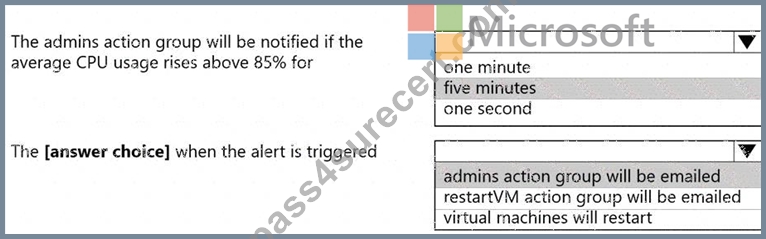
Box 1: five minutes
Window Size is 5 minutes.
Box 2: admins action group will be emailed
The admins1 actiongroup will be executed.
Reference:
https://docs.microsoft.com/en-us/azure/azure-monitor/alerts/alerts-metric-overview
NEW QUESTION # 18
You plan to deploy an SAP environment on Azure that will use Azure Availability Zones.
Which load balancing solution supports the deployment?
- A. Azure Application Gateway v1 SKU
- B. Azure Standard Load Balancer
- C. Azure Basic Load Balancer
Answer: B
Explanation:
When you deploy Azure VMs across Availability Zones and establish failover solutions within the same Azure region, some restrictions apply:
* You can't use an Azure Basic Load Balancer to create failover cluster solutions based on Windows Server Failover Clustering or Linux Pacemaker. Instead, you need to use the Azure Standard Load Balancer SKU.
References:
https://docs.microsoft.com/en-us/azure/virtual-machines/workloads/sap/sap-ha-availability-zones
NEW QUESTION # 19
Note: This question is part of a series of questions that present the same scenario. Each question in the series contains a unique solution that might meet the stated goals. Some question sets might have more than one correct solution, while others might not have a correct solution.
After you answer a question in this section, you will NOT be able to return to it. As a result, these questions will not appear in the review screen.
You plan to migrate an SAP HANA instance to Azure.
You need to gather CPU metrics from the last 24 hours from the instance.
Solution: You query views from SAP HANA Studio.
Does this meet the goal?
- A. No
- B. Yes
Answer: A
Explanation:
The SAP HANA cockpit provides a single point of access to a range of SAP HANA administration and monitoring tasks. It is used to monitor and ensure the overall health of the system.
The HANA Monitoring dashboard also visualizes key HANA Metrics of SAP HANA system.
References:
https://developers.sap.com/tutorials/dt-monitoring-hana-part1.html
https://www.hanatutorials.com/p/hana-monitoring-dashboard.html
Design an Azure Solution to Support SAP Workloads
Testlet 1
Case Study
This is a case study. Case studies are not timed separately. You can use as much exam time as you would like to complete each case. However, there may be additional case studies and sections on this exam. You must manage your time to ensure that you are able to complete all questions included on this exam in the time provided.
To answer the questions included in a case study, you will need to reference information that is provided in the case study. Case studies might contain exhibits and other resources that provide more information about the scenario that is described in the case study. Each question is independent of the other questions in this case study.
At the end of this case study, a review screen will appear. This screen allows you to review your answers and to make changes before you move to the next section of the exam. After you begin a new section, you cannot return to this section.
To start the case study
To display the first question in this case study, click the Next button. Use the buttons in the left pane to explore the content of the case study before you answer the questions. Clicking these buttons displays information such as business requirements, existing environment, and problem statements. If the case study has an All Information tab, note that the information displayed is identical to the information displayed on the subsequent tabs. When you are ready to answer a question, click the Question button to return to the question.
Overview
Litware, Inc. is an international manufacturing company that has 3,000 employees.
Litware has two main offices. The offices are located in Miami, FL, and Madrid, Spain.
Existing Environment
Infrastructure
Litware currently uses a third-party provider to host a datacenter in Miami and a disaster recovery datacenter in Chicago, IL.
The network contains an Active Directory domain named litware.com. Litware has two third-party applications hosted in Azure.
Litware already implemented a site-to-site VPN connection between the on-premises network and Azure.
SAP Environment
Litware currently runs the following SAP products:
* Enhancement Pack6 for SAP ERP Central Component 6.0 (SAP ECC 6.0)
* SAP Extended Warehouse Management (SAP EWM)
* SAP Supply Chain Management (SAP SCM)
* SAP NetWeaver Process Integration (PI)
* SAP Business Warehouse (SAP BW)
* SAP Solution Manager
All servers run on the Windows Server platform. All databases use Microsoft SQL Server. Currently, you have
20 production servers.
You have 30 non-production servers including five testing servers, five development servers, five quality assurance (QA) servers, and 15 pre-production servers.
Currently, all SAP applications are in the litware.com domain.
Problem Statements
The current version of SAP ECC has a transaction that, when run in batches overnight, takes eight hours to complete. You confirm that upgrading to SAP Business Suite on HANA will improve performance because of code changes and the SAP HANA database platform.
Litware is dissatisfied with the performance of its current hosted infrastructure vendor. Litware experienced several hardware failures and the vendor struggled to adequately support its 24/7 business operations.
Requirements
Business Goals
Litware identifies the following business goals:
* Increase the performance of SAP ECC applications by moving to SAP HANA. All other SAP databases will remain on SQL Server.
* Move away from the current infrastructure vendor to increase the stability and availability of the SAP services.
* Use the new Environment, Health and Safety (EH&S) in Recipe Management function.
* Ensure that any migration activities can be completed within a 48-hour period during a weekend.
Planned Changes
Litware identifies the following planned changes:
* Migrate SAP to Azure.
* Upgrade and migrate SAP ECC to SAP Business Suite on HANA Enhancement Pack 8.
Technical Requirements
Litware identifies the following technical requirements:
* Implement automated backups.
* Support load testing during the migration.
* Identify opportunities to reduce costs during the migration.
* Continue to use the litware.com domain for all SAP landscapes.
* Ensure that all SAP applications and databases are highly available.
* Establish an automated monitoring solution to avoid unplanned outages.
* Remove all SAP components from the on-premises network once the migration is complete.
* Minimize the purchase of additional SAP licenses. SAP HANA licenses were already purchased.
* Ensure that SAP can provide technical support for all the SAP landscapes deployed to Azure.
NEW QUESTION # 20
You need direct connectivity from an on-premises network to SAP HANA (Large Instances). The solution must meet the following requirements:
* Minimize administrative effort.
* Provide the highest level of resiliency.
What should you use?
- A. ExpressRoute Global Reach
- B. ExpressRoute
- C. NGINX as a reverse proxy
- D. Linux IPTables
Answer: B
Explanation:
The Azure network functionality used is:
* Azure virtual networks are connected to the ExpressRoute circuit that connects to your on-premises network assets.
* An ExpressRoute circuit that connects on-premises to Azure should have a minimum bandwidth of 1 Gbps or higher. This minimal bandwidth allows adequate bandwidth for the transfer of data between on-premises systems and systems that run on VMs. It also allows adequate bandwidth for connection to Azure systems from on-premises users.
* All SAP systems in Azure are set up in virtual networks to communicate with each other.
Reference:
https://docs.microsoft.com/en-us/azure/virtual-machines/workloads/sap/hana-network-architecture
NEW QUESTION # 21
You need direct connectivity from an on-premises network to SAP HANA (Large Instances). The solution must meet the following requirements:
* Minimize administrative effort.
* Provide the highest level of resiliency.
What should you use?
- A. ExpressRoute Global Reach
- B. ExpressRoute
- C. NGINX as a reverse proxy
- D. Linux IPTables
Answer: B
Explanation:
The Azure network functionality used is:
Azure virtual networks are connected to the ExpressRoute circuit that connects to your on-premises network assets.
An ExpressRoute circuit that connects on-premises to Azure should have a minimum bandwidth of 1 Gbps or higher. This minimal bandwidth allows adequate bandwidth for the transfer of data between on-premises systems and systems that run on VMs. It also allows adequate bandwidth for connection to Azure systems from on-premises users.
All SAP systems in Azure are set up in virtual networks to communicate with each other.
References:
https://docs.microsoft.com/en-us/azure/virtual-machines/workloads/sap/hana-network-architecture
NEW QUESTION # 22
You are planning replication of the SAP HANA database for the disaster recovery environment in Azure.
For each of the following statements, select Yes if the statement is true. Otherwise, select No.
NOTE: Each correct selection is worth one point.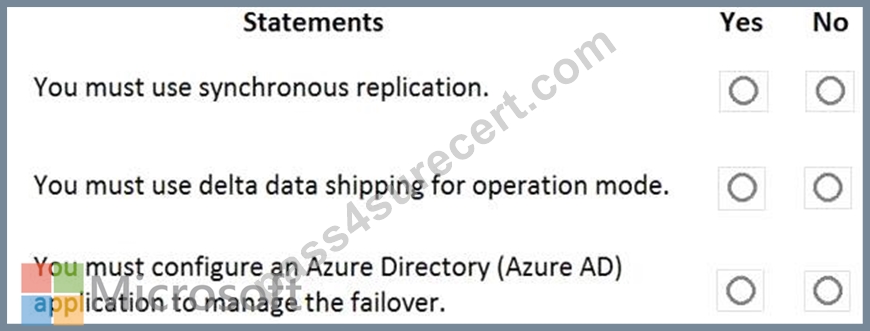
Answer:
Explanation: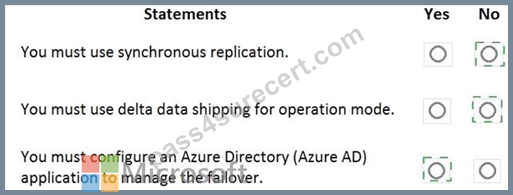
Explanation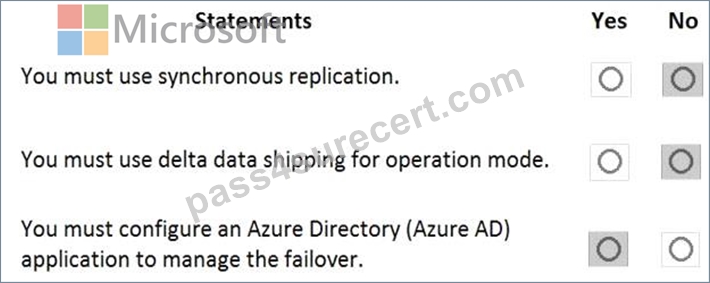
Box 1: No
SAP HANA Replication consists of one primary node and at least one secondary node. Changes to the data on the primary node are replicated to the secondary node synchronously or asynchronously.
Box 2: No
Since SPS11 SAP HANA system replication can be run in two different operation modes:
delta_datashipping
logreplay
Box 3: Yes
Reference:
https://docs.microsoft.com/en-us/azure/virtual-machines/workloads/sap/sap-hana-high-availability-rhel
https://blogs.sap.com/2018/01/08/your-sap-on-azure-part-4-high-availability-for-sap-hana-using-system-replicati
NEW QUESTION # 23
You are validating an SAP HANA on Azure (Large Instances) deployment.
You need to ensure that sapconf is installed and the kernel parameters are set appropriately for the active profile.
How should you complete the commands? To answer, drag the appropriate values to the correct targets. Each value may be used once, more than once, or not at all. You may need to drag the split bar between panes or scroll to view content.
NOTE: Each correct selection is worth one point.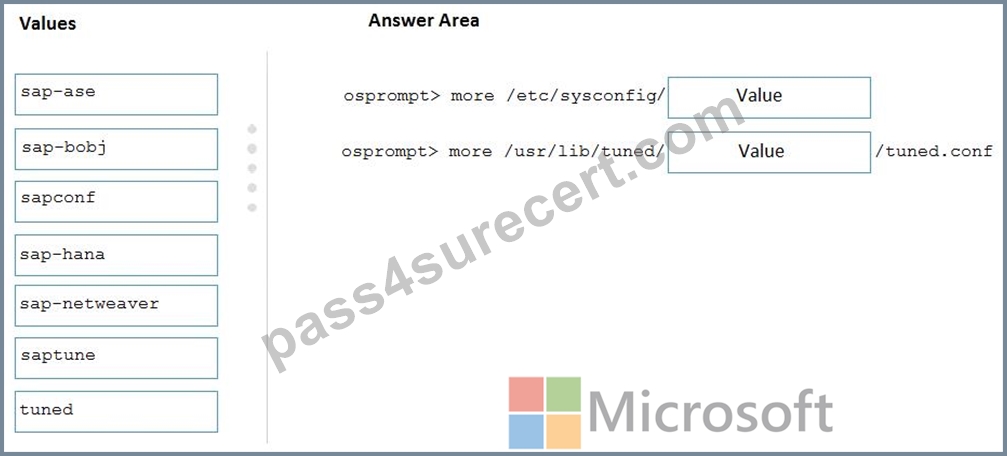
Answer:
Explanation: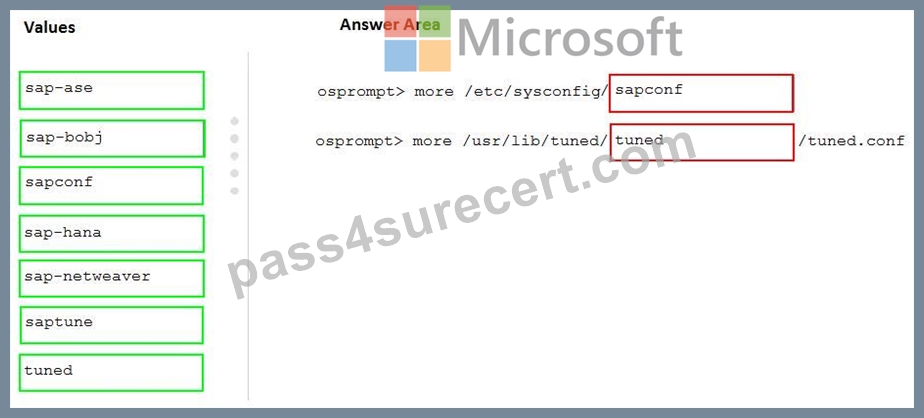
Explanation:
Box 1: sapconf
The configuration is split into two parts:
/etc/sysconfig/sapconf
/usr/lib/tuned//tuned.conf
Box 2: tuned
References:
https://www.suse.com/c/sapconf-a-way-to-prepare-a-sles-system-for-sap-workload-part-2/
NEW QUESTION # 24
You have ah SAP environment on Azure that contains a single-tenant SAP NANA server at instance 03.
You need to monitor the network throughput from an SAP application server to the SAP HANA server.
How should you complete the script? To answer, select the appropriate options in the answer are.
NOTE: Each correct selection is worth one point.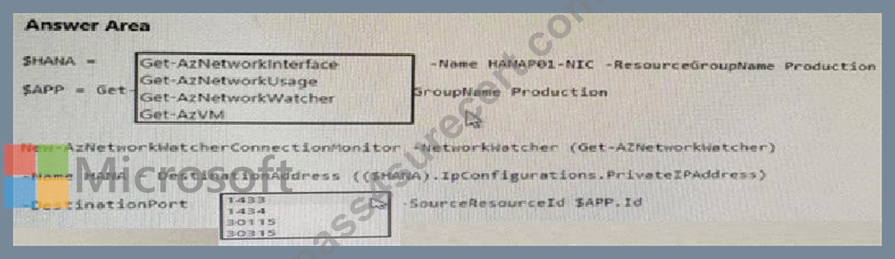
Answer:
Explanation: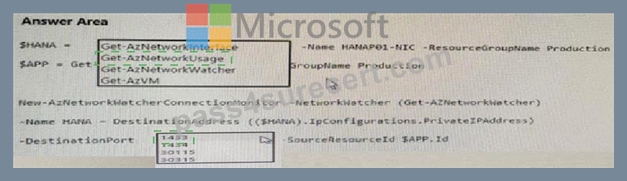
NEW QUESTION # 25
You have an SAP environment that contains the following components:
* Enhancement Package 6 for SAP ERP Central Component 6.0 (SAP ECC 6.0)
* Servers that runs SUSE Linux Enterprise Server 12 (SIES 12)
* Databases on IBM D82 10.5
* SAP Solution Manager 7.1
You plan to migrate the SAP environment to Azure.
For each of the following statements, select Yes if the statement is true. Otherwise, select No.
NOTE: Each correct selection is worth one point.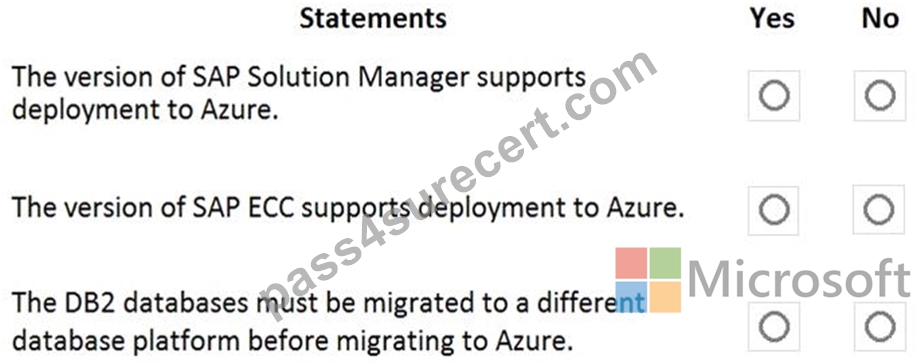
Answer:
Explanation: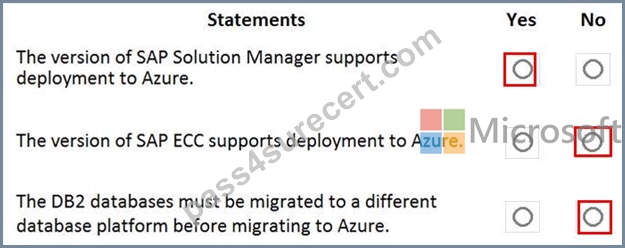
Reference:
https://docs.microsoft.com/en-us/azure/data-factory/connector-sap-table
https://docs.microsoft.com/en-us/azure/virtual-machines/workloads/sap/dbms_guide_ibm
NEW QUESTION # 26
You have an on- premises SAP environment hosted on VMware VSphere that in Microsoft SQL Server as the database platform. You plan to migrate the environment to Azure. The database platform will remain the same.
You need gather information to size the target Azure Environment for the migration. What should you use?
What should you use?
- A. Azure Monitor
- B. the SAP EarlyWatch Alert report
- C. Azure Advisor
- D. the SAP NANA sizing report
Answer: B
Explanation:
Explanation
https://azure.microsoft.com/nl-nl/blog/sap-on-azure-architecture-designing-for-performance-and-scalability/
"For existing on-premises systems, you should reference system configuration and resource utilization data.
The system utilization information is collected by the SAP OS Collector and can be reported via SAP transaction OS07N as well as the EarlyWatch Alert. "
NEW QUESTION # 27
You are designing a four-node SAP Web Dispatcher deployment for an SAP on Azure landscape.
You need to recommend a resiliency solution and a load-balancing solution for the deployment. The solution must meet the following requirements;
* Receive the highest SLA from Microsoft.
* Load balance client connections.
* Minimize administrative effort
What should include in the recommendation for each solution? To answer, select the appropriate options in the answer area. NOTE Each correct selection is worth one point.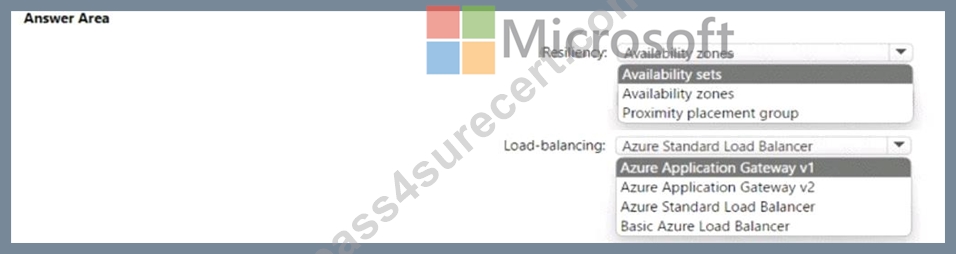
Answer:
Explanation: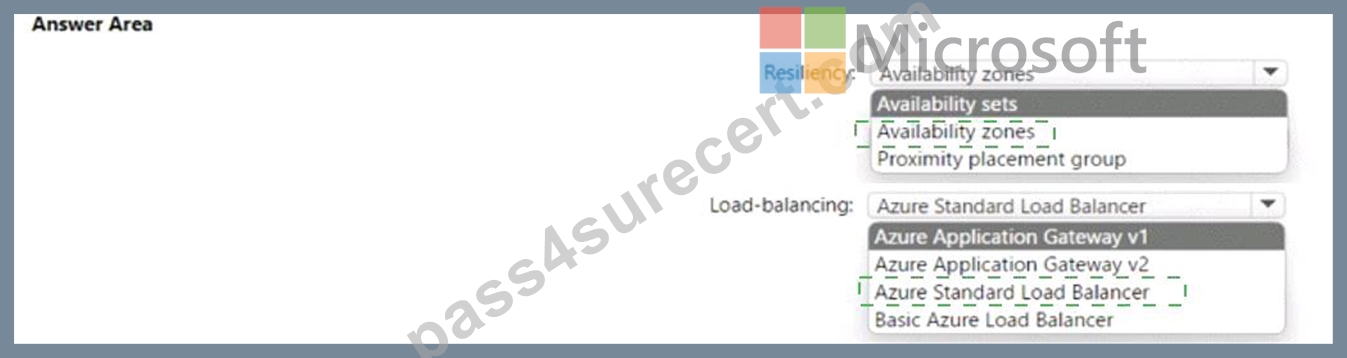
Explanation:
NEW QUESTION # 28
A company named Contoso, Ltd. has users across the globe. Contoso is evaluating whether to migrate SAP to Azure.
The SAP environment runs on SUSE Linux Enterprise Server (SLES) servers and SAP HANA databases. The Suite on HANA database is 4 TB.
You need to recommend a migration solution to migrate SAP application servers and the SAP HANA databases. The solution must minimize downtime.
Which migration solutions should you recommend? To answer, select the appropriate options in the answer area.
NOTE: Each correct selection is worth one point.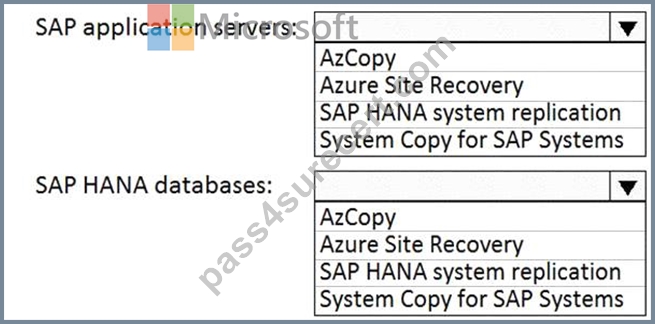
Answer:
Explanation:
Box 1: Azure Site Recovery
Microsoft Azure Site Recovery (ASR) now supports SUSE Linux Enterprise Server 11 SP3/SP4 and SUSE Linux Enterprise Server 12 SP1/SP2/SP3. This is great for customers that are planning to migrate systems to Microsoft Azure or customers who need to have a business continuity strategy for their Azure deployments.
Azure Site Recovery enables SUSE customers to migrate their non-Azure virtual machines or physical servers to Microsoft Azure virtual machines.
Box 2: SAP Hana System replication
Reference:
https://www.suse.com/c/asr_supports_suse/
https://www.netapp.com/us/media/tr-4746.pdf
NEW QUESTION # 29
Note: This question is part of a series of questions that present the same scenario. Each question in the series contains a unique solution that might meet the stated goals. Some question sets might have more than one correct solution, while others might not have a correct solution.
After you answer a question in this section, you will NOT be able to return to it. As a result, these questions will not appear in the review screen.
You deploy SAP HANA on Azure (Large Instances).
You need to back up the SAP HANA database to Azure.
Solution: Back up directly to disk, copy the backups to an Azure virtual machine, and then copy the backup to an Azure Storage account Does this meet the goal?
- A. No
- B. Yes
Answer: A
Explanation:
Explanation
Instead you should create a Recovery Services vault and a backup policy.
Reference:
https://docs.microsoft.com/en-us/azure/backup/sap-hana-db-about
https://docs.microsoft.com/en-us/azure/backup/backup-azure-sap-hana-database#configure-backup
NEW QUESTION # 30
You are planning the Azure network infrastructure for an SAP environment.
For each of the following statements, select Yes if the statement is true. Otherwise, select No.
NOTE: Each correct selection is worth one point.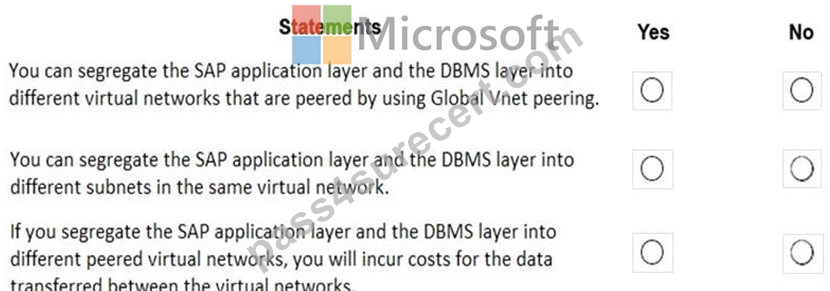
Answer:
Explanation: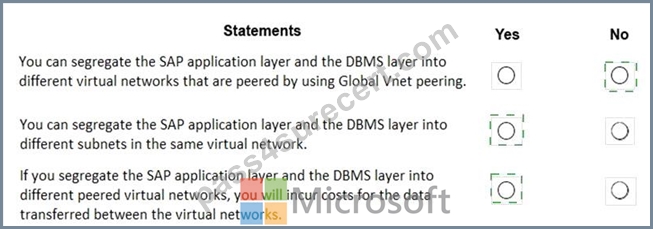
Explanation
Box 1: NO
Box 2: Yes
Box 3: Yes
Be aware that network traffic between two peered Azure virtual networks is subject to transfer costs. Huge data volume that consists of many terabytes is exchanged between the SAP application layer and the DBMS layer. You can accumulate substantial costs if the SAP application layer and DBMS layer are segregated between two peered Azure virtual networks.
References:
https://docs.microsoft.com/en-us/azure/virtual-machines/workloads/sap/dbms_guide_general
NEW QUESTION # 31
You have an Azure subscription.
You plan to deploy a SAP NetWeaver landscape that will use SQL Server on Azure virtual machines. The solution must meet the following requirements:
The SAP application and database tiers must reside in the same Azure zone.
The application tier in the Azure virtual machines must belong to the same Availability Set.
Which four actions should you perform in sequence? To answer, move the appropriate actions from the list of actions to the answer area and arrange them in the correct order.
NOTE: More than one order of answer choices is correct. You will receive credit for any of the correct orders you select.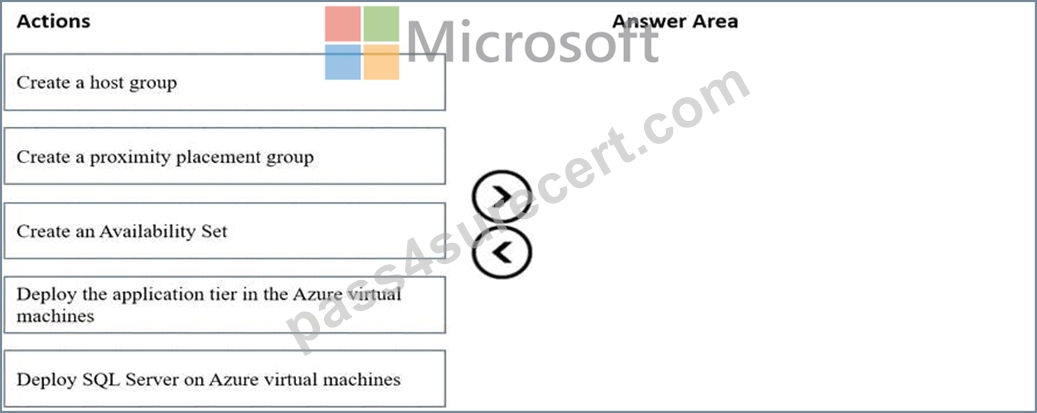
Answer:
Explanation: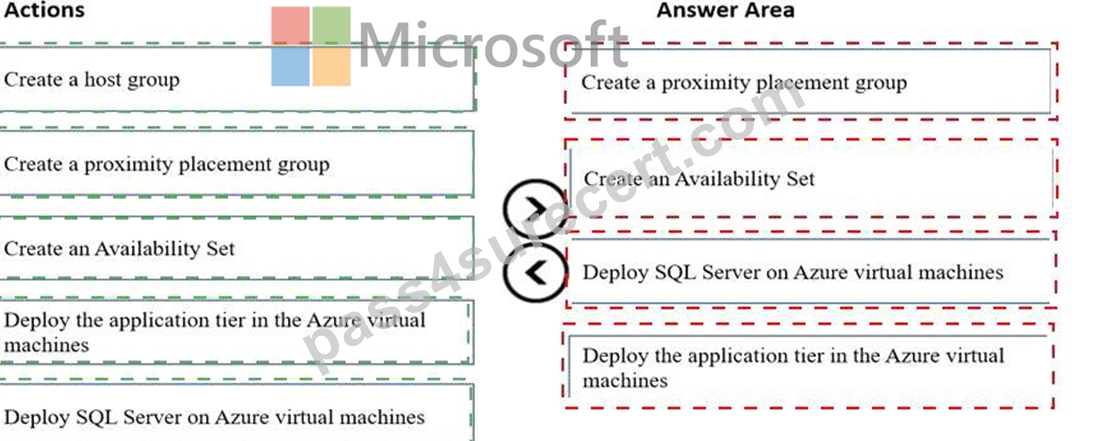
Explanation
Text Description automatically generated with medium confidence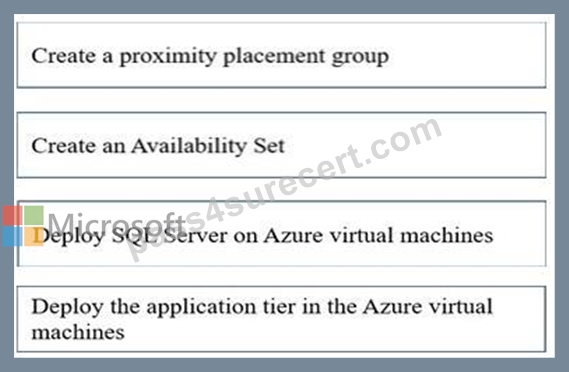
Step 1: Create a proximity placement group
A proximity placement group is a logical grouping of Azure resources within the same Azure data center in order to reduce latency.
Step 2: Create an Availability Set
Create an availability set that references the Azure proximity group.
By adding the availability sets to proximity placement groups, the network latencies are considerably reduced, thereby improving the overall performance.
Step 3: Deploy SQL Server on Azure Virtual machines
Step 4: Deploy the application tier in the Azure virtual machines
Deploy the application layer VMs by referencing the availability set and the proximity placement group.
Reference:
https://docs.microsoft.com/en-us/azure/virtual-machines/workloads/sap/sap-proximity-placement-scenarios
NEW QUESTION # 32
Note: This question is part of a series of questions that present the same scenario. Each question in the series contains a unique solution that might meet the stated goals. Some question sets might have more than one correct solution, while others might not have a correct solution.
After you answer a question in this section, you will NOT be able to return to it. As a result, these questions will not appear in the review screen.
You deploy SAP HANA on Azure (Large Instances).
You need to back up the SAP HANA database to Azure.
Solution: You use a third-party tool that uses backint to back up the SAP HANA database to Azure storage.
Does this meet the goal?
- A. No
- B. Yes
Answer: A
Explanation:
References:
https://docs.microsoft.com/en-us/azure/backup/sap-hana-db-about
https://docs.microsoft.com/en-us/azure/backup/backup-azure-sap-hana-database#configure-backup
NEW QUESTION # 33
You have the following Azure Resource Manager template.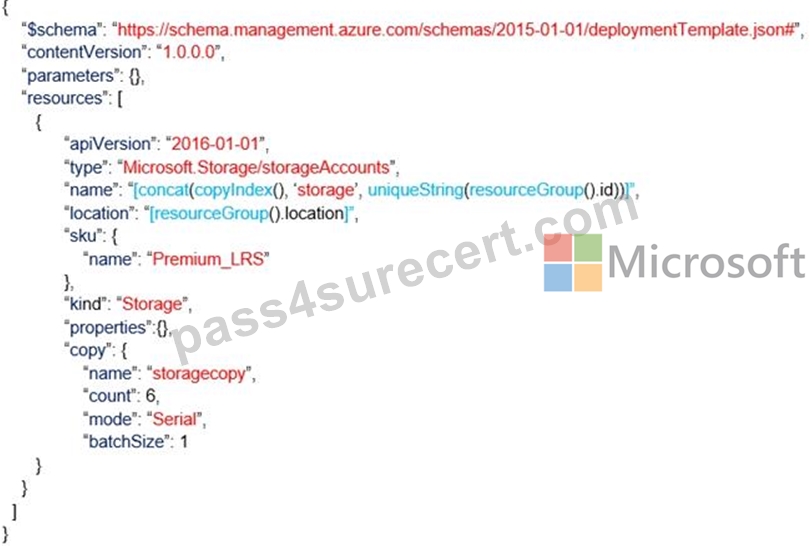
For each of the following statements, select Yes if the statement is true. Otherwise, select No.
NOTE: Each correct selection is worth one point.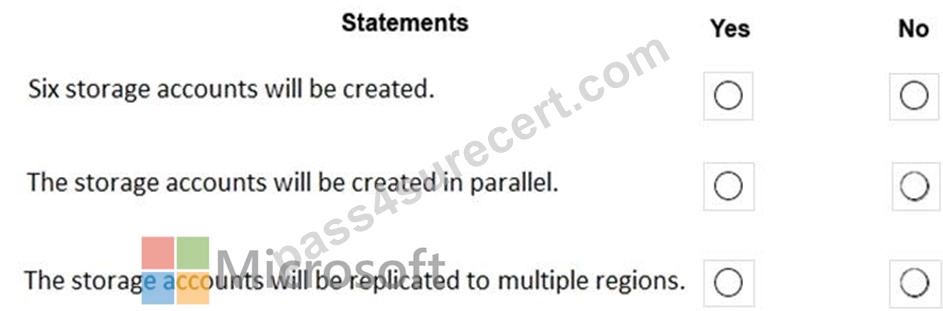
Answer:
Explanation: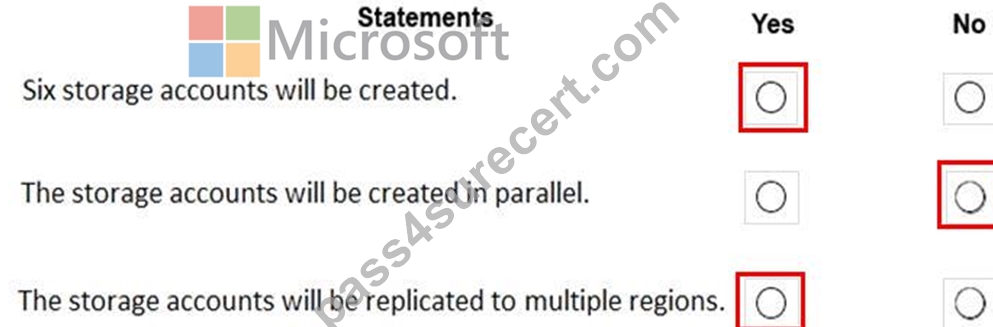
Explanation:
Box 1: Yes
Count is 6.
Box 2: No
Mode is serial.
Box 3: Yes
References:
https://docs.microsoft.com/en-us/azure/azure-resource-manager/templates/copy-resources
NEW QUESTION # 34
You have an on-premises SAP environment hosted on VMware vSphere.
You plan to migrate the environment to Azure by using Azure Site Recovery.
You need to prepare the environment to support Azure Site Recovery.
What should you deploy first?
- A. an Azure Backup server
- B. an on-premises data gateway to vSphere
- C. Microsoft System Center Virtual Machine Manager (VMM)
- D. a configuration server to vSphere
Answer: D
Explanation:
When you set up disaster recovery for on-premises VMware VMs, Site Recovery needs access to the vCenter Server/vSphere host so that the Site Recovery process server can automatically discover VMs, and fail them over as needed. By default the process server runs on the Site Recovery configuration server. Add an account for the configuration server to connect to the vCenter Server/vSphere host.
References:
https://docs.microsoft.com/en-us/azure/site-recovery/vmware-azure-manage-vcenter
NEW QUESTION # 35
for each of the following statements, select Yes if the statement is true. Otherwise. select No.
NOTE: Each correct selection is worth one point.
Answer:
Explanation:
Explanation: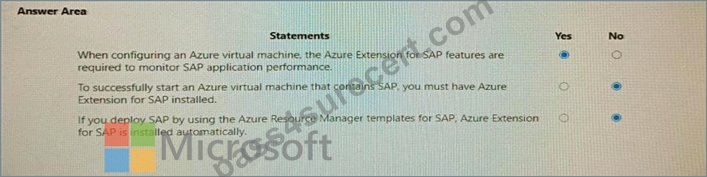
NEW QUESTION # 36
......
Test Engine to Practice AZ-120 Test Questions: https://www.pass4surecert.com/Microsoft/AZ-120-practice-exam-dumps.html
Use Valid AZ-120 Exam - Actual Exam Question & Answer: https://drive.google.com/open?id=1044sc975sOFj9z1WsmFgC1iIWmHuwF-G