

Get Microsoft AZ-204 Dumps Questions [2021] To Gain Brilliant Result
AZ-204 dumps - Pass4sureCert - 100% Passing Guarantee
NEW QUESTION 68
You are developing an Azure Web App. You configure TLS mutual authentication for the web app.
You need to validate the client certificate in the web app. To answer, select the appropriate options in the answer area.
NOTE: Each correct selection is worth one point.
Answer:
Explanation:
Explanation:
Accessing the client certificate from App Service.
If you are using ASP.NET and configure your app to use client certificate authentication, the certificate will be available through the HttpRequest.ClientCertificate property. For other application stacks, the client cert will be available in your app through a base64 encoded value in the "X-ARR-ClientCert" request header. Your application can create a certificate from this value and then use it for authentication and authorization purposes in your application.
References:
https://docs.microsoft.com/en-us/azure/app-service/app-service-web-configure-tls-mutual-auth
NEW QUESTION 69
Hotspot Question
You are developing a ticket reservation system for an airline.
The storage solution for the application must meet the following requirements:
- Ensure at least 99.99% availability and provide low latency.
- Accept reservations event when localized network outages or other
unforeseen failures occur.
- Process reservations in the exact sequence as reservations are
submitted to minimize overbooking or selling the same seat to multiple
travelers.
- Allow simultaneous and out-of-order reservations with a maximum five- second tolerance window.
You provision a resource group named airlineResourceGroup in the Azure South-Central US region.
You need to provision a SQL SPI Cosmos DB account to support the app.
How should you complete the Azure CLI commands? To answer, select the appropriate options in the answer area.
NOTE: Each correct selection is worth one point.
Answer:
Explanation:
Explanation:
Box 1: BoundedStaleness
Bounded staleness: The reads are guaranteed to honor the consistent-prefix guarantee. The reads might lag behind writes by at most "K" versions (that is, "updates") of an item or by "T" time interval. In other words, when you choose bounded staleness, the "staleness" can be configured in two ways:
The number of versions (K) of the item
The time interval (T) by which the reads might lag behind the writes
Incorrect Answers:
Strong
Strong consistency offers a linearizability guarantee. Linearizability refers to serving requests concurrently. The reads are guaranteed to return the most recent committed version of an item. A client never sees an uncommitted or partial write. Users are always guaranteed to read the latest committed write.
Box 2: --enable-automatic-failover true\
For multi-region Cosmos accounts that are configured with a single-write region, enable automatic-failover by using Azure CLI or Azure portal. After you enable automatic failover, whenever there is a regional disaster, Cosmos DB will automatically failover your account.
Question: Accept reservations event when localized network outages or other unforeseen failures occur.
Box 3: --locations'southcentralus=0 eastus=1 westus=2
Need multi-region.
Reference:
https://docs.microsoft.com/en-us/azure/cosmos-db/consistency-levels
https://github.com/MicrosoftDocs/azure-docs/blob/master/articles/cosmos-db/manage-with-cli.md
NEW QUESTION 70
You need to implement telemetry for non-user actions.
How should you complete the Filter class? To answer, drag the appropriate code segments to the correct locations. Each code segment may be used once, more than once, or not at all. You may need to drag the split bar between panes or scroll to view content.
NOTE: Each correct selection is worth one point.
Answer:
Explanation:
Reference:
https://docs.microsoft.com/en-us/azure/azure-monitor/app/api-filtering-sampling
NEW QUESTION 71
You have to deploy a microservice based application to Azure. The application needs to be deployed to an Azure Kubernetes cluster. The solution has the following requirements:
- Reverse proxy capabilities
- Ability to configure traffic routing
- Termination of TLS with a custom certificate
Which of the following would you use to implement a single public IP endpoint to route traffic to multiple microservices?
- A. Ingress Controller
- B. Kubectl
- C. Helm
- D. Brigade
- E. Virtual Kubelet
Answer: A
Explanation:
You can use the Ingress controller to route traffic at the application layer.
https://docs.microsoft.com/en-us/azure/aks/ingress-basic
NEW QUESTION 72
You have a web service that is used to pay for food deliveries. The web service uses Azure Cosmos DB as the data store.
You plan to add a new feature that allows users to set a tip amount. The new feature requires that a property named tip on the document in Cosmos DB must be present and contain a numeric value.
There are many existing websites and mobile apps that use the web service that will not be updated to set the tip property for some time.
How should you complete the trigger?
NOTE: Each correct selection is worth one point.
Answer:
Explanation:
Explanation
Box 1: getContext().getRequest();
Box 2: if(isNaN(i)["tip"] ..
In JavaScript, there are two ways to check if a variable is a number :
isNaN() - Stands for "is Not a Number", if variable is not a number, it return true, else return false.
typeof - If variable is a number, it will returns a string named "number".
Box 3:r.setBody(i);
// update the item that will be created
References:
https://docs.microsoft.com/bs-latn-ba/azure/cosmos-db/how-to-write-stored-procedures-triggers-udfs
https://mkyong.com/javascript/check-if-variable-is-a-number-in-javascript/
NEW QUESTION 73
You need to resolve the log capacity issue.
What should you do?
- A. Implement Application Insights Sampling
- B. Create an Application Insights Telemetry Filter
- C. Set a LogCategoryFilter during startup
- D. Change the minimum log level in the host.json file for the function
Answer: A
Explanation:
Scenario, the log capacity issue: Developers report that the number of log message in the trace output for the processor is too high, resulting in lost log messages.
Sampling is a feature in Azure Application Insights. It is the recommended way to reduce telemetry traffic and storage, while preserving a statistically correct analysis of application data. The filter selects items that are related, so that you can navigate between items when you are doing diagnostic investigations. When metric counts are presented to you in the portal, they are renormalized to take account of the sampling, to minimize any effect on the statistics.
Sampling reduces traffic and data costs, and helps you avoid throttling.
Reference:
https://docs.microsoft.com/en-us/azure/azure-monitor/app/sampling
Monitor, troubleshoot, and optimize Azure solutions
Question Set 5
NEW QUESTION 74
You develop Azure solutions.
You must connect to a No-SQL globally-distributed database by using the .NET API.
You need to create an object to configure and execute requests in the database.
Which code segment should you use?
- A. new CosmosClient(EndpointUri, PrimaryKey);
- B. new Container(EndpointUri, PrimaryKey);
- C. new Database(EndpointUri, PrimaryKey);
Answer: A
Explanation:
Example:
// Create a new instance of the Cosmos Client
this.cosmosClient = new CosmosClient(EndpointUri, PrimaryKey)
//ADD THIS PART TO YOUR CODE
await this.CreateDatabaseAsync();
Reference:
https://docs.microsoft.com/en-us/azure/cosmos-db/sql-api-get-started
Implement Azure security
Testlet 1
Case study
This is a case study. Case studies are not timed separately. You can use as much exam time as you would like to complete each case. However, there may be additional case studies and sections on this exam.
You must manage your time to ensure that you are able to complete all questions included on this exam in the time provided.
To answer the questions included in a case study, you will need to reference information that is provided in the case study. Case studies might contain exhibits and other resources that provide more information about the scenario that is described in the case study. Each question is independent of the other questions in this case study.
At the end of this case study, a review screen will appear. This screen allows you to review your answers and to make changes before you move to the next section of the exam. After you begin a new section, you cannot return to this section.
To start the case study
To display the first question in this case study, click the Next button. Use the buttons in the left pane to explore the content of the case study before you answer the questions. Clicking these buttons displays information such as business requirements, existing environment, and problem statements. When you are ready to answer a question, click the Question button to return to the question.
Background
Overview
You are a developer for Contoso, Ltd. The company has a social networking website that is developed as a Single Page Application (SPA). The main web application for the social networking website loads user uploaded content from blob storage.
You are developing a solution to monitor uploaded data for inappropriate content. The following process occurs when users upload content by using the SPA:
* Messages are sent to ContentUploadService.
* Content is processed by ContentAnalysisService.
* After processing is complete, the content is posted to the social network or a rejection message is posted in its place.
The ContentAnalysisService is deployed with Azure Container Instances from a private Azure Container Registry named contosoimages.
The solution will use eight CPU cores.
Azure Active Directory
Contoso, Ltd. uses Azure Active Directory (Azure AD) for both internal and guest accounts.
Requirements
ContentAnalysisService
The company's data science group built ContentAnalysisService which accepts user generated content as a string and returns a probable value for inappropriate content. Any values over a specific threshold must be reviewed by an employee of Contoso, Ltd.
You must create an Azure Function named CheckUserContent to perform the content checks.
Costs
You must minimize costs for all Azure services.
Manual review
To review content, the user must authenticate to the website portion of the ContentAnalysisService using their Azure AD credentials. The website is built using React and all pages and API endpoints require authentication.
In order to review content a user must be part of a ContentReviewer role. All completed reviews must include the reviewer's email address for auditing purposes.
High availability
All services must run in multiple regions. The failure of any service in a region must not impact overall application availability.
Monitoring
An alert must be raised if the ContentUploadService uses more than 80 percent of available CPU cores.
Security
You have the following security requirements:
* Any web service accessible over the Internet must be protected from cross site scripting attacks.
* All websites and services must use SSL from a valid root certificate authority.
* Azure Storage access keys must only be stored in memory and must be available only to the service.
* All Internal services must only be accessible from internal Virtual Networks (VNets).
* All parts of the system must support inbound and outbound traffic restrictions.
* All service calls must be authenticated by using Azure AD.
User agreements
When a user submits content, they must agree to a user agreement. The agreement allows employees of Contoso, Ltd. to review content, store cookies on user devices, and track user's IP addresses.
Information regarding agreements is used by multiple divisions within Contoso, Ltd.
User responses must not be lost and must be available to all parties regardless of individual service uptime.
The volume of agreements is expected to be in the millions per hour.
Validation testing
When a new version of the ContentAnalysisService is available the previous seven days of content must be processed with the new version to verify that the new version does not significantly deviate from the old version.
Issues
Users of the ContentUploadService report that they occasionally see HTTP 502 responses on specific pages.
Code
ContentUploadService

Implement Azure security
Testlet 2
Case study
This is a case study. Case studies are not timed separately. You can use as much exam time as you would like to complete each case. However, there may be additional case studies and sections on this exam.
You must manage your time to ensure that you are able to complete all questions included on this exam in the time provided.
To answer the questions included in a case study, you will need to reference information that is provided in the case study. Case studies might contain exhibits and other resources that provide more information about the scenario that is described in the case study. Each question is independent of the other questions in this case study.
At the end of this case study, a review screen will appear. This screen allows you to review your answers and to make changes before you move to the next section of the exam. After you begin a new section, you cannot return to this section.
To start the case study
To display the first question in this case study, click the Next button. Use the buttons in the left pane to explore the content of the case study before you answer the questions. Clicking these buttons displays information such as business requirements, existing environment, and problem statements. When you are ready to answer a question, click the Question button to return to the question.
Current environment
Windows Server 2016 virtual machine
This virtual machine (VM) runs BizTalk Server 2016. The VM runs the following workflows:
* Ocean Transport - This workflow gathers and validates container information including container contents and arrival notices at various shipping ports.
* Inland Transport - This workflow gathers and validates trucking information including fuel usage, number of stops, and routes.
The VM supports the following REST API calls:
* Container API - This API provides container information including weight, contents, and other attributes.
* Location API - This API provides location information regarding shipping ports of call and trucking stops.
* Shipping REST API - This API provides shipping information for use and display on the shipping website.
Shipping Data
The application uses MongoDB JSON document storage database for all container and transport information.
Shipping Web Site
The site displays shipping container tracking information and container contents. The site is located at http:// shipping.wideworldimporters.com/ Proposed solution The on-premises shipping application must be moved to Azure. The VM has been migrated to a new Standard_D16s_v3 Azure VM by using Azure Site Recovery and must remain running in Azure to complete the BizTalk component migrations. You create a Standard_D16s_v3 Azure VM to host BizTalk Server. The Azure architecture diagram for the proposed solution is shown below:
Requirements
Shipping Logic app
The Shipping Logic app must meet the following requirements:
* Support the ocean transport and inland transport workflows by using a Logic App.
* Support industry-standard protocol X12 message format for various messages including vessel content details and arrival notices.
* Secure resources to the corporate VNet and use dedicated storage resources with a fixed costing model.
* Maintain on-premises connectivity to support legacy applications and final BizTalk migrations.
Shipping Function app
Implement secure function endpoints by using app-level security and include Azure Active Directory (Azure AD).
REST APIs
The REST API's that support the solution must meet the following requirements:
* Secure resources to the corporate VNet.
* Allow deployment to a testing location within Azure while not incurring additional costs.
* Automatically scale to double capacity during peak shipping times while not causing application downtime.
* Minimize costs when selecting an Azure payment model.
Shipping data
Data migration from on-premises to Azure must minimize costs and downtime.
Shipping website
Use Azure Content Delivery Network (CDN) and ensure maximum performance for dynamic content while minimizing latency and costs.
Issues
Windows Server 2016 VM
The VM shows high network latency, jitter, and high CPU utilization. The VM is critical and has not been backed up in the past. The VM must enable a quick restore from a 7-day snapshot to include in-place restore of disks in case of failure.
Shipping website and REST APIs
The following error message displays while you are testing the website:
Failed to load http://test-shippingapi.wideworldimporters.com/: No 'Access- Control-Allow-Origin' header is present on the requested resource. Origin
'http://test.wideworldimporters.com/' is therefore not allowed access.
NEW QUESTION 75
You need to implement the bindings for the CheckUserContent function.
How should you complete the code segment? To answer, select the appropriate options in the answer area.
NOTE: Each correct selection is worth one point.
Answer:
Explanation:
Reference:
https://docs.microsoft.com/en-us/azure/azure-functions/functions-bindings-storage-blob-output
Topic 2, Windows Server 2016 virtual machine
Current environment
Windows Server 2016 virtual machine
The virtual machine (VM) runs BizTalk Server 2016. The VM runs the following workflows:
Ocean Transport - This workflow gathers and validates container information including container contents and arrival notices at various shipping ports.
Inland Transport - This workflow gathers and validates trucking information including fuel usage, number of stops, and routes.
The VM supports the following REST API calls:
Container API - This API provides container information including weight, contents, and other attributes.
Location API - This API provides location information regarding shipping ports of call and tracking stops.
Shipping REST API - This API provides shipping information for use and display on the shipping website.
Shipping Data
The application uses MongoDB JSON document storage database for all container and transport information.
Shipping Web Site
The site displays shipping container tracking information and container contents. The site is located at http://shipping.wideworldimporters.com/ Proposed solution The on-premises shipping application must be moved to Azure. The VM has been migrated to a new Standard_D16s_v3 Azure VM by using Azure Site Recovery and must remain running in Azure to complete the BizTalk component migrations. You create a Standard_D16s_v3 Azure VM to host BizTalk Server. The Azure architecture diagram for the proposed solution is shown below:
Requirements
Shipping Logic app
The Shipping Logic app must meet the following requirements:
Support the ocean transport and inland transport workflows by using a Logic App.
Support industry-standard protocol X12 message format for various messages including vessel content details and arrival notices.
Secure resources to the corporate VNet and use dedicated storage resources with a fixed costing model.
Maintain on-premises connectivity to support legacy applications and final BizTalk migrations.
Shipping Function app
Implement secure function endpoints by using app-level security and include Azure Active Directory (Azure AD).
REST APIs
The REST API's that support the solution must meet the following requirements:
Secure resources to the corporate VNet.
Allow deployment to a testing location within Azure while not incurring additional costs.
Automatically scale to double capacity during peak shipping times while not causing application downtime.
Minimize costs when selecting an Azure payment model.
Shipping data
Data migration from on-premises to Azure must minimize costs and downtime.
Shipping website
Use Azure Content Delivery Network (CDN) and ensure maximum performance for dynamic content while minimizing latency and costs.
Issues
Windows Server 2016 VM
The VM shows high network latency, jitter, and high CPU utilization. The VM is critical and has not been backed up in the past. The VM must enable a quick restore from a 7-day snapshot to include in-place restore of disks in case of failure.
Shipping website and REST APIs
The following error message displays while you are testing the website:
Failed to load http://test-shippingapi.wideworldimporters.com/: No 'Access-Control-Allow-Origin' header is present on the requested resource. Origin 'http://test.wideworldimporters.com/' is therefore not allowed access.
NEW QUESTION 76
You are developing Azure WebJobs.
You need to recommend a WebJob type for each scenario.
Which WebJob type should you recommend? To answer, drag the appropriate WebJob types to the correct scenarios. Each WebJob type may be used once, more than once, or not at all. You may need to drag the split bar between panes or scroll to view content.
NOTE: Each correct selection is worth one point.
Answer:
Explanation:
Explanation
Box 1: Continuous
Continuous runs on all instances that the web app runs on. You can optionally restrict the WebJob to a single instance.
Box 2: Triggered
Triggered runs on a single instance that Azure selects for load balancing.
Box 3: Continuous
Continuous supports remote debugging.
Note:
The following table describes the differences between continuous and triggered WebJobs.
References:
https://docs.microsoft.com/en-us/azure/app-service/web-sites-create-web-jobs
NEW QUESTION 77
Case Study 7
Policy service
You develop and deploy a stateful ASP.NET Core 2.1 web application named Policy service to an Azure App Service Web App. The application reacts to events from Azure Event Grid and performs policy actions based on those events.
The application must include the Event Grid Event ID field in all Application Insights telemetry.
Policy service must use Application Insights to automatically scale with the number of policy actions that it is performing.
Other
Anomaly detection service
You have an anomaly detection service that analyzes log infrmation for anomalies. It is implemented as an Azure Machine Learning model. The model is deployed as a web service.
If an anomaly is detected, an Azure Function that emails administrators is called by using an HTTP WebHook.
Health monitoring
All web applications and services have health monitoring at the /health service endpoint.
Issues
Policy loss
When you deploy Policy service, policies may not be applied if they were in the process of being applied during the deployment.
Performance issue
When under heavy load, the anomaly detection service undergoes slowdowns and rejects connections.
Notification latency
Users report that anomaly detection emails can sometimes arrive several minutes after an anomaly is detected.
Policies
Log policy
All Azure App Service Web Apps must write logs to Azure Blob storage. All log files should be saved to a container named logdrop. Logs must remain in the container for 15 days.
Authentication events
Authentication events are used to monitor users signing in and signing out. All authentication events must be processed by Policy service. Sign outs must be processed as quickly as possible.
PolicyLib
You have a shared library named PolicyLib that contains functionality common to all ASP.NET Core web services and applications. The PolicyLib library must:
* Exclude non-user actions from Application Insights telemetry.
* Provide methods that allow a web service to scale itself.
* Ensure that scaling actions do not disrupt application usage.
Relevant portions of the app files are shown below. Line numbers are included for reference only and include a two-character prefix that denotes the specific file to which they belong.
Relevant portions of the app files are shown below. Line numbers are included for reference only and include a two-character prefix that denotes the specific file to which they belong.
Drag and Drop Question
You need to add code at line EG15 in EventGridController.cs to ensure that the Log policy applies to all services.
How should you complete the code? To answer, drag the appropriate code segments to the correct locations. Each code segment may be used once, more than once, or not at all. You may need to drag the split bar between panes or scroll to view content.
NOTE: Each correct selection is worth one point.
Answer:
Explanation:
Explanation:
Scenario, Log policy: All Azure App Service Web Apps must write logs to Azure Blob storage.
Box 1: Status
Box 2: Succeeded
Box 3: operationName
Microsoft.Web/sites/write is resource provider operation. It creates a new Web App or updates an existing one, References:
https://docs.microsoft.com/en-us/azure/role-based-access-control/resource-provider-operations
NEW QUESTION 78
You are a developer for a Software as a Service (SaaS) company. You develop solutions that provide the ability to send notifications by using Azure Notification Hubs.
You need to create sample code that customers can use as a reference for how to send raw notifications to Windows Push Notification Services (WNS) devices. The sample code must not use external packages.
How should you complete the code segment? To answer, drag the appropriate code segments to the correct locations. Each code segment may be used once, more than once, or not at all. You may need to drag the split bar between panes or scroll to view content.
NOTE: Each correct selection is worth one point.
Answer:
Explanation:
Reference:
https://stackoverflow.com/questions/31346714/how-to-send-raw-notification-to-azure-notification-hub/31347901
NEW QUESTION 79
You need to correct the VM issues.
Which tools should you use? To answer, select the appropriate options in the answer area.
NOTE: Each correct selection is worth one point.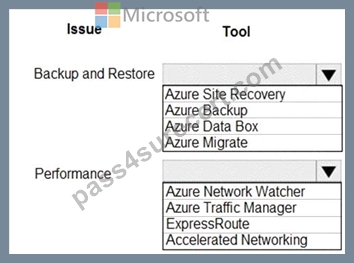
Answer:
Explanation:
Explanation
Backup and Restore: Azure Backup
Scenario: The VM is critical and has not been backed up in the past. The VM must enable a quick restore from a 7-day snapshot to include in-place restore of disks in case of failure.
In-Place restore of disks in IaaS VMs is a feature of Azure Backup.
Performance: Accelerated Networking
Scenario: The VM shows high network latency, jitter, and high CPU utilization.
Accelerated networking enables single root I/O virtualization (SR-IOV) to a VM, greatly improving its networking performance. This high-performance path bypasses the host from the datapath, reducing latency, jitter, and CPU utilization, for use with the most demanding network workloads on supported VM types.
References:
https://azure.microsoft.com/en-us/blog/an-easy-way-to-bring-back-your-azure-vm-with-in-place-restore/
NEW QUESTION 80
You have an Azure Batch project that processes and converts files and stores the files in Azure storage. You are developing a function to start the batch job.
You add the following parameters to the function.
You must ensure that converted files are placed in the container referenced by the outputContainerSasUrl parameter. Files which fail to convert are places in the container referenced by the failedContainerSasUrl parameter.
You need to ensure the files are correctly processed.
How should you complete the code segment? To answer, select the appropriate options in the answer area.
NOTE: Each correct selection is worth one point.
Answer:
Explanation:
References:
https://docs.microsoft.com/en-us/dotnet/api/microsoft.azure.batch.protocol.models.outputfileuploadcondition
https://docs.microsoft.com/en-us/azure/batch/batch-task-output-files
NEW QUESTION 81
You need to support the message processing for the ocean transport workflow.
Which four actions should you perform in sequence? To answer, move the appropriate actions from the list of actions to the answer area and arrange them in the correct order.
Answer:
Explanation:
Explanation
Step 1: Create an integration account in the Azure portal
You can define custom metadata for artifacts in integration accounts and get that metadata during runtime for your logic app to use. For example, you can provide metadata for artifacts, such as partners, agreements, schemas, and maps - all store metadata using key-value pairs.
Step 2: Link the Logic App to the integration account
A logic app that's linked to the integration account and artifact metadata you want to use.
Step 3: Add partners, schemas, certificates, maps, and agreements
Step 4: Create a custom connector for the Logic App.
References:
https://docs.microsoft.com/bs-latn-ba/azure/logic-apps/logic-apps-enterprise-integration-metadata
NEW QUESTION 82
You need to configure API Management for authentication.
Which policy values should you use? To answer, select the appropriate options in the answer area.
NOTE: Each correct selection is worth one point.
Answer:
Explanation:
Explanation
Box 1: Validate JWT
The validate-jwt policy enforces existence and validity of a JWT extracted from either a specified HTTP Header or a specified query parameter.
Scenario: User authentication (see step 5 below)
The following steps detail the user authentication process:
The user selects Sign in in the website.
The browser redirects the user to the Azure Active Directory (Azure AD) sign in page.
The user signs in.
Azure AD redirects the user's session back to the web application. The URL includes an access token.
The web application calls an API and includes the access token in the authentication header. The application ID is sent as the audience ('aud') claim in the access token.
The back-end API validates the access token.
Box 2: Outbound
Reference:
https://docs.microsoft.com/en-us/azure/api-management/api-management-access-restriction-policies
NEW QUESTION 83
Note: This question is part of a series of questions that present the same scenario. Each question in the series contains a unique solution that might meet the stated goals. Some question sets might have more than one correct solution, while others might not have a correct solution.
After you answer a question in this question, you will NOT be able to return to it. As a result, these questions will not appear in the review screen.
You are developing a solution that will be deployed to an Azure Kubernetes Service (AKS) cluster. The solution will include a custom VNet, Azure Container Registry images, and an Azure Storage account.
The solution must allow dynamic creation and management of all Azure resources within the AKS cluster.
You need to configure an AKS cluster for use with the Azure APIs.
Solution: Enable the Azure Policy Add-on for Kubernetes to connect the Azure Policy service to the GateKeeper admission controller for the AKS cluster. Apply a built-in policy to the cluster.
Does the solution meet the goal?
- A. No
- B. Yes
Answer: A
Explanation:
Instead create an AKS cluster that supports network policy. Create and apply a network to allow traffic only from within a defined namespace References:
https://docs.microsoft.com/en-us/azure/aks/use-network-policies
NEW QUESTION 84
You need to implement telemetry for non-user actions.
How should you complete the Filter class? To answer, drag the appropriate code segments to the correct locations. Each code segment may be used once, more than once, or not at all. You may need to drag the split bar between panes or scroll to view content.
NOTE: Each correct selection is worth one point.
Answer:
Explanation:
Explanation
Scenario: Exclude non-user actions from Application Insights telemetry.
Box 1: ITelemetryProcessor
To create a filter, implement ITelemetryProcessor. This technique gives you more direct control over what is included or excluded from the telemetry stream.
Box 2: ITelemetryProcessor
Box 3: ITelemetryProcessor
Box 4: RequestTelemetry
Box 5: /health
To filter out an item, just terminate the chain.
Reference:
https://docs.microsoft.com/en-us/azure/azure-monitor/app/api-filtering-sampling
NEW QUESTION 85
You are developing an ASP.NET Core Web API web service. The web service uses Azure Application Insights for all telemetry and dependency tracking. The web service reads and writes data to a database other than Microsoft SQL Server.
You need to ensure that dependency tracking works for calls to the third-party database.
Which two Dependency Telemetry properties should you store in the database? Each correct answer presents part of the solution.
NOTE: Each correct selection is worth one point.
- A. Tetemetry.Context.Cloud.Rolelnstance
- B. Telemetry.Name
- C. Telemetry.Context.Operation.Id
- D. Telemetry.ContextSession.Id
- E. Telemetry.Id
Answer: C,E
Explanation:
Explanation
References:
https://docs.microsoft.com/en-us/azure/azure-monitor/app/custom-operations-tracking Example:
public async Task Enqueue(string payload)
{
// StartOperation is a helper method that initializes the telemetry item
// and allows correlation of this operation with its parent and children.
var operation = telemetryClient.StartOperation<DependencyTelemetry>("enqueue " + queueName); operation.Telemetry.Type = "Azure Service Bus"; operation.Telemetry.Data = "Enqueue " + queueName; var message = new BrokeredMessage(payload);
// Service Bus queue allows the property bag to pass along with the message.
// We will use them to pass our correlation identifiers (and other context)
// to the consumer.
message.Properties.Add("ParentId", operation.Telemetry.Id);
message.Properties.Add("RootId", operation.Telemetry.Context.Operation.Id); Reference:
https://docs.microsoft.com/en-us/azure/azure-monitor/app/custom-operations-tracking
NEW QUESTION 86
You are developing a .NET Core MVC application for customers to research hotels. The application will use Azure Search. The application will search the index by using various criteria to locate documents related to hotels. The index will include search fields for rate, a list of amenities, and distance to the nearest airport.
The application must support the following scenarios for specifying search criteria and organizing results:
* Search the index by using regular expressions.
* Organize results by counts for name-value pairs.
* List hotels within a specified distance to an airport and that fall within a specific price range.
You need to configure the SearchParameters class.
Which properties should you configure? To answer, select the appropriate options in the answer area.
NOTE Each correct selection is worth one point.
Answer:
Explanation:
References:
https://docs.microsoft.com/en-us/dotnet/api/microsoft.azure.search.models.searchparameters
https://docs.microsoft.com/en-us/azure/search/query-lucene-syntax
https://docs.microsoft.com/en-us/dotnet/api/microsoft.azure.search.models.searchparameters.querytype
NEW QUESTION 87
You are developing a solution that uses the Azure Storage Client library for .NET. You have the following code: (Line numbers are included for reference only.)
For each of the following statements, select Yes if the statement is true. Otherwise, select No.
NOTE: Each correct selection is worth one point.
Answer:
Explanation:
Reference:
https://docs.microsoft.com/en-us/dotnet/api/microsoft.azure.storage.blob.cloudblobcontainer.acquireleaseasync
https://docs.microsoft.com/en-us/dotnet/api/microsoft.azure.storage.blob.cloudblobcontainer.getblockblobreference
https://docs.microsoft.com/en-us/dotnet/api/microsoft.azure.storage.blob.cloudblobcontainer.breakleaseasync
NEW QUESTION 88
You plan to create a Docker image that runs as ASP.NET Core application named ContosoApp. You have a setup script named setupScript.ps1 and a series of application files including ContosoApp.dll.
You need to create a Dockerfile document that meets the following requirements:
* Call setupScript.ps1 when the container is built.
* Run ContosoApp.dll when the container starts.
The Docker document must be created in the same folder where ContosoApp.dll and setupScript.ps1 are stored.
Which four commands should you use to develop the solution? To answer, move the appropriate commands from the list of commands to the answer area and arrange them in the correct order.
Answer:
Explanation:
1 - WORKDIR /apps/ContosoApp
2 - COPY ./-
3 - EXPOSE ./ContosApp/ /app/ContosoApp
4 - CMD powershell ./setupScript.ps1
References:
https://docs.microsoft.com/en-us/azure/app-service/containers/tutorial-custom-docker-image
NEW QUESTION 89
You are creating a script that will run a large workload on an Azure Batch pool. Resources will be reused and do not need to be cleaned up after use.
You have the following parameters:
You need to write an Azure CLI script that will create the jobs, tasks, and the pool.
In which order should you arrange the commands to develop the solution? To answer, move the appropriate commands from the list of command segments to the answer area and arrange them in the correct order.
Answer:
Explanation:
Explanation
Step 1: az batch pool create
# Create a new Linux pool with a virtual machine configuration.
az batch pool create \
--id mypool \
--vm-size Standard_A1 \
--target-dedicated 2 \
--image canonical:ubuntuserver:16.04-LTS \
--node-agent-sku-id "batch.node.ubuntu 16.04"
Step 2: az batch job create
# Create a new job to encapsulate the tasks that are added.
az batch job create \
--id myjob \
--pool-id mypool
Step 3: az batch task create
# Add tasks to the job. Here the task is a basic shell command.
az batch task create \
--job-id myjob \
--task-id task1 \
--command-line "/bin/bash -c 'printenv AZ_BATCH_TASK_WORKING_DIR'"
Step 4: for i in {1..$numberOfJobs} do
References:
https://docs.microsoft.com/bs-latn-ba/azure/batch/scripts/batch-cli-sample-run-job
NEW QUESTION 90
Note: This question is part of a series of questions that present the same scenario. Each question in the series contains a unique solution that might meet the stated goals. Some question sets might have more than one correct solution, while others might not have a correct solution.
After you answer a question in this section, you will NOT be able to return to it. As a result, these questions will not appear in the review screen.
You are developing an Azure solution to collect point-of-sale (POS) device data from 2,000 stores located throughout the world. A single device can produce 2 megabytes (MB) of data every 24 hours. Each store location has one to five devices that send data.
You must store the device data in Azure Blob storage. Device data must be correlated based on a device identifier. Additional stores are expected to open in the future.
You need to implement a solution to receive the device data.
Solution: Provision an Azure Event Grid. Configure the machine identifier as the partition key and enable capture.
Does the solution meet the goal?
- A. No
- B. Yes
Answer: B
Explanation:
Reference:
https://docs.microsoft.com/en-us/azure/event-grid/compare-messaging-services
NEW QUESTION 91
You develop a news and blog content app for Windows devices.
A notification must arrive on a user's device when there is a new article available for them to view.
You need to implement push notifications.
How should you complete the code segment? To answer, select the appropriate options in the answer area.
NOTE: Each correct selection is worth one point.
Answer:
Explanation:
Explanation
Box 1: NotificationHubClient
Box 2: NotificationHubClient
Box 3: CreateClientFromConnectionString
// Initialize the Notification Hub
NotificationHubClient hub = NotificationHubClient.CreateClientFromConnectionString(listenConnString, hubName); Box 4: SendWindowsNativeNotificationAsync Send the push notification.
var result = await hub.SendWindowsNativeNotificationAsync(windowsToastPayload); Reference:
https://docs.microsoft.com/en-us/azure/notification-hubs/notification-hubs-push-notification-registration-manage
https://github.com/MicrosoftDocs/azure-docs/blob/master/articles/app-service-mobile/app-service-mobile-windo
NEW QUESTION 92
You are developing an application that uses Azure Blob storage.
The application must read the transaction logs of all the changes that occur to the blobs and the blob metadata in the storage account for auditing purposes. The changes must be in the order in which they occurred, include only create, update, delete, and copy operations and be retained for compliance reasons.
You need to process the transaction logs asynchronously.
What should you do?
- A. Use the Azure Monitor HTTP Data Collector API and scan the request body for successful blob events.
- B. Enable the change feed on the storage account and process all changes for available events.
- C. Process all Azure Blob storage events by using Azure Event Grid with a subscriber Azure Function app.
- D. Process all Azure Storage Analytics logs for successful blob events.
Answer: B
Explanation:
Explanation
Change feed support in Azure Blob Storage
The purpose of the change feed is to provide transaction logs of all the changes that occur to the blobs and the blob metadata in your storage account. The change feed provides ordered, guaranteed, durable, immutable, read-only log of these changes. Client applications can read these logs at any time, either in streaming or in batch mode. The change feed enables you to build efficient and scalable solutions that process change events that occur in your Blob Storage account at a low cost.
Reference:
https://docs.microsoft.com/en-us/azure/storage/blobs/storage-blob-change-feed
NEW QUESTION 93
......
Get 100% Passing Success With True AZ-204 Exam: https://www.pass4surecert.com/Microsoft/AZ-204-practice-exam-dumps.html
Premium Quality Microsoft AZ-204 Online dumps: https://drive.google.com/open?id=1yRVc6obopWSrAQZ8TWnl8AEG6eVAJo42