

ECCouncil 312-50v12 Certification All-in-One Exam Guide Apr-2025
Get Real 312-50v12 Exam Dumps [Apr-2025] Practice Tests
ECCouncil 312-50v12 certification exam is a comprehensive exam that covers a wide range of topics related to ethical hacking. 312-50v12 exam is designed to test the knowledge and skills of an individual in various areas of ethical hacking. 312-50v12 exam consists of 125 multiple-choice questions that need to be completed within four hours. 312-50v12 exam is available in both English and Japanese languages.
NEW QUESTION # 339
Your company performs penetration tests and security assessments for small and medium-sized business in the local are a. During a routine security assessment, you discover information that suggests your client is involved with human trafficking.
What should you do?
- A. Copy the data to removable media and keep it in case you need it.
- B. Immediately stop work and contact the proper legal authorities.
- C. Confront the client in a respectful manner and ask her about the data.
- D. Ignore the data and continue the assessment until completed as agreed.
Answer: B
NEW QUESTION # 340
Tony wants to integrate a 128-bit symmetric block cipher with key sizes of 128,192, or 256 bits into a software program, which involves 32 rounds of computational operations that include substitution and permutation operations on four 32-bit word blocks using 8-variable S-boxes with 4-bit entry and 4-bit exit. Which of the following algorithms includes all the above features and can be integrated by Tony into the software program?
- A. TEA
- B. RC5
- C. serpent
- D. CAST-128
Answer: B
NEW QUESTION # 341
Clark, a professional hacker, was hired by an organization lo gather sensitive Information about its competitors surreptitiously. Clark gathers the server IP address of the target organization using Whole footprinting. Further, he entered the server IP address as an input to an online tool to retrieve information such as the network range of the target organization and to identify the network topology and operating system used in the network. What is the online tool employed by Clark in the above scenario?
- A. DuckDuckGo
- B. ARIN
- C. Baidu
- D. AOL
Answer: B
Explanation:
https://search.arin.net/rdap/?query=199.43.0.43
NEW QUESTION # 342
Jude, a pen tester, examined a network from a hacker's perspective to identify exploits and vulnerabilities accessible to the outside world by using devices such as firewalls, routers, and servers. In this process, he also estimated the threat of network security attacks and determined the level of security of the corporate network.
What is the type of vulnerability assessment that Jude performed on the organization?
- A. External assessment
- B. Application assessment
- C. Passive assessment
- D. Host-based assessment
Answer: A
NEW QUESTION # 343
By performing a penetration test, you gained access under a user account. During the test, you established a connection with your own machine via the SMB service and occasionally entered your login and password in plaintext.
Which file do you have to clean to clear the password?
- A. .X session-log
- B. .bashrc
- C. .bash_history
- D. .profile
Answer: C
Explanation:
File created by Bash, a Unix-based shell program commonly used on Mac OS X and Linux operating systems; stores a history of user commands entered at the command prompt; used for viewing old commands that are executed. BASH_HISTORY files are hidden files with no filename prefix. They always use the filename .bash_history. NOTE: Bash is that the shell program employed by Apple Terminal. Our goal is to assist you understand what a file with a *.bash_history suffix is and the way to open it. The Bash History file type, file format description, and Mac and Linux programs listed on this page are individually researched and verified by the FileInfo team. we attempt for 100% accuracy and only publish information about file formats that we've tested and validated.
NEW QUESTION # 344
What does the -oX flag do in an Nmap scan?
- A. Output the results in truncated format to the screen
- B. Perform an Xmas scan
- C. Output the results in XML format to a file
- D. Perform an eXpress scan
Answer: C
Explanation:
https://nmap.org/book/man-output.html
-oX <filespec> - Requests that XML output be directed to the given filename.
Incorrect answers:
Run an express scan https://nmap.org/book/man-port-specification.html
There is no express scan in Nmap, but there is a fast scan.
-F (Fast (limited port) scan)
Specifies that you wish to scan fewer ports than the default. Normally Nmap scans the most common 1,000 ports for each scanned protocol. With -F, this is reduced to 100.
Or we can influence the intensity (and speed) of the scan with the -T flag. https://nmap.org/book/man-performance.html
-T paranoid|sneaky|polite|normal|aggressive|insane
Output the results in truncated format to the screen https://nmap.org/book/man-output.html
-oG <filespec> (grepable output)
It is a simple format that lists each host on one line and can be trivially searched and parsed with standard Unix tools such as grep, awk, cut, sed, diff, and Perl.
Run a Xmas scan https://nmap.org/book/man-port-scanning-techniques.html Xmas scan (-sX) Sets the FIN, PSH, and URG flags, lighting the packet up like a Christmas tree.
NEW QUESTION # 345
Session splicing is an IDS evasion technique in which an attacker delivers data in multiple, small sized packets to the target computer, making it very difficult for an IDS to detect the attack signatures. Which tool can be used to perform session splicing attacks?
- A. Whisker
- B. Burp
- C. Hydra
- D. tcpsplice
Answer: A
Explanation:
"Many IDS reassemble communication streams; hence, if a packet is not received within a reasonable period, many IDS stop reassembling and handling that stream. If the application under attack keeps a session active for a longer time than that spent by the IDS on reassembling it, the IDS will stop. As a result, any session after the IDS stops reassembling the sessions will be susceptible to malicious data theft by attackers. The IDS will not log any attack attempt after a successful splicing attack. Attackers can use tools such as Nessus for session splicing attacks." Did you know that the EC-Council exam shows how well you know their official book? So, there is no "Whisker" in it. In the chapter "Evading IDS" -> "Session Splicing", the recommended tool for performing a session-splicing attack is Nessus. Where Wisker came from is not entirely clear, but I will assume the author of the question found it while copying Wikipedia.
https://en.wikipedia.org/wiki/Intrusion_detection_system_evasion_techniques One basic technique is to split the attack payload into multiple small packets so that the IDS must reassemble the packet stream to detect the attack. A simple way of splitting packets is by fragmenting them, but an adversary can also simply craft packets with small payloads. The 'whisker' evasion tool calls crafting packets with small payloads 'session splicing'.
By itself, small packets will not evade any IDS that reassembles packet streams. However, small packets can be further modified in order to complicate reassembly and detection. One evasion technique is to pause between sending parts of the attack, hoping that the IDS will time out before the target computer does. A second evasion technique is to send the packets out of order, confusing simple packet re-assemblers but not the target computer.
NOTE: Yes, I found scraps of information about the tool that existed in 2012, but I can not give you unverified information. According to the official tutorials, the correct answer is Nessus, but if you know anything about Wisker, please write in the QA section. Maybe this question will be updated soon, but I'm not sure about that.
NEW QUESTION # 346
Annie, a cloud security engineer, uses the Docker architecture to employ a client/server model in the application she is working on. She utilizes a component that can process API requests and handle various Docker objects, such as containers, volumes. Images, and networks. What is the component of the Docker architecture used by Annie in the above scenario?
- A. Docker daemon
- B. Docker client
- C. Docker objects
- D. Docker registries
Answer: A
Explanation:
Docker uses a client-server design. The docker client talks to the docker daemon, that will the work of building, running, and distributing your docker containers. The docker client and daemon will run on the same system, otherwise you will connect a docker consumer to a remote docker daemon. The docker consumer and daemon communicate using a REST API, over OS sockets or a network interface.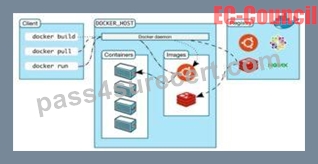
The docker daemon (dockerd) listens for docker API requests and manages docker objects like pictures, containers, networks, and volumes. A daemon may communicate with other daemons to manage docker services.
NEW QUESTION # 347
In the context of password security, a simple dictionary attack involves loading a dictionary file (a text file full of dictionary words) into a cracking application such as L0phtCrack or John the Ripper, and running it against user accounts located by the application. The larger the word and word fragment selection, the more effective the dictionary attack is. The brute force method is the most inclusive, although slow. It usually tries every possible letter and number combination in its automated exploration. If you would use both brute force and dictionary methods combined together to have variation of words, what would you call such an attack?
- A. Hybrid
- B. Full Blown
- C. BruteDics
- D. Thorough
Answer: A
NEW QUESTION # 348
To create a botnet. the attacker can use several techniques to scan vulnerable machines. The attacker first collects Information about a large number of vulnerable machines to create a list. Subsequently, they infect the machines. The list Is divided by assigning half of the list to the newly compromised machines. The scanning process runs simultaneously. This technique ensures the spreading and installation of malicious code in little time.
Which technique is discussed here?
- A. Hit-list-scanning technique
- B. Permutation scanning technique
- C. Topological scanning technique
- D. Subnet scanning technique
Answer: A
Explanation:
One of the biggest problems a worm faces in achieving a very fast rate of infection is "getting off the ground." although a worm spreads exponentially throughout the early stages of infection, the time needed to infect say the first 10,000 hosts dominates the infection time.
There is a straightforward way for an active worm a simple this obstacle, that we term hit-list scanning. Before the worm is free, the worm author collects a listing of say ten,000 to 50,000 potentially vulnerable machines, ideally ones with sensible network connections. The worm, when released onto an initial machine on this hit-list, begins scanning down the list. once it infects a machine, it divides the hit-list in half, communicating half to the recipient worm, keeping the other half.
This fast division ensures that even if only 10-20% of the machines on the hit-list are actually vulnerable, an active worm can quickly bear the hit-list and establish itself on all vulnerable machines in only some seconds. though the hit-list could begin at 200 kilobytes, it quickly shrinks to nothing during the partitioning. This provides a great benefit in constructing a quick worm by speeding the initial infection.
The hit-list needn't be perfect: a simple list of machines running a selected server sort could serve, though larger accuracy can improve the unfold. The hit-list itself is generated victimization one or many of the following techniques, ready well before, typically with very little concern of detection.
Stealthy scans. Portscans are so common and then wide ignored that even a quick scan of the whole net would be unlikely to attract law enforcement attention or over gentle comment within the incident response community. However, for attackers wish to be particularly careful, a randomised sneaky scan taking many months would be not possible to attract much attention, as most intrusion detection systems are not currently capable of detecting such low-profile scans. Some portion of the scan would be out of date by the time it had been used, however abundant of it'd not.
Distributed scanning. an assailant might scan the web using a few dozen to some thousand already-compromised "zombies," the same as what DDOS attackers assemble in a very fairly routine fashion. Such distributed scanning has already been seen within the wild-Lawrence Berkeley National Laboratory received ten throughout the past year.
DNS searches. Assemble a list of domains (for example, by using wide offered spam mail lists, or trolling the address registries). The DNS will then be searched for the science addresses of mail-servers (via mx records) or net servers (by looking for www.domain.com).
Spiders. For net server worms (like Code Red), use Web-crawling techniques the same as search engines so as to produce a list of most Internet-connected web sites. this would be unlikely to draw in serious attention.
Public surveys. for many potential targets there may be surveys available listing them, like the Netcraft survey.
Just listen. Some applications, like peer-to-peer networks, wind up advertising many of their servers. Similarly, many previous worms effectively broadcast that the infected machine is vulnerable to further attack. easy, because of its widespread scanning, during the Code Red I infection it was easy to select up the addresses of upwards of 300,000 vulnerable IIS servers-because each came knock on everyone's door!
NEW QUESTION # 349
Which DNS resource record can indicate how long any "DNS poisoning" could last?
- A. SOA
- B. MX
- C. TIMEOUT
- D. NS
Answer: A
NEW QUESTION # 350
What type of virus is most likely to remain undetected by antivirus software?
- A. File-extension virus
- B. Macro virus
- C. Cavity virus
- D. Stealth virus
Answer: D
NEW QUESTION # 351
John is an incident handler at a financial institution. His steps in a recent incident are not up to the standards of the company. John frequently forgets some steps and procedures while handling responses as they are very stressful to perform. Which of the following actions should John take to overcome this problem with the least administrative effort?
- A. Create an incident checklist.
- B. Read the incident manual every time it occurs.
- C. Select someone else to check the procedures.
- D. Increase his technical skills.
Answer: D
NEW QUESTION # 352
In an attempt to damage the reputation of a competitor organization, Hailey, a professional hacker, gathers a list of employee and client email addresses and other related information by using various search engines, social networking sites, and web spidering tools. In this process, she also uses an automated tool to gather a list of words from the target website to further perform a brute-force attack on the previously gathered email addresses.
What is the tool used by Hailey for gathering a list of words from the target website?
- A. Orbot
- B. Psiphon
- C. CeWL
- D. Shadowsocks
Answer: C
Explanation:
Gathering Wordlist from the Target Website An attacker uses the CeWL tool to gather a list of words from the target website and perform a brute-force attack on the email addresses gathered earlier. # Cewl www.certifiedhacker.com (P.200/184)
NEW QUESTION # 353
A hacker is an intelligent individual with excellent computer skills and the ability to explore a computer's software and hardware without the owner's permission. Their intention can either be to simply gain knowledge or to illegally make changes.
Which of the following class of hacker refers to an individual who works both offensively and defensively at various times?
- A. Black Hat
- B. Suicide Hacker
- C. Gray Hat
- D. White Hat
Answer: C
NEW QUESTION # 354
John, a security analyst working for an organization, found a critical vulnerability on the organization's LAN that allows him to view financial and personal information about the rest of the employees. Before reporting the vulnerability, he examines the information shown by the vulnerability for two days without disclosing any information to third parties or other internal employees. He does so out of curiosity about the other employees and may take advantage of this information later. What would John be considered as?
- A. Black hat
- B. Cybercriminal
- C. Gray hat
- D. White hat
Answer: C
NEW QUESTION # 355
You have the SOA presented below in your Zone.
Your secondary servers have not been able to contact your primary server to synchronize information. How long will the secondary servers attempt to contact the primary server before it considers that zone is dead and stops responding to queries?
collegae.edu.SOA, cikkye.edu ipad.college.edu. (200302028 3600 3600 604800 3600)
- A. One week
- B. One day
- C. One month
- D. One hour
Answer: A
NEW QUESTION # 356
Why should the security analyst disable/remove unnecessary ISAPI filters?
- A. To defend against social engineering attacks
- B. To defend against webserver attacks
- C. To defend against jailbreaking
- D. To defend against wireless attacks
Answer: B
NEW QUESTION # 357
Which of the following Linux commands will resolve a domain name into IP address?
- A. >host-t ns hackeddomain.com
- B. >host -t AXFR hackeddomain.com
- C. >host -t soa hackeddomain.com
- D. >host-t a hackeddomain.com
Answer: D
NEW QUESTION # 358
Joseph was the Web site administrator for the Mason Insurance in New York, who's main Web site was located at www.masonins.com. Joseph uses his laptop computer regularly to administer the Web site. One night, Joseph received an urgent phone call from his friend, Smith. According to Smith, the main Mason Insurance web site had been vandalized! All of its normal content was removed and replaced with an attacker's message ''Hacker Message: You are dead! Freaks!" From his office, which was directly connected to Mason Insurance's internal network, Joseph surfed to the Web site using his laptop. In his browser, the Web site looked completely intact.
No changes were apparent. Joseph called a friend of his at his home to help troubleshoot the problem. The Web site appeared defaced when his friend visited using his DSL connection. So, while Smith and his friend could see the defaced page, Joseph saw the intact Mason Insurance web site. To help make sense of this problem, Joseph decided to access the Web site using hisdial-up ISP. He disconnected his laptop from the corporate internal network and used his modem to dial up the same ISP used by Smith. After his modem connected, he quickly typed www.masonins.com in his browser to reveal the following web page: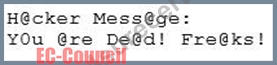
After seeing the defaced Web site, he disconnected his dial-up line, reconnected to the internal network, and used Secure Shell (SSH) to log in directly to the Web server. He ran Tripwire against the entire Web site, and determined that every system file and all the Web content on the server were intact. How did the attacker accomplish this hack?
- A. Routing table injection
- B. ARP spoofing
- C. SQL injection
- D. DNS poisoning
Answer: D
NEW QUESTION # 359
......
Last 312-50v12 practice test reviews: Practice Test ECCouncil dumps: https://www.pass4surecert.com/ECCouncil/312-50v12-practice-exam-dumps.html
Try 312-50v12 Free Now! Real Exam Question Answers: https://drive.google.com/open?id=1Eca696gsMwM3GEiOp5UMMWo1NyP-s2XA