

[Aug-2022] Microsoft DP-300 Exam: Basic Questions With Answers
New 2022 Realistic Free Microsoft DP-300 Exam Dump Questions and Answer
The Microsoft DP-300 is also known as Administering Relational Databases on Microsoft Azure. It is a broad step towards emerging as a top-notch Microsoft accredited Azure Database Administrator Associate. As a rule, this test has mainly been conducted to check out an aspirant’s capability to perform countless tasks, such as implementing a safe environment, analyzing and improving various operational supplies, improving query performance, performing administration by utilizing T-SQL, planning, incorporating resources of data platform, and finally accomplishing automation of tasks.
Career Prospects
As a certified Azure database administrator, there are different job roles that you can explore. These include a Database Administrator, a Database Engineer, a Database Architect, a System Administrator, an IT Azure Cloud Engineer, and a Service Engineer, among others. The average salary to expect from any of these positions is $77,670 per annum. However, the professionals with advanced experience can earn above the average industry standard.
NEW QUESTION 97
You need to implement the monitoring of SalesSQLDb1. The solution must meet the technical requirements.
How should you collect and stream metrics? To answer, select the appropriate options in the answer area.
NOTE: Each correct selection is worth one point.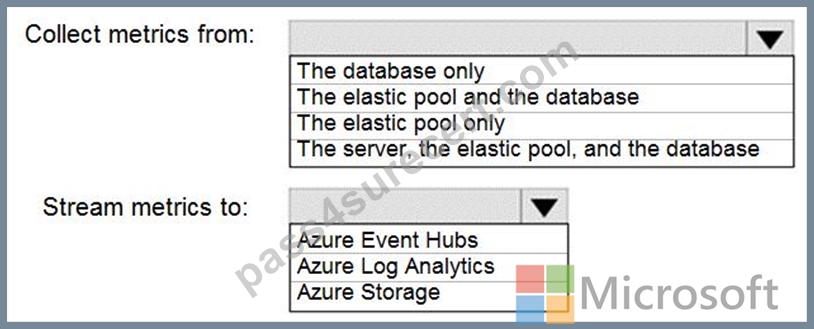
Answer:
Explanation: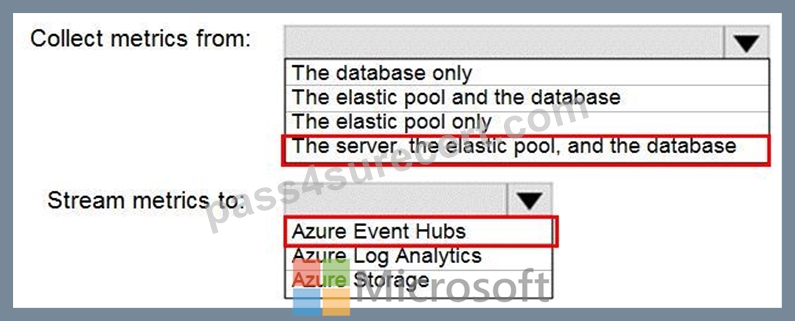
NEW QUESTION 98
You have an Azure SQL Database instance named DatabaseA on a server named Server1.
You plan to add a new user named App1 to DatabaseA and grant App1 db_datacenter permissions. App1 will use SQL Server Authentication.
You need to create App1. The solution must ensure that App1 can be given access to other databases by using the same credentials.
Which three actions should you perform in sequence? To answer, move the appropriate actions from the list of actions to the answer area and arrange them in the correct order.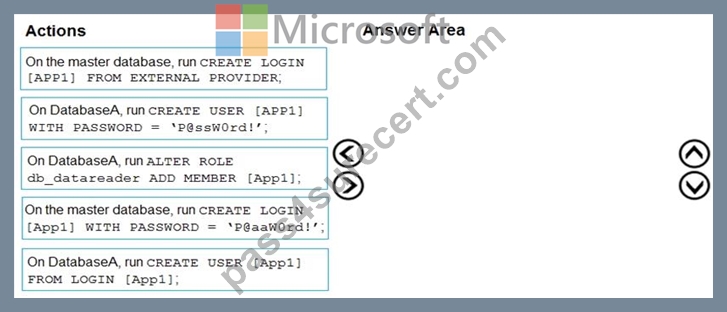
Answer:
Explanation: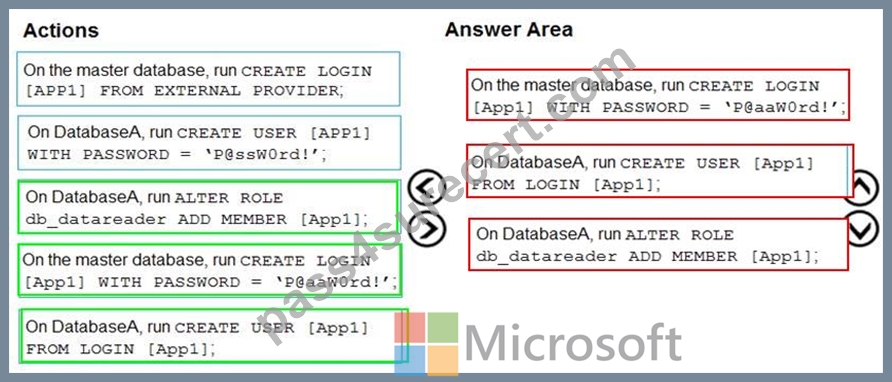
Explanation:
Step 1: On the master database, run CREATE LOGIN [App1] WITH PASSWORD = 'p@aaW0rd!' Logins are server wide login and password pairs, where the login has the same password across all databases. Here is some sample Transact-SQL that creates a login:
CREATE LOGIN readonlylogin WITH password='1231!#ASDF!a';
You must be connected to the master database on SQL Azure with the administrative login (which you get from the SQL Azure portal) to execute the CREATE LOGIN command.
Step 2: On DatabaseA, run CREATE USER [App1] FROM LOGIN [App1]
Users are created per database and are associated with logins. You must be connected to the database in where you want to create the user. In most cases, this is not the master database. Here is some sample Transact-SQL that creates a user:
CREATE USER readonlyuser FROM LOGIN readonlylogin;
Step 3: On DatabaseA run ALTER ROLE db_datareader ADD Member [App1]
Just creating the user does not give them permissions to the database. You have to grant them access. In the Transact-SQL example below the readonlyuser is given read only permissions to the database via the db_datareader role.
EXEC sp_addrolemember 'db_datareader', 'readonlyuser';
Reference:
https://azure.microsoft.com/en-us/blog/adding-users-to-your-sql-azure-database/
NEW QUESTION 99
You need to apply 20 built-in Azure Policy definitions to all new and existing Azure SQL Database deployments in an Azure subscription. The solution must minimize administrative effort.
Which three actions should you perform in sequence? To answer, move the appropriate actions from the list of actions to the answer area and arrange them in the correct order.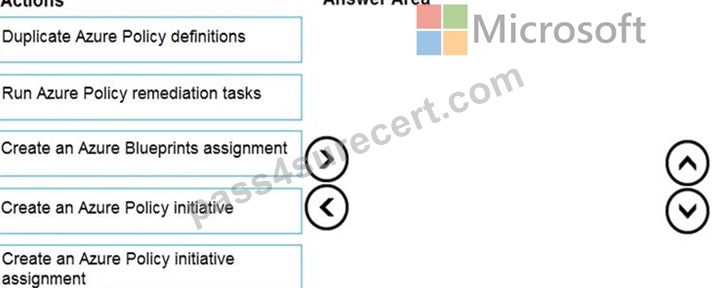
Answer:
Explanation: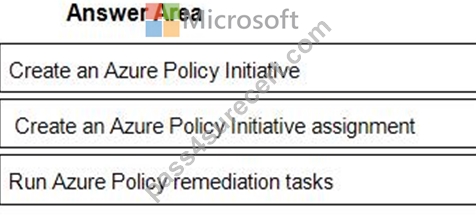
1 - Create an Azure Policy Initiative
2 - Create an Azure Policy Initiative assignment
3 - Run Azure Policy remediation tasks
Reference:
https://docs.microsoft.com/en-us/azure/governance/policy/tutorials/create-and-manage
NEW QUESTION 100
DRAG DROP
You have an Azure SQL database that contains a table named Employees. Employees contains a column named Salary.
You need to encrypt the Salary column. The solution must prevent database administrators from reading the data in the Salary column and must provide the most secure encryption.
Which three actions should you perform in sequence? To answer, move the appropriate actions from the list of actions to the answer area and arrange them in the correct order.
Select and Place: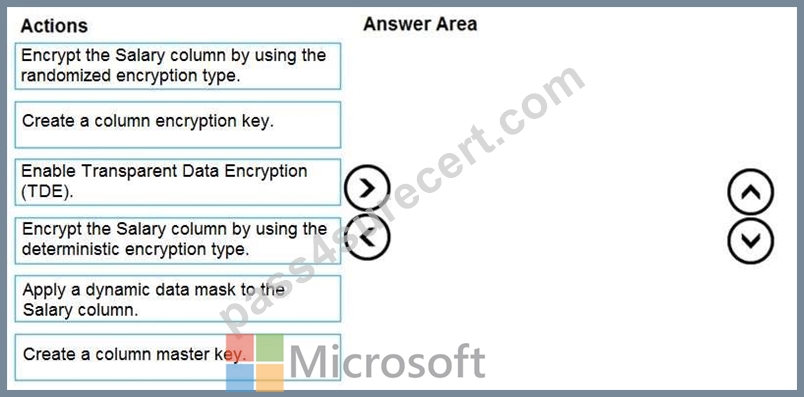
Answer:
Explanation: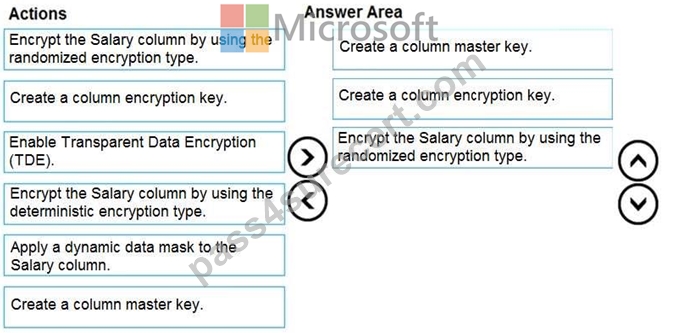
Explanation:
Step 1: Create a column master key
Create a column master key metadata entry before you create a column encryption key metadata entry in the database and before any column in the database can be encrypted using Always Encrypted.
Step 2: Create a column encryption key.
Step 3: Encrypt the Salary column by using the randomized encryption type.
Randomized encryption uses a method that encrypts data in a less predictable manner. Randomized encryption is more secure, but prevents searching, grouping, indexing, and joining on encrypted columns.
Note: A column encryption key metadata object contains one or two encrypted values of a column encryption key that is used to encrypt data in a column. Each value is encrypted using a column master key.
Incorrect Answers:
Deterministic encryption.
Deterministic encryption always generates the same encrypted value for any given plain text value. Using deterministic encryption allows point lookups, equality joins, grouping and indexing on encrypted columns.
However, it may also allow unauthorized users to guess information about encrypted values by examining patterns in the encrypted column, especially if there's a small set of possible encrypted values, such as True/ False, or North/South/East/West region.
Reference:
https://docs.microsoft.com/en-us/sql/relational-databases/security/encryption/always-encrypted-database- engine Monitor and Optimize Operational Resources Testlet 1 This is a case study. Case studies are not timed separately. You can use as much exam time as you would like to complete each case. However, there may be additional case studies and sections on this exam. You must manage your time to ensure that you are able to complete all questions included on this exam in the time provided.
To answer the questions included in a case study, you will need to reference information that is provided in the case study. Case studies might contain exhibits and other resources that provide more information about the scenario that is described in the case study. Each question is independent of the other questions in this case study.
At the end of this case study, a review screen will appear. This screen allows you to review your answers and to make changes before you move to the next section of the exam. After you begin a new section, you cannot return to this section.
To start the case study
To display the first question in this case study, click the Next button. Use the buttons in the left pane to explore the content of the case study before you answer the questions. Clicking these buttons displays information such as business requirements, existing environment, and problem statements. If the case study has an All Information tab, note that the information displayed is identical to the information displayed on the subsequent tabs. When you are ready to answer a question, click the Question button to return to the question.
Existing Environment
Network Environment
The manufacturing and research datacenters connect to the primary datacenter by using a VPN.
The primary datacenter has an ExpressRoute connection that uses both Microsoft peering and private peering.
The private peering connects to an Azure virtual network named HubVNet.
Identity Environment
Litware has a hybrid Azure Active Directory (Azure AD) deployment that uses a domain named litwareinc.com.
All Azure subscriptions are associated to the litwareinc.com Azure AD tenant.
Database Environment
The sales department has the following database workload:
* An on-premises named SERVER1 hosts an instance of Microsoft SQL Server 2012 and two 1-TB databases.
* A logical server named SalesSrv01A contains a geo-replicated Azure SQL database named SalesSQLDb1.
SalesSQLDb1 is in an elastic pool named SalesSQLDb1Pool. SalesSQLDb1 uses database firewall rules and contained database users.
* An application named SalesSQLDb1App1 uses SalesSQLDb1.
The manufacturing office contains two on-premises SQL Server 2016 servers named SERVER2 and SERVER3. The servers are nodes in the same Always On availability group. The availability group contains a database named ManufacturingSQLDb1 Database administrators have two Azure virtual machines in HubVnet named VM1 and VM2 that run Windows Server 2019 and are used to manage all the Azure databases.
Licensing Agreement
Litware is a Microsoft Volume Licensing customer that has License Mobility through Software Assurance.
Current Problems
SalesSQLDb1 experiences performance issues that are likely due to out-of-date statistics and frequent blocking queries.
Requirements
Planned Changes
Litware plans to implement the following changes:
* Implement 30 new databases in Azure, which will be used by time-sensitive manufacturing apps that have varying usage patterns. Each database will be approximately 20 GB.
* Create a new Azure SQL database named ResearchDB1 on a logical server named ResearchSrv01.
ResearchDB1 will contain Personally Identifiable Information (PII) data.
* Develop an app named ResearchApp1 that will be used by the research department to populate and access ResearchDB1.
* Migrate ManufacturingSQLDb1 to the Azure virtual machine platform.
* Migrate the SERVER1 databases to the Azure SQL Database platform.
Technical Requirements
Litware identifies the following technical requirements:
* Maintenance tasks must be automated.
* The 30 new databases must scale automatically.
* The use of an on-premises infrastructure must be minimized.
* Azure Hybrid Use Benefits must be leveraged for Azure SQL Database deployments.
* All SQL Server and Azure SQL Database metrics related to CPU and storage usage and limits must be analyzed by using Azure built-in functionality.
Security and Compliance Requirements
Litware identifies the following security and compliance requirements:
* Store encryption keys in Azure Key Vault.
* Retain backups of the PII data for two months.
* Encrypt the PII data at rest, in transit, and in use.
* Use the principle of least privilege whenever possible.
* Authenticate database users by using Active Directory credentials.
* Protect Azure SQL Database instances by using database-level firewall rules.
* Ensure that all databases hosted in Azure are accessible from VM1 and VM2 without relying on public endpoints.
Business Requirements
Litware identifies the following business requirements:
* Meet an SLA of 99.99% availability for all Azure deployments.
* Minimize downtime during the migration of the SERVER1 databases.
* Use the Azure Hybrid Use Benefits when migrating workloads to Azure.
* Once all requirements are met, minimize costs whenever possible.
NEW QUESTION 101
You have an Azure virtual machine named VM1 on a virtual network named VNet1. Outbound traffic from VM1 to the internet is blocked.
You have an Azure SQL database named SqlDb1 on a logical server named SqlSrv1.
You need to implement connectivity between VM1 and SqlDb1 to meet the following requirements:
* Ensure that all traffic to the public endpoint of SqlSrv1 is blocked.
* Minimize the possibility of VM1 exfiltrating data stored in SqlDb1.
What should you create on VNet1?
- A. a VPN gateway
- B. a service endpoint
- C. a private link
- D. an ExpressRoute gateway
Answer: C
Explanation:
Section: [none]
Explanation:
Azure Private Link enables you to access Azure PaaS Services (for example, Azure Storage and SQL Database) and Azure hosted customer-owned/partner services over a private endpoint in your virtual network.
Traffic between your virtual network and the service travels the Microsoft backbone network. Exposing your service to the public internet is no longer necessary.
Reference:
https://docs.microsoft.com/en-us/azure/private-link/private-link-overview
NEW QUESTION 102
You have an Azure Stream Analytics job.
You need to ensure that the job has enough streaming units provisioned.
You configure monitoring of the SU % Utilization metric.
Which two additional metrics should you monitor? Each correct answer presents part of the solution.
NOTE: Each correct selection is worth one point.
- A. Late Input Events
- B. Function Events
- C. Backlogged Input Events
- D. Watermark Delay
- E. Out of order Events
Answer: C,D
Explanation:
Section: [none]
Explanation:
To react to increased workloads and increase streaming units, consider setting an alert of 80% on the SU Utilization metric. Also, you can use watermark delay and backlogged events metrics to see if there is an impact.
Note: Backlogged Input Events: Number of input events that are backlogged. A non-zero value for this metric implies that your job isn't able to keep up with the number of incoming events. If this value is slowly increasing or consistently non-zero, you should scale out your job, by increasing the SUs.
Reference:
https://docs.microsoft.com/en-us/azure/stream-analytics/stream-analytics-monitoring
NEW QUESTION 103
HOTSPOT
You have SQL Server on an Azure virtual machine that contains a database named DB1.
The database reports a CHECKSUM error.
You need to recover the database.
How should you complete the statements? To answer, select the appropriate options in the answer area.
NOTE: Each correct selection is worth one point.
Hot Area: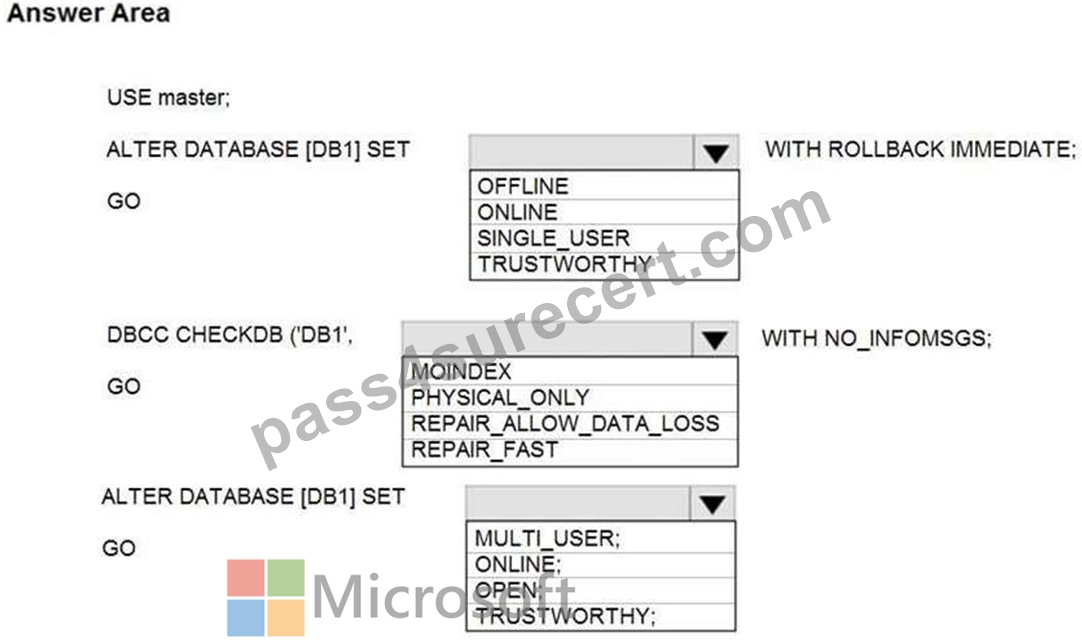
Answer:
Explanation: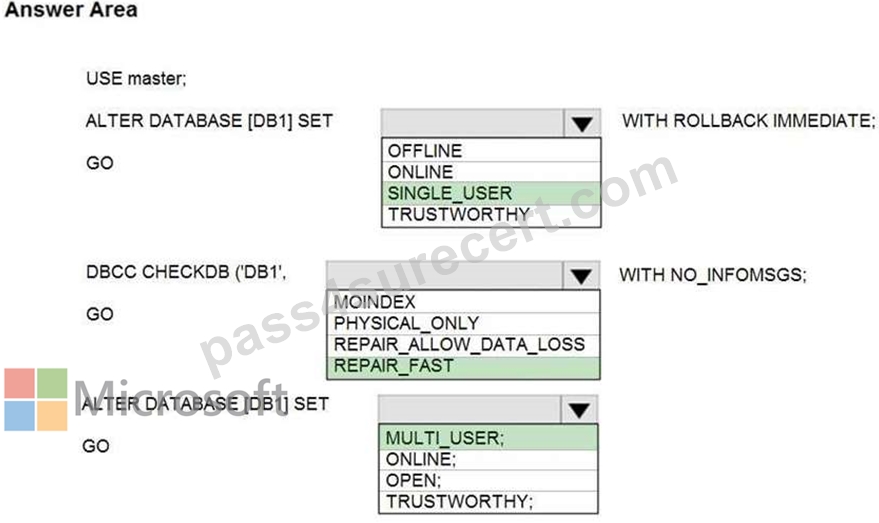
Section: [none]
Explanation:
Box 1: SINGLE_USER
The specified database must be in single-user mode to use one of the following repair options.
Box 2: REPAIR_ALLOW_DATA_LOSS
REPAIR_ALLOW_DATA_LOSS tries to repair all reported errors. These repairs can cause some data loss.
Note: The REPAIR_ALLOW_DATA_LOSS option is a supported feature but it may not always be the best
option for bringing a database to a physically consistent state. If successful, the
REPAIR_ALLOW_DATA_LOSS option may result in some data loss. In fact, it may result in more data lost than
if a user were to restore the database from the last known good backup.
Incorrect Answers:
REPAIR_FAST
Maintains syntax for backward compatibility only. No repair actions are performed.
Box 3: MULTI_USER
MULTI_USER
All users that have the appropriate permissions to connect to the database are allowed.
Reference:
https://docs.microsoft.com/en-us/sql/t-sql/database-console-commands/dbcc-checkdb-transact-sql
NEW QUESTION 104
You have a SQL pool in Azure Synapse that contains a table named dbo.Customers. The table contains a column name Email.
You need to prevent nonadministrative users from seeing the full email addresses in the Email column. The users must see values in a format of [email protected] instead.
What should you do?
- A. From Microsoft SQL Server Management Studio, set an email mask on the Email column.
- B. From the Azure portal, set a mask on the Email column.
- C. From the Azure portal, set a sensitivity classification of Confidential for the Email column.
- D. From Microsoft SQL Server Management Studio, grant the SELECT permission to the users for all the columns in the dbo.Customers table except Email.
Answer: C
Explanation:
The Email masking method, which exposes the first letter and replaces the domain with XXX.com using a constant string prefix in the form of an email address.
Example: [email protected]
NEW QUESTION 105
You have an Azure virtual machine named VM1 on a virtual network named VNet1. Outbound traffic from VM1
to the internet is blocked.
You have an Azure SQL database named SqlDb1 on a logical server named SqlSrv1.
You need to implement connectivity between VM1 and SqlDb1 to meet the following requirements:
Ensure that VM1 cannot connect to any Azure SQL Server other than SqlSrv1.
Restrict network connectivity to SqlSrv1.
What should you create on VNet1?
- A. a VPN gateway
- B. a service endpoint
- C. a private link
- D. an ExpressRoute gateway
Answer: C
Explanation:
Section: [none]
Explanation:
Azure Private Link enables you to access Azure PaaS Services (for example, Azure Storage and SQL
Database) and Azure hosted customer-owned/partner services over a private endpoint in your virtual network.
Traffic between your virtual network and the service travels the Microsoft backbone network. Exposing your
service to the public internet is no longer necessary.
Reference:
https://docs.microsoft.com/en-us/azure/private-link/private-link-overview
Testlet 1
This is a case study. Case studies are not timed separately. You can use as much exam time as you
would like to complete each case. However, there may be additional case studies and sections on this exam.
You must manage your time to ensure that you are able to complete all questions included on this exam in the
time provided.
To answer the questions included in a case study, you will need to reference information that is provided in the
case study. Case studies might contain exhibits and other resources that provide more information about the
scenario that is described in the case study. Each question is independent of the other questions in this case
study.
At the end of this case study, a review screen will appear. This screen allows you to review your answers and to
make changes before you move to the next section of the exam. After you begin a new section, you cannot
return to this section.
To start the case study
To display the first question in this case study, click the Next button. Use the buttons in the left pane to explore
the content of the case study before you answer the questions. Clicking these buttons displays information such
as business requirements, existing environment, and problem statements. If the case study has an All
Information tab, note that the information displayed is identical to the information displayed on the subsequent
tabs. When you are ready to answer a question, click the Question button to return to the question.
Overview
Litware, Inc. is a renewable energy company that has a main office in Boston. The main office hosts a sales
department and the primary datacenter for the company.
Physical Locations
Existing Environment
Litware has a manufacturing office and a research office is separate locations near Boston. Each office has its
own datacenter and internet connection.
The manufacturing and research datacenters connect to the primary datacenter by using a VPN.
Network Environment
The primary datacenter has an ExpressRoute connection that uses both Microsoft peering and private peering.
The private peering connects to an Azure virtual network named HubVNet.
Identity Environment
Litware has a hybrid Azure Active Directory (Azure AD) deployment that uses a domain named litwareinc.com.
All Azure subscriptions are associated to the litwareinc.com Azure AD tenant.
Database Environment
The sales department has the following database workload:
* An on-premises named SERVER1 hosts an instance of Microsoft SQL Server 2012 and two 1-TB
databases.
* A logical server named SalesSrv01A contains a geo-replicated Azure SQL database named SalesSQLDb1.
SalesSQLDb1 is in an elastic pool named SalesSQLDb1Pool. SalesSQLDb1 uses database firewall rules
and contained database users.
* An application named SalesSQLDb1App1 uses SalesSQLDb1.
The manufacturing office contains two on-premises SQL Server 2016 servers named SERVER2 and
SERVER3. The servers are nodes in the same Always On availability group. The availability group contains a
database named ManufacturingSQLDb1
Database administrators have two Azure virtual machines in HubVnet named VM1 and VM2 that run Windows
Server 2019 and are used to manage all the Azure databases.
Licensing Agreement
Litware is a Microsoft Volume Licensing customer that has License Mobility through Software Assurance.
Current Problems
SalesSQLDb1 experiences performance issues that are likely due to out-of-date statistics and frequent blocking
queries.
Requirements
Planned Changes
Litware plans to implement the following changes:
* Implement 30 new databases in Azure, which will be used by time-sensitive manufacturing apps that have
varying usage patterns. Each database will be approximately 20 GB.
* Create a new Azure SQL database named ResearchDB1 on a logical server named ResearchSrv01.
ResearchDB1 will contain Personally Identifiable Information (PII) data.
* Develop an app named ResearchApp1 that will be used by the research department to populate and access
ResearchDB1.
* Migrate ManufacturingSQLDb1 to the Azure virtual machine platform.
* Migrate the SERVER1 databases to the Azure SQL Database platform.
Technical Requirements
Litware identifies the following technical requirements:
* Maintenance tasks must be automated.
* The 30 new databases must scale automatically.
* The use of an on-premises infrastructure must be minimized.
* Azure Hybrid Use Benefits must be leveraged for Azure SQL Database deployments.
* All SQL Server and Azure SQL Database metrics related to CPU and storage usage and limits must be
analyzed by using Azure built-in functionality.
Security and Compliance Requirements
Litware identifies the following security and compliance requirements:
* Store encryption keys in Azure Key Vault.
* Retain backups of the PII data for two months.
* Encrypt the PII data at rest, in transit, and in use.
* Use the principle of least privilege whenever possible.
* Authenticate database users by using Active Directory credentials.
* Protect Azure SQL Database instances by using database-level firewall rules.
* Ensure that all databases hosted in Azure are accessible from VM1 and VM2 without relying on public
endpoints.
Business Requirements
Litware identifies the following business requirements:
* Meet an SLA of 99.99% availability for all Azure deployments.
* Minimize downtime during the migration of the SERVER1 databases.
* Use the Azure Hybrid Use Benefits when migrating workloads to Azure.
* Once all requirements are met, minimize costs whenever possible.
NEW QUESTION 106
What should you do after a failover of SalesSQLDb1 to ensure that the database remains accessible to SalesSQLDb1App1?
- A. Configure SalesSQLDb1 as writable.
- B. Update the firewall rules of SalesSQLDb1.
- C. Update the users in SalesSQLDb1.
- D. Update the connection strings of SalesSQLDb1App1.
Answer: B
Explanation:
Section: [none]
Explanation:
Scenario: SalesSQLDb1 uses database firewall rules and contained database users.
Testlet 2
Case study
This is a case study. Case studies are not timed separately. You can use as much exam time as you would like to complete each case. However, there may be additional case studies and sections on this exam.
You must manage your time to ensure that you are able to complete all questions included on this exam in the time provided.
To answer the questions included in a case study, you will need to reference information that is provided in the case study. Case studies might contain exhibits and other resources that provide more information about the scenario that is described in the case study. Each question is independent of the other questions in this case study.
At the end of this case study, a review screen will appear. This screen allows you to review your answers and to make changes before you move to the next section of the exam. After you begin a new section, you cannot return to this section.
To start the case study
To display the first question in this case study, click the Next button. Use the buttons in the left pane to explore the content of the case study before you answer the questions. Clicking these buttons displays information such as business requirements, existing environment, and problem statements. If the case study has an All Information tab, note that the information displayed is identical to the information displayed on the subsequent tabs. When you are ready to answer a question, click the Question button to return to the question.
Overview
General Overview
Contoso, Ltd. is a financial data company that has 100 employees. The company delivers financial data to customers.
Physical Locations
Contoso has a datacenter in Los Angeles and an Azure subscription. All Azure resources are in the US West 2 Azure region. Contoso has a 10-Gb ExpressRoute connection to Azure.
The company has customers worldwide.
Existing Environment
Active Directory
Contoso has a hybrid Azure Active Directory (Azure AD) deployment that syncs to on-premises Active Directory.
Database Environment
Contoso has SQL Server 2017 on Azure virtual machines shown in the following table.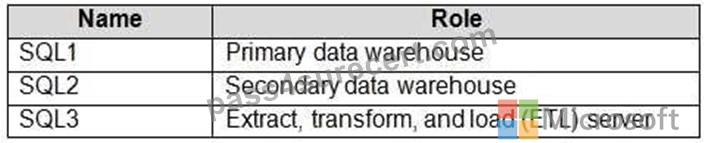
SQL1 and SQL2 are in an Always On availability group and are actively queried. SQL3 runs jobs, provides historical data, and handles the delivery of data to customers.
The on-premises datacenter contains a PostgreSQL server that has a 50-TB database.
Current Business Model
Contoso uses Microsoft SQL Server Integration Services (SSIS) to create flat files for customers. The customers receive the files by using FTP.
Requirements
Planned Changes
Contoso plans to move to a model in which they deliver data to customer databases that run as platform as a service (PaaS) offerings. When a customer establishes a service agreement with Contoso, a separate resource group that contains an Azure SQL database will be provisioned for the customer. The database will have a complete copy of the financial data. The data to which each customer will have access will depend on the service agreement tier. The customers can change tiers by changing their service agreement.
The estimated size of each PaaS database is 1 TB.
Contoso plans to implement the following changes:
* Move the PostgreSQL database to Azure Database for PostgreSQL during the next six months.
* Upgrade SQL1, SQL2, and SQL3 to SQL Server 2019 during the next few months.
* Start onboarding customers to the new PaaS solution within six months.
Business Goals
Contoso identifies the following business requirements:
* Use built-in Azure features whenever possible.
* Minimize development effort whenever possible.
* Minimize the compute costs of the PaaS solutions.
* Provide all the customers with their own copy of the database by using the PaaS solution.
* Provide the customers with different table and row access based on the customer's service agreement.
* In the event of an Azure regional outage, ensure that the customers can access the PaaS solution with minimal downtime. The solution must provide automatic failover.
* Ensure that users of the PaaS solution can create their own database objects but be prevented from modifying any of the existing database objects supplied by Contoso.
Technical Requirements
Contoso identifies the following technical requirements:
* Users of the PaaS solution must be able to sign in by using their own corporate Azure AD credentials or have Azure AD credentials supplied to them by Contoso. The solution must avoid using the internal Azure AD of Contoso to minimize guest users.
* All customers must have their own resource group, Azure SQL server, and Azure SQL database. The deployment of resources for each customer must be done in a consistent fashion.
* Users must be able to review the queries issued against the PaaS databases and identify any new objects created.
* Downtime during the PostgreSQL database migration must be minimized.
Monitoring Requirements
Contoso identifies the following monitoring requirements:
* Notify administrators when a PaaS database has a higher than average CPU usage.
* Use a single dashboard to review security and audit data for all the PaaS databases.
* Use a single dashboard to monitor query performance and bottlenecks across all the PaaS databases.
* Monitor the PaaS databases to identify poorly performing queries and resolve query performance issues automatically whenever possible.
PaaS Prototype
During prototyping of the PaaS solution in Azure, you record the compute utilization of a customer's Azure SQL database as shown in the following exhibit.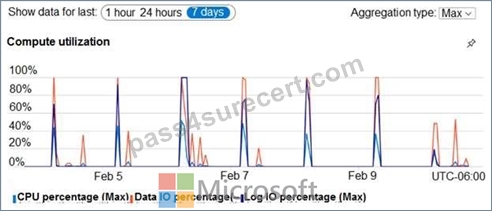
Role Assignments
For each customer's Azure SQL Database server, you plan to assign the roles shown in the following exhibit.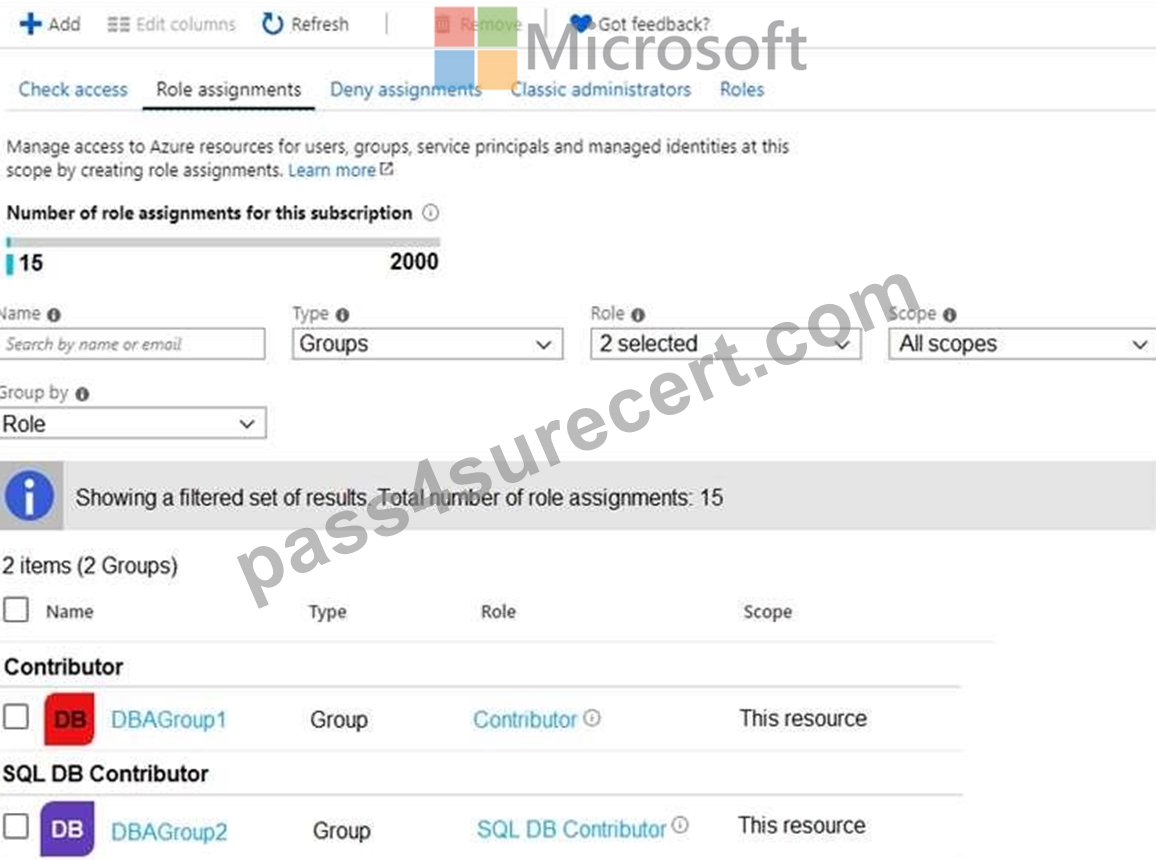
NEW QUESTION 107
You need to implement a solution to notify the administrators. The solution must meet the monitoring requirements.
What should you do?
- A. Add a diagnostic setting that logs QueryStoreRuntimeStatistics and streams to an Azure event hub.
- B. Create an Azure Monitor alert rule that has a dynamic threshold and assign the alert rule to an action group.
- C. Create an Azure Monitor alert rule that has a static threshold and assign the alert rule to an action group.
- D. Add a diagnostic setting that logs Timeouts and streams to an Azure event hub.
Answer: B
Explanation:
Reference:
https://azure.microsoft.com/en-gb/blog/announcing-azure-monitor-aiops-alerts-with-dynamic-thresholds/ This is a case study. Case studies are not timed separately. You can use as much exam time as you would like to complete each case. However, there may be additional case studies and sections on this exam. You must manage your time to ensure that you are able to complete all questions included on this exam in the time provided.
To answer the questions included in a case study, you will need to reference information that is provided in the case study. Case studies might contain exhibits and other resources that provide more information about the scenario that is described in the case study. Each question is independent of the other questions in this case study.
At the end of this case study, a review screen will appear. This screen allows you to review your answers and to make changes before you move to the next section of the exam. After you begin a new section, you cannot return to this section.
To start the case study
To display the first question in this case study, click the Next button. Use the buttons in the left pane to explore the content of the case study before you answer the questions. Clicking these buttons displays information such as business requirements, existing environment, and problem statements. If the case study has an All Information tab, note that the information displayed is identical to the information displayed on the subsequent tabs. When you are ready to answer a question, click the Question button to return to the question.
Overview
ADatum Corporation is a retailer that sells products through two sales channels: retail stores and a website.
NEW QUESTION 108
Note: This question is part of a series of questions that present the same scenario. Each question in the series contains a unique solution that might meet the stated goals. Some question sets might have more than one correct solution, while others might not have a correct solution.
After you answer a question in this section, you will NOT be able to return to it. As a result, these questions will not appear in the review screen.
You have an Azure SQL database named Sales.
You need to implement disaster recovery for Sales to meet the following requirements:
* During normal operations, provide at least two readable copies of Sales.
* Ensure that Sales remains available if a datacenter fails.
Solution: You deploy an Azure SQL database that uses the General Purpose service tier and geo-replication.
Does this meet the goal?
- A. Yes
- B. No
Answer: B
Explanation:
Instead deploy an Azure SQL database that uses the Business Critical service tier and Availability Zones.
Note: Premium and Business Critical service tiers leverage the Premium availability model, which integrates compute resources (sqlservr.exe process) and storage (locally attached SSD) on a single node. High availability is achieved by replicating both compute and storage to additional nodes creating a three to four- node cluster.
By default, the cluster of nodes for the premium availability model is created in the same datacenter. With the introduction of Azure Availability Zones, SQL Database can place different replicas of the Business Critical database to different availability zones in the same region. To eliminate a single point of failure, the control ring is also duplicated across multiple zones as three gateway rings (GW).
Reference:
https://docs.microsoft.com/en-us/azure/azure-sql/database/high-availability-sla Perform Administration by Using T-SQL Testlet 1 This is a case study. Case studies are not timed separately. You can use as much exam time as you would like to complete each case. However, there may be additional case studies and sections on this exam. You must manage your time to ensure that you are able to complete all questions included on this exam in the time provided.
To answer the questions included in a case study, you will need to reference information that is provided in the case study. Case studies might contain exhibits and other resources that provide more information about the scenario that is described in the case study. Each question is independent of the other questions in this case study.
At the end of this case study, a review screen will appear. This screen allows you to review your answers and to make changes before you move to the next section of the exam. After you begin a new section, you cannot return to this section.
To start the case study
To display the first question in this case study, click the Next button. Use the buttons in the left pane to explore the content of the case study before you answer the questions. Clicking these buttons displays information such as business requirements, existing environment, and problem statements. If the case study has an All Information tab, note that the information displayed is identical to the information displayed on the subsequent tabs. When you are ready to answer a question, click the Question button to return to the question.
Existing Environment
Network Environment
The manufacturing and research datacenters connect to the primary datacenter by using a VPN.
The primary datacenter has an ExpressRoute connection that uses both Microsoft peering and private peering.
The private peering connects to an Azure virtual network named HubVNet.
Identity Environment
Litware has a hybrid Azure Active Directory (Azure AD) deployment that uses a domain named litwareinc.com.
All Azure subscriptions are associated to the litwareinc.com Azure AD tenant.
Database Environment
The sales department has the following database workload:
* An on-premises named SERVER1 hosts an instance of Microsoft SQL Server 2012 and two 1-TB databases.
* A logical server named SalesSrv01A contains a geo-replicated Azure SQL database named SalesSQLDb1.
SalesSQLDb1 is in an elastic pool named SalesSQLDb1Pool. SalesSQLDb1 uses database firewall rules and contained database users.
* An application named SalesSQLDb1App1 uses SalesSQLDb1.
The manufacturing office contains two on-premises SQL Server 2016 servers named SERVER2 and SERVER3. The servers are nodes in the same Always On availability group. The availability group contains a database named ManufacturingSQLDb1 Database administrators have two Azure virtual machines in HubVnet named VM1 and VM2 that run Windows Server 2019 and are used to manage all the Azure databases.
Licensing Agreement
Litware is a Microsoft Volume Licensing customer that has License Mobility through Software Assurance.
Current Problems
SalesSQLDb1 experiences performance issues that are likely due to out-of-date statistics and frequent blocking queries.
Requirements
Planned Changes
Litware plans to implement the following changes:
* Implement 30 new databases in Azure, which will be used by time-sensitive manufacturing apps that have varying usage patterns. Each database will be approximately 20 GB.
* Create a new Azure SQL database named ResearchDB1 on a logical server named ResearchSrv01.
ResearchDB1 will contain Personally Identifiable Information (PII) data.
* Develop an app named ResearchApp1 that will be used by the research department to populate and access ResearchDB1.
* Migrate ManufacturingSQLDb1 to the Azure virtual machine platform.
* Migrate the SERVER1 databases to the Azure SQL Database platform.
Technical Requirements
Litware identifies the following technical requirements:
* Maintenance tasks must be automated.
* The 30 new databases must scale automatically.
* The use of an on-premises infrastructure must be minimized.
* Azure Hybrid Use Benefits must be leveraged for Azure SQL Database deployments.
* All SQL Server and Azure SQL Database metrics related to CPU and storage usage and limits must be analyzed by using Azure built-in functionality.
Security and Compliance Requirements
Litware identifies the following security and compliance requirements:
* Store encryption keys in Azure Key Vault.
* Retain backups of the PII data for two months.
* Encrypt the PII data at rest, in transit, and in use.
* Use the principle of least privilege whenever possible.
* Authenticate database users by using Active Directory credentials.
* Protect Azure SQL Database instances by using database-level firewall rules.
* Ensure that all databases hosted in Azure are accessible from VM1 and VM2 without relying on public endpoints.
Business Requirements
Litware identifies the following business requirements:
* Meet an SLA of 99.99% availability for all Azure deployments.
* Minimize downtime during the migration of the SERVER1 databases.
* Use the Azure Hybrid Use Benefits when migrating workloads to Azure.
* Once all requirements are met, minimize costs whenever possible.
NEW QUESTION 109
You create five Azure SQL Database instances on the same logical server.
In each database, you create a user for an Azure Active Directory (Azure AD) user named User1.
User1 attempts to connect to the logical server by using Azure Data Studio and receives a login error.
You need to ensure that when User1 connects to the logical server by using Azure Data Studio, User1 can see all the databases.
What should you do?
- A. Assign User1 the db_datareader role for the databases that Userl creates.
- B. Grant select on sys.databases to public in the master database.
- C. Assign User1 the db_datareader role for the master database.
- D. Create User1 in the master database.
Answer: D
Explanation:
Reference:
https://docs.microsoft.com/en-us/azure/azure-sql/database/logins-create-manage
NEW QUESTION 110
You have a new Azure SQL database. The database contains a column that stores confidential information.
You need to track each time values from the column are returned in a query. The tracking information must be stored for 365 days from the date the query was executed.
Which three actions should you perform? Each correct answer presents part of the solution.
NOTE: Each correct selection is worth one point.
- A. Apply sensitivity labels named Highly Confidential to the column.
- B. Add extended properties to the column.
- C. Turn on auditing and write audit logs to an Azure Storage account.
- D. Turn on Azure Advanced Threat Protection (ATP).
- E. Turn on Advanced Data Security for the Azure SQL server.
Answer: A,C,E
Explanation:
C: Advanced Data Security (ADS) is a unified package for advanced SQL security capabilities. ADS is available for Azure SQL Database, Azure SQL Managed Instance, and Azure Synapse Analytics. It includes functionality for discovering and classifying sensitive data D: You can apply sensitivity-classification labels persistently to columns by using new metadata attributes that have been added to the SQL Server database engine. This metadata can then be used for advanced, sensitivity-based auditing and protection scenarios.
A: An important aspect of the information-protection paradigm is the ability to monitor access to sensitive data. Azure SQL Auditing has been enhanced to include a new field in the audit log called data_sensitivity_information. This field logs the sensitivity classifications (labels) of the data that was returned by a query. Here's an example:
Reference:
https://docs.microsoft.com/en-us/azure/azure-sql/database/data-discovery-and-classification-overview
NEW QUESTION 111
You have a new Azure SQL database named DB1 on an Azure SQL server named AzSQL1.
The only user who was created is the server administrator.
You need to create a contained database user in DB1 who will use Azure Active Directory (Azure AD) for authentication.
Which three actions should you perform in sequence? To answer, move the appropriate actions from the list of actions to the answer area and arrange them in the correct order.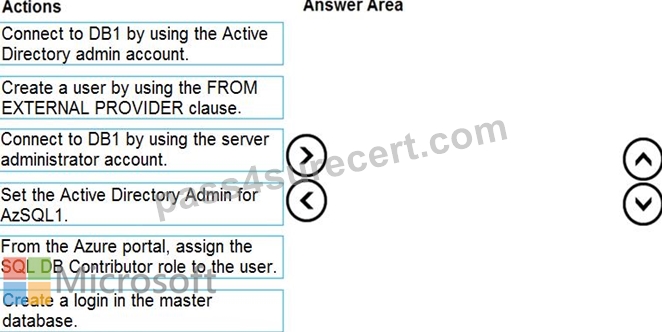
Answer:
Explanation: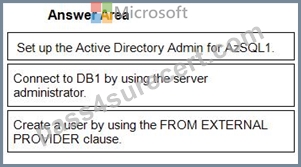
1 - Set up the Active Directory Admin for AzSQL1.
2 - Connect to DB1 by using the server administrator.
3 - Create a user by using the FROM EXTERNAL PROVIDER clause.
Reference:
https://docs.microsoft.com/en-us/sql/t-sql/statements/create-user-transact-sql
NEW QUESTION 112
You are designing a dimension table in an Azure Synapse Analytics dedicated SQL pool.
You need to create a surrogate key for the table. The solution must provide the fastest query performance.
What should you use for the surrogate key?
- A. a GUID column
- B. an IDENTITY column
- C. a sequence object
Answer: B
Explanation:
Dedicated SQL pool supports many, but not all, of the table features offered by other databases.
Surrogate keys are not supported. Implement it with an Identity column.
Reference:
https://docs.microsoft.com/en-us/azure/synapse-analytics/sql-data-warehouse/sql-data-warehouse-tablesoverview
NEW QUESTION 113
You have an on-premises Microsoft SQL Server 2019 instance that hosts a database named DB1.
You plan to perform an online migration of DB1 to an Azure SQL managed instance by using the Azure Database Migration Service.
You need to create a backup of DB1 that is accessible to the Azure Database Migration Service.
What should you run for the backup and where should you store the backup? To answer, select the appropriate options in the answer area.
NOTE: Each correct selection is worth one point.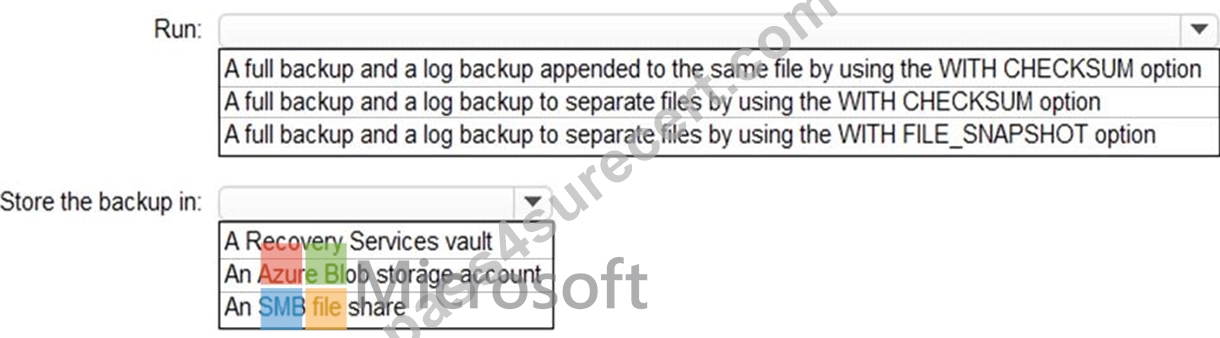
Answer:
Explanation: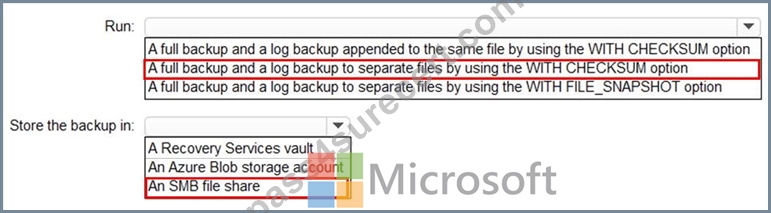
Reference:
https://docs.microsoft.com/en-us/azure/dms/tutorial-sql-server-managed-instance-online
NEW QUESTION 114
You plan to move two 100-GB databases to Azure.
You need to dynamically scale resources consumption based on workloads. The solution must minimize
downtime during scaling operations.
What should you use?
- A. two Azure SQL Databases in an elastic pool
- B. two databases hosted in SQL Server on an Azure virtual machine
- C. two single Azure SQL databases
- D. two databases in an Azure SQL Managed instance
Answer: A
Explanation:
Section: [none]
Explanation:
Azure SQL Database elastic pools are a simple, cost-effective solution for managing and scaling multiple
databases that have varying and unpredictable usage demands. The databases in an elastic pool are on a
single server and share a set number of resources at a set price.
Reference:
https://docs.microsoft.com/en-us/azure/azure-sql/database/elastic-pool-overview
NEW QUESTION 115
Your company uses Azure Stream Analytics to monitor devices.
The company plans to double the number of devices that are monitored.
You need to monitor a Stream Analytics job to ensure that there are enough processing resources to handle the additional load.
Which metric should you monitor?
- A. Early Input Events
- B. Late Input Events
- C. Input Deserialization Errors
- D. Watermark delay
Answer: D
Explanation:
Section: [none]
Explanation:
The Watermark delay metric is computed as the wall clock time of the processing node minus the largest watermark it has seen so far.
The watermark delay metric can rise due to:
1. Not enough processing resources in Stream Analytics to handle the volume of input events.
2. Not enough throughput within the input event brokers, so they are throttled.
3. Output sinks are not provisioned with enough capacity, so they are throttled.
Reference:
https://docs.microsoft.com/en-us/azure/stream-analytics/stream-analytics-time-handling
NEW QUESTION 116
You have SQL Server on an Azure virtual machine that contains a database named DB1. DB1 contains a table
named CustomerPII.
You need to record whenever users query the CustomerPII table.
Which two options should you enable? Each correct answer presents part of the solution.
NOTE: Each correct selection is worth one point.
- A. SQL Server audit
- B. a server principal
- C. database audit specification
- D. server audit specification
Answer: C,D
Explanation:
Section: [none]
Explanation:
An auditing policy can be defined for a specific database or as a default server policy in Azure (which hosts
SQL Database or Azure Synapse):
* A server policy applies to all existing and newly created databases on the server.
* If server auditing is enabled, it always applies to the database. The database will be audited, regardless of
the database auditing settings.
* Enabling auditing on the database, in addition to enabling it on the server, does not override or change any
of the settings of the server auditing. Both audits will exist side by side.
Note:
The Server Audit Specification object belongs to an audit.
A Database Audit Specification defines which Audit Action Groups will be audited for the specific database in
which the specification is created.
Reference:
https://docs.microsoft.com/en-us/azure/azure-sql/database/auditing-overview
NEW QUESTION 117
HOTSPOT
You are evaluating the role assignments.
For each of the following statements, select Yes if the statement is true. Otherwise, select No.
NOTE: Each correct selection is worth one point.
Hot Area: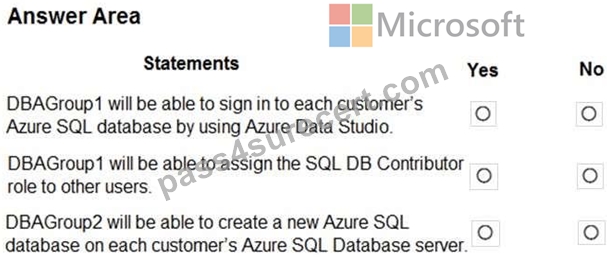
Answer:
Explanation: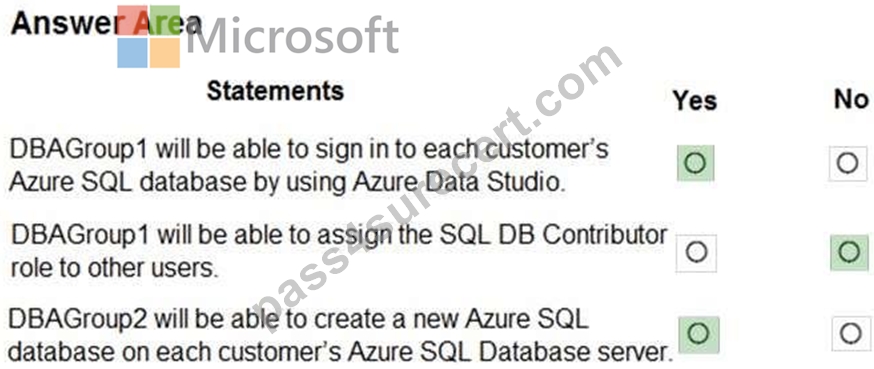
Section: [none]
Explanation:
Box 1: Yes
DBAGroup1 is member of the Contributor role.
The Contributor role grants full access to manage all resources, but does not allow you to assign roles in Azure
RBAC, manage assignments in Azure Blueprints, or share image galleries.
Box 2: No
Box 3: Yes
DBAGroup2 is member of the SQL DB Contributor role.
The SQL DB Contributor role lets you manage SQL databases, but not access to them. Also, you can't manage
their security-related policies or their parent SQL servers. As a member of this role you can create and manage
SQL databases.
Reference:
https://docs.microsoft.com/en-us/azure/role-based-access-control/built-in-roles
Question Set 3
NEW QUESTION 118
You have an Azure SQL database named db1 that contains an Azure Active Directory (Azure AD) user named user1.
You need to test impersonation of user1 in db1 by running a SELECT statement and returning to the original execution context.
How should you complete the Transact-SQL statement? To answer, select the appropriate options in the answer area.
NOTE: Each correct selection is worth one point.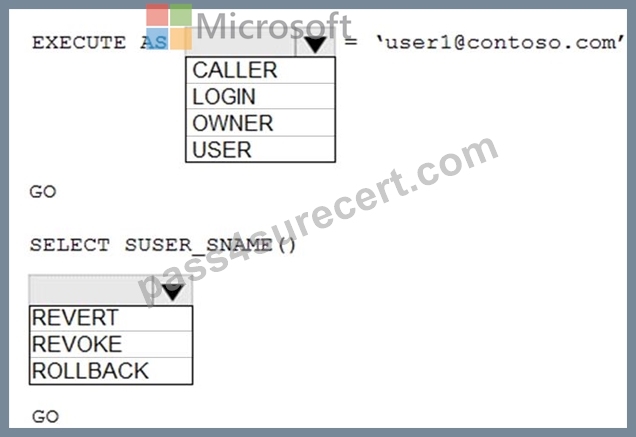
Answer:
Explanation: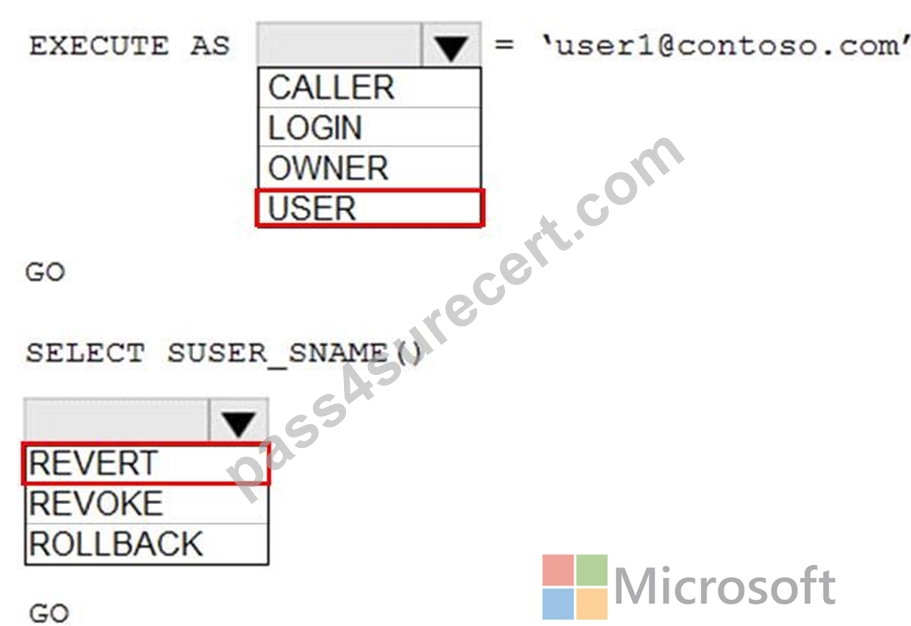
Reference:
https://docs.microsoft.com/en-us/sql/t-sql/statements/execute-as-transact-sql?view=sql-server-ver15
https://docs.microsoft.com/en-us/sql/t-sql/functions/suser-sname-transact-sql?view=sql-server-ver15
NEW QUESTION 119
......
Guaranteed Success in Microsoft Azure DP-300 Exam Dumps: https://www.pass4surecert.com/Microsoft/DP-300-practice-exam-dumps.html
DP-300 Practice Test Engine: Try These 208 Exam Questions: https://drive.google.com/open?id=1OC-sv_2w-uOmljAPUB2CGP6EI6FgDN4h