

[Mar-2026] Study resources for the Valid SC-300 Braindumps!
Updated SC-300 Tests Engine pdf - All Free Dumps Guaranteed!
Microsoft SC-300 exam is targeted at IT professionals and solution architects who have experience working with Microsoft 365 and Azure technologies. It is recommended that candidates have a solid understanding of core identity and access management concepts, as well as experience with Microsoft 365 and Azure AD administration. Candidates should also be familiar with security and compliance requirements and best practices.
Microsoft SC-300 certification is recognized globally and is highly valued by employers. Microsoft Identity and Access Administrator certification demonstrates that the holder has the skills and knowledge required to manage and secure identity and access solutions in Microsoft environments. It is also an excellent way to differentiate oneself from other professionals in the field and demonstrate expertise in a critical area of IT.
NEW QUESTION # 137
You have an Azure Active Directory (Azure AD) tenant that contains three users named User1, User1, and User3, You create a group named Group1. You add User2 and User3 to Group1.
You configure a role in Azure AD Privileged identity Management (PIM) as shown in the application administrator exhibit. (Click the application Administrator tab.)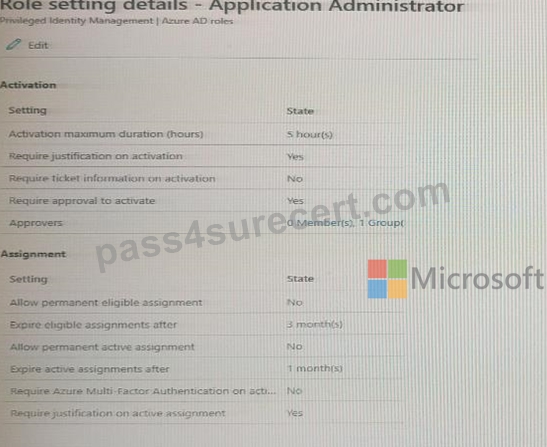
Group1 is configured as the approver for the application administrator role.
You configure User2to be eligible for the application administrator role.
For User1, you add an assignment to the Application administrator role as shown in the Assignment exhibit. (Click Assignment tab)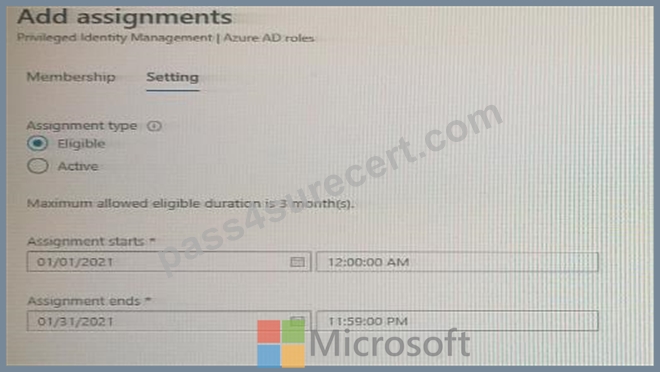
For each of the following statement, select Yes if the statement is true, Otherwise, select No.
NOTE: Each correct selection is worth one point.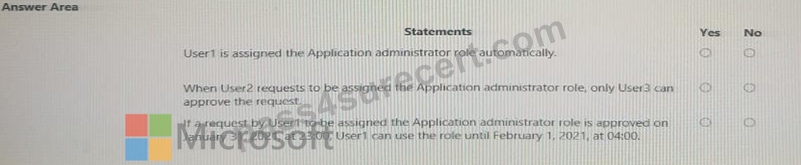
Answer:
Explanation: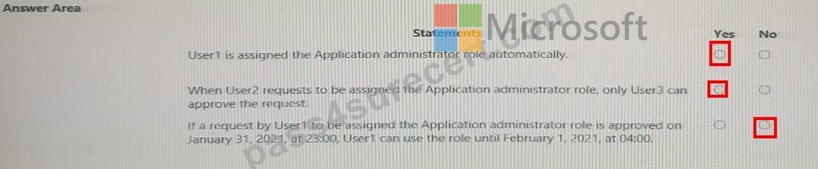
NEW QUESTION # 138
You have a custom cloud app named App1 that is registered in Azure Active Directory (Azure AD).
App1 is configured as shown in the following exhibit.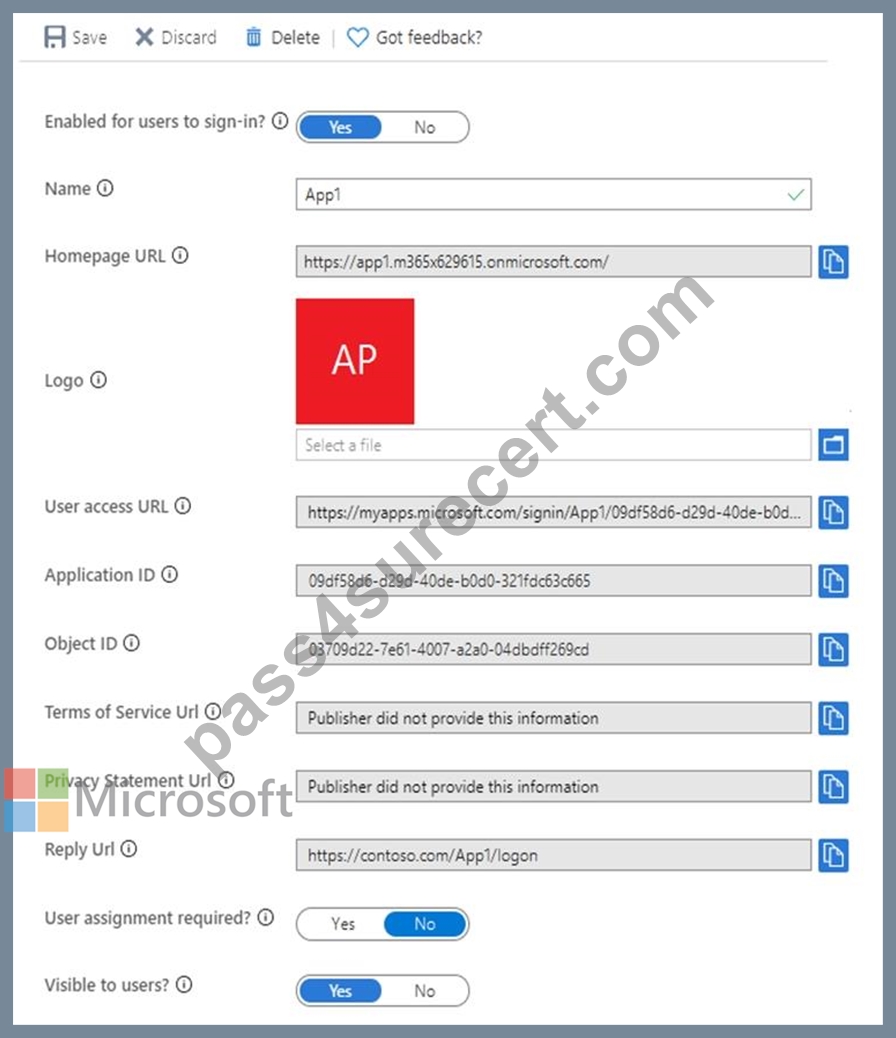
Use the drop-down menus to select the answer choice that completes each statement based on the information presented in the graphic.
NOTE: Each correct selection is worth one point.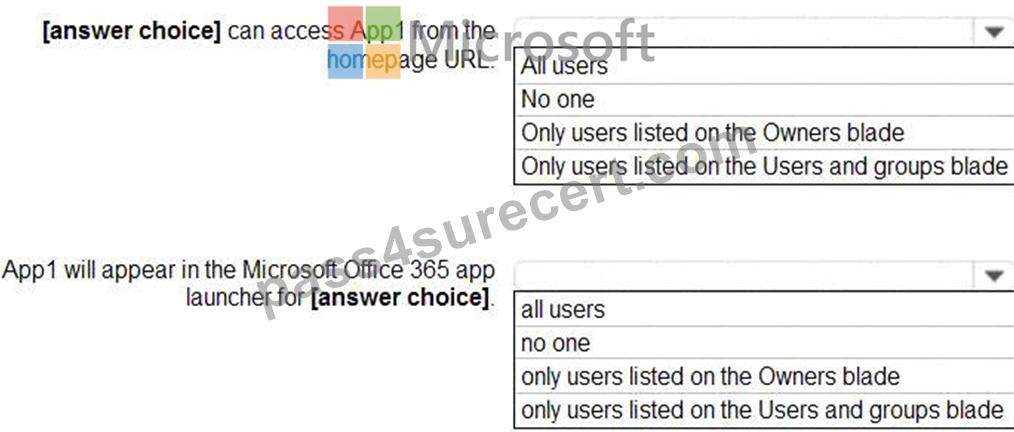
Answer:
Explanation: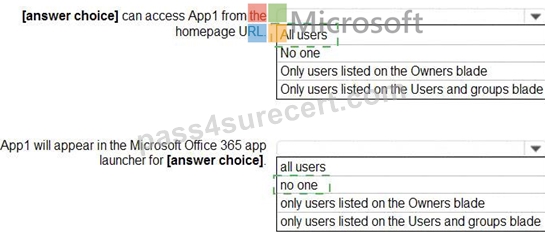
Explanation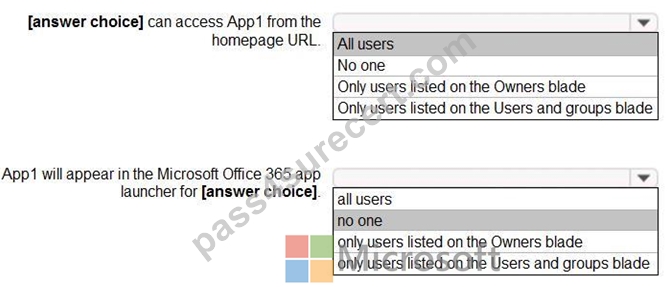
Reference:
https://docs.microsoft.com/en-us/azure/active-directory/manage-apps/assign-user-or-group-access-portal
NEW QUESTION # 139
You have an Azure subscription named Sub1 ilia1 contains a storage account named storage1. You need to deploy two apps named App1 and App2 that will have the following configurations:
* App1 will be deployed as a registered app in Sub1.
* App1 will access storage1 by using Microsoft Entra authentication.
* App2 will access storage1 by using a single Microsoft Entra identity.
* App2 be hosted on two new virtual machines named VM1 and VM2.
The solution must minimize administrative effort.
Which type of identity will each app use to access storage1? To answer, select the appropriate options in the answer area.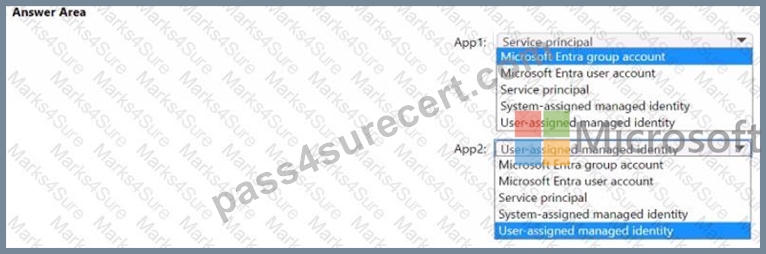
Answer:
Explanation: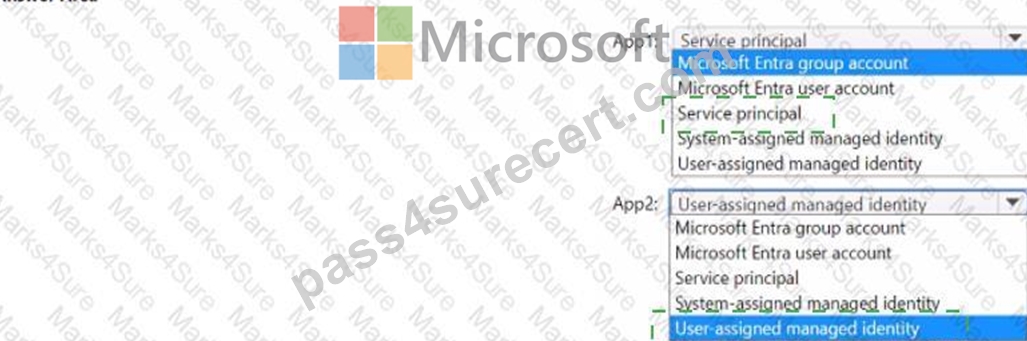
Explanation:
NEW QUESTION # 140
You have a Microsoft 365 tenant named contoso.com.
Guest user access is enabled.
Users are invited to collaborate with contoso.com as shown in the following table.
From the External collaboration settings in the Azure Active Directory admin center, you configure the Collaboration restrictions settings as shown in the following exhibit.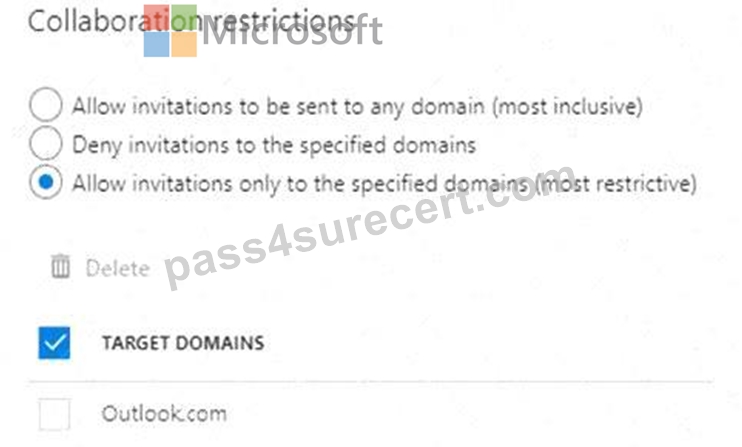
From a Microsoft SharePoint Online site, a user invites [email protected] to the site.
For each of the following statements, select Yes if the statement is true. Otherwise, select No.
NOTE:Each correct selection is worth one point.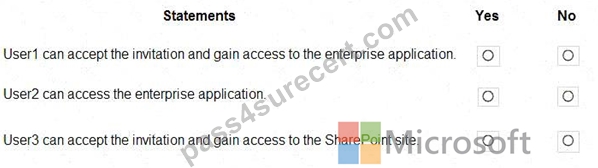
Answer:
Explanation: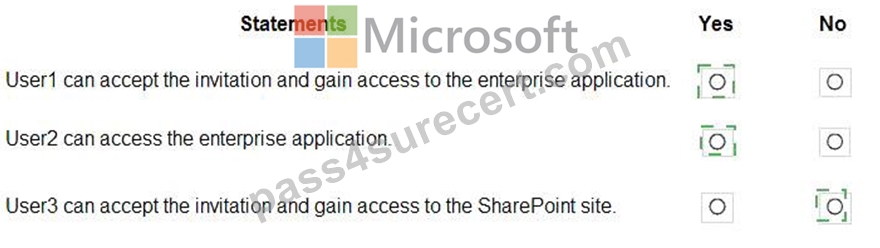
Explanation:
Box 1: Yes
Invitations can only be sent to outlook.com. Therefore, User1 can accept the invitation and access the application.
Box 2. Yes
Invitations can only be sent to outlook.com. However, User2 has already received and accepted an invitation so User2 can access the application.
Box 3. No
Invitations can only be sent to outlook.com. Therefore, User3 will not receive an invitation.
NEW QUESTION # 141
You have an Azure Active Directory (Azure AD) tenant named conto.so.com that has Azure AD Identity Protection enabled. You need to Implement a sign-in risk remediation policy without blocking access.
What should you do first?
- A. Configure access reviews in Azure AD.
- B. implement multi-factor authentication (MFA) for all users.
- C. Enforce Azure AD Password Protection.
- D. Configure self-service password reset (SSPR) for all users.
Answer: B
Explanation:
MFA and SSPR are both required. However, MFA is required first.
Reference:
https://docs.microsoft.com/en-us/azure/active-directory/identity-protection/howto-identity-protection-remediate-unblock
https://docs.microsoft.com/en-us/azure/active-directory/authentication/howto-sspr-deployment
NEW QUESTION # 142
You have a Microsoft 365 tenant.
The Azure Active Directory (Azure AD) tenant contains the groups shown in the following table.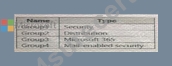
In Azure AD. you add a new enterprise application named Appl. Which groups can you assign to App1?
- A. Group1 only
- B. Group1 and Group2 only
- C. Group3 only
- D. Group2 only
- E. Group1 and Group4
Answer: C
NEW QUESTION # 143
You have an Azure Active Directory (Azure AD) tenant that has an Azure Active Directory Premium Plan 2 license. The tenant contains the users shown in the following table.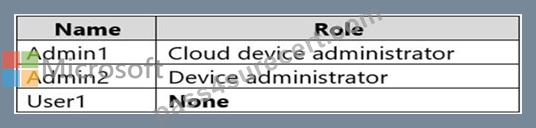
You have the Device Settings shown in the following exhibit.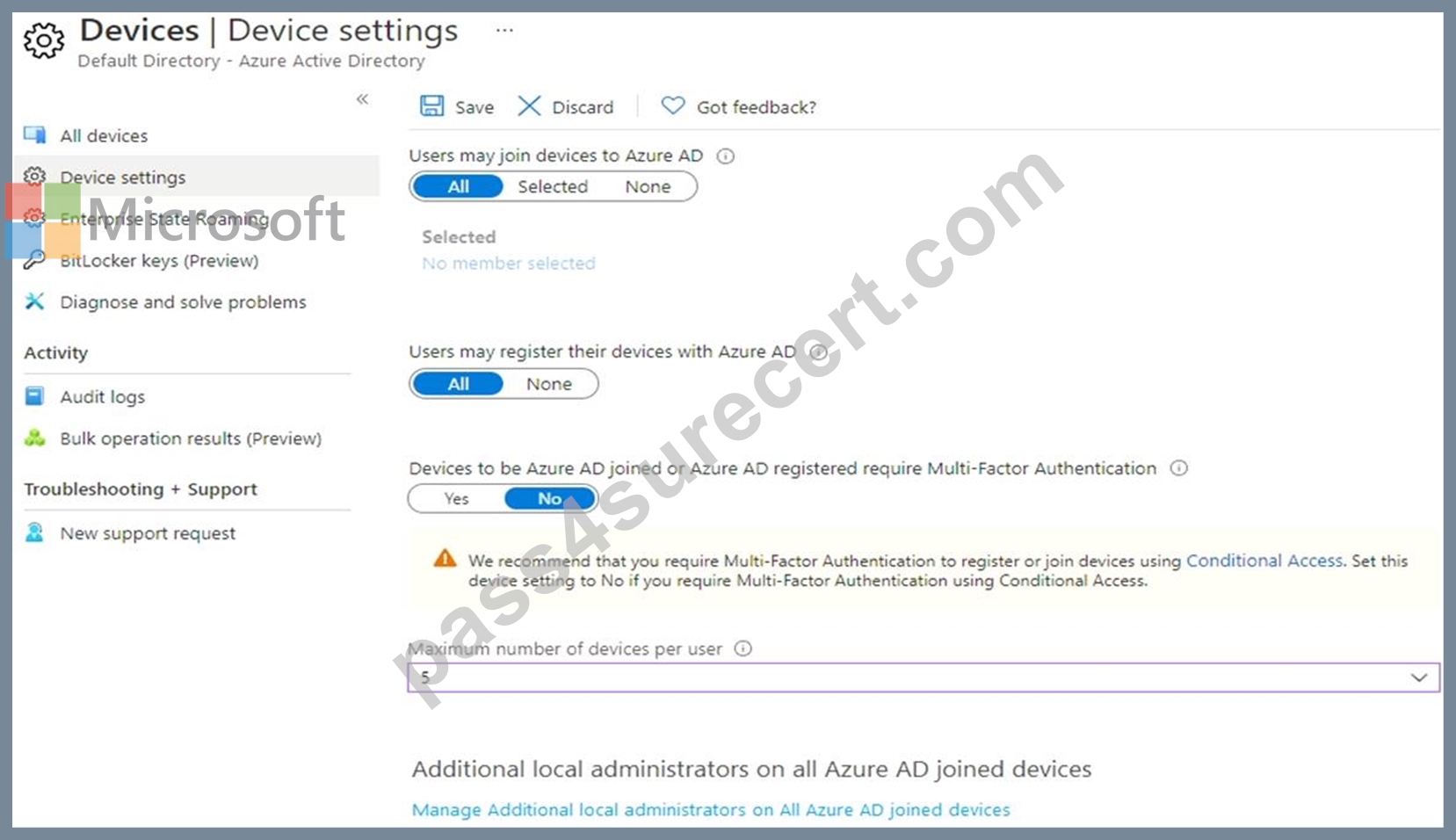
User1 has the devices shown in the following table.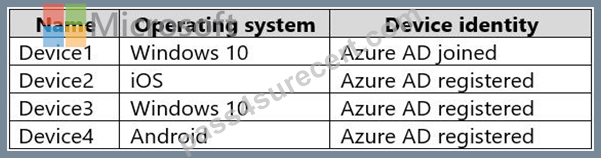
For each of the following statements, select Yes if the statement is true. Otherwise, select No.
NOTE: Each correct selection is worth one point.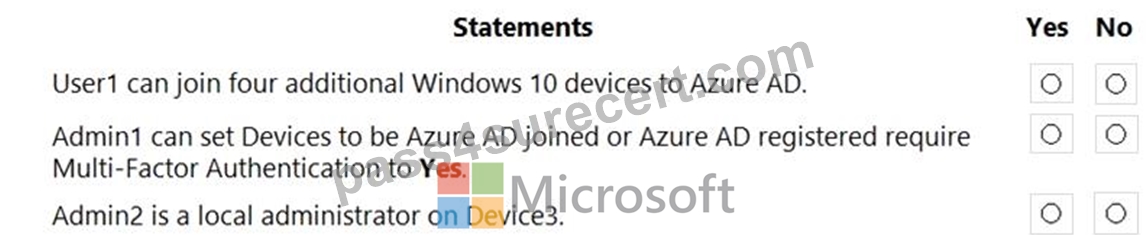
Answer:
Explanation: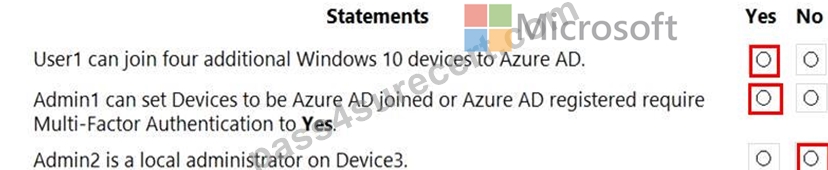
Reference:
https://docs.microsoft.com/en-us/azure/active-directory/devices/device-management-azure-portal
NEW QUESTION # 144
You have an Azure subscription that contains a user named User1. The subscription is onboarded to Microsoft Entra Permissions Management. You need to provide User! with access to Permissions Management. The solution must meet the following requirements:
* Follow the principle of least privilege.
* Minimize administrative effort.
What should you do first?
- A. From the Microsoft Entra admin center, assign a role to User1.
- B. From the Role/Policy Template subtab of Permissions Management, create a template.
- C. From the My Requests subtab of Permissions Management, create a new request.
- D. From the Microsoft Entra admin center, create a security group.
Answer: A
Explanation:
When onboarding to Microsoft Entra Permissions Management (a CIEM solution), before a user can perform any functions inside Permissions Management, that user must be granted an appropriate Permissions Management role in the Entra tenant. The principle of least privilege dictates that you grant only the minimal role necessary (for example, a Permissions Management Approver, Viewer, or Controller). The SC-300 study materials and Microsoft's documentation emphasize that administrative access must begin by assigning roles within Entra ID.
Creating a security group (option A) is a useful organizational practice but doesn't itself grant the user permissions inside Permissions Management.
Creating a role/policy template (option B) is about defining permission scopes and is not a first step to allow a user access.
Creating a request in My Requests (option D) presupposes that User1 already has some entitlement to make requests (i.e. some role), which they don't yet.
Therefore, the first action is to assign a Permissions Management role to User1 from the Entra admin center, thus giving them appropriate access while adhering to least privilege.
NEW QUESTION # 145
You need to create the LWGroup1 group to meet the management requirements.
How should you complete the dynamic membership rule? To answer, drag the appropriate values to the correct targets. Each value may be used once, more than once, or not at all. You many need to drag the split bar between panes or scroll to view content.
NOTE: Each correct selection is worth one point.
Answer:
Explanation:
NEW QUESTION # 146
You have an Azure AD tenant that contains a user named Admin1.
Admin1 uses the Require password change for high-risk user's policy template to create a new Conditional Access policy.
Who is included and excluded by default in the policy assignment? To answer, drag the appropriate options to the correct target. Each option may be used once, more than once, or not at all. You may need to drag the split bar between panes or scroll to view content.
NOTE: Each correct selection is worth one point.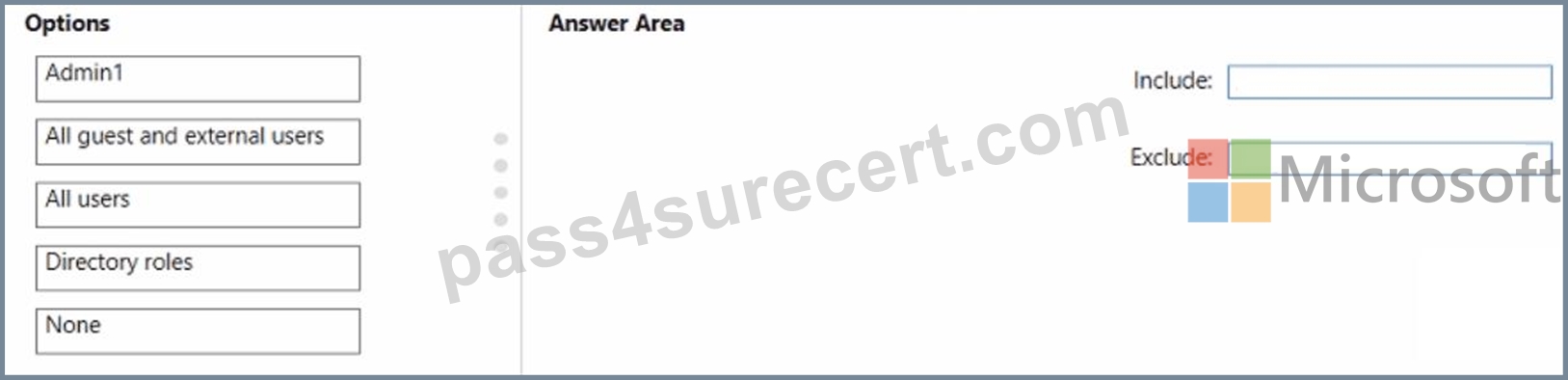
Answer:
Explanation: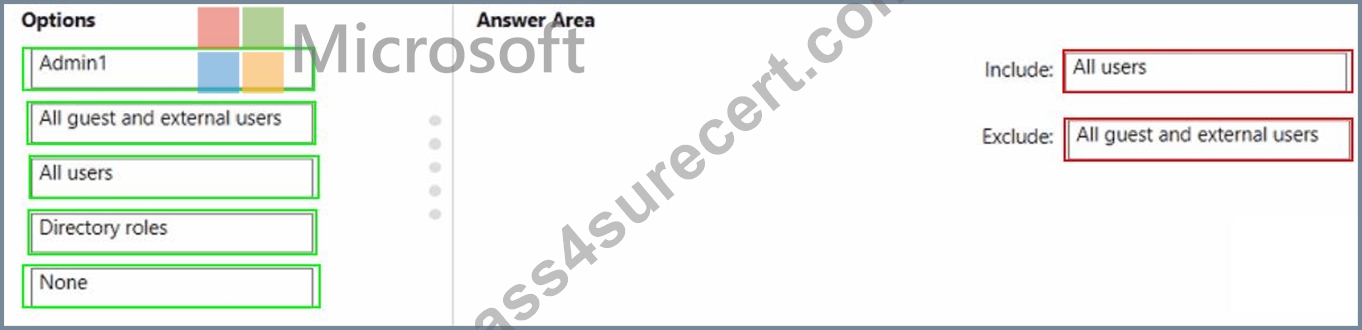
NEW QUESTION # 147
You have a Microsoft 365 E5 subscription.
Users authorize third-party cloud apps to access their data.
You need to configure an alert that will be triggered when an app requires high permissions and is authorized by more than 20 users.
Which type of policy should you create in the Microsoft Defender for Cloud Apps portal?
- A. OAuth app policy
- B. activity policy
- C. anomaly detection policy
- D. access policy
Answer: B
NEW QUESTION # 148
You have an Azure subscription that contains the following virtual machine Name: VM1 Azure region: East US System-assigned managed identity: Disabled You create the managed identities shown in the following table.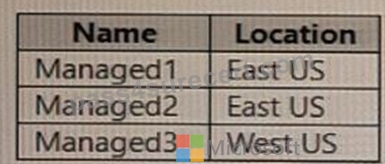
You perform the following actions:
* Assign Managed1 to VM1.
* Create a resource group named RG1 in the West US region.
For each of the following statements, select Yes if the statement is true. Otherwise, select No.
NOTE: Each correct selection is worth one point.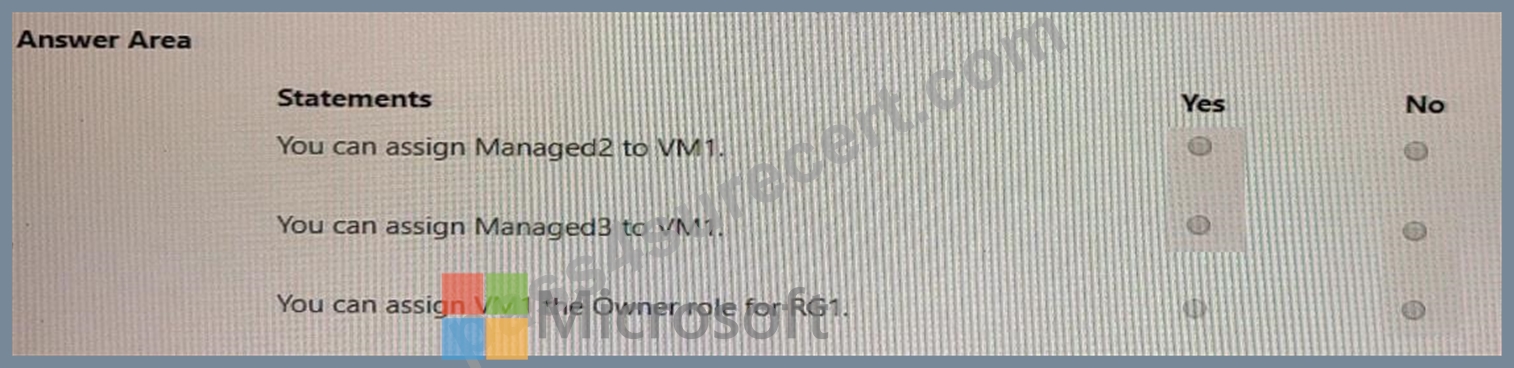
Answer:
Explanation: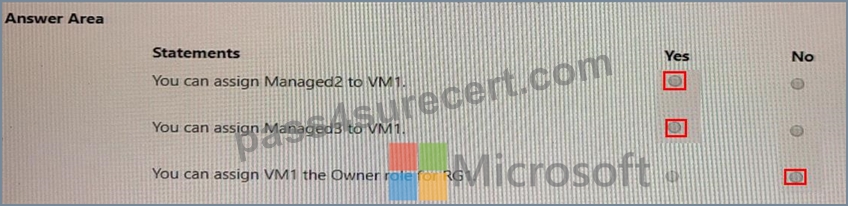
NEW QUESTION # 149
You need to configure the assignment of Azure AD licenses to the Litware users. The solution must meet the licensing requirements.
What should you do? To answer, select the appropriate options in the answer area.
NOTE: Each correct selection is worth one point.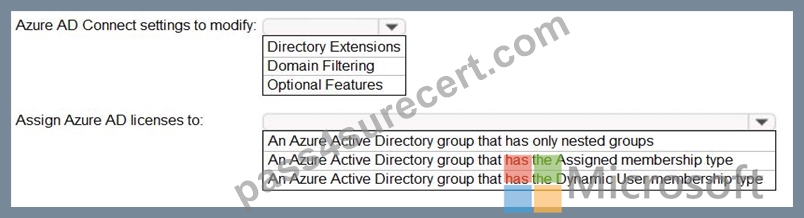
Answer:
Explanation: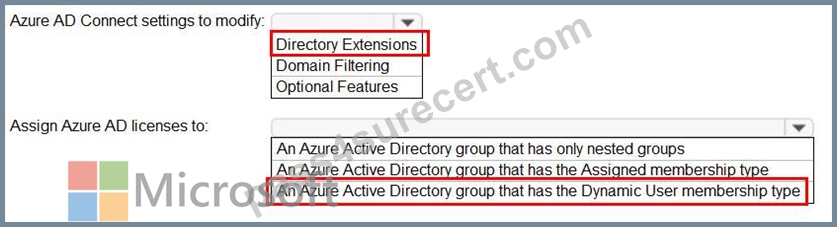
NEW QUESTION # 150
Hotspot Question
You have a Microsoft 365 E5 subscription.
You need to configure app consent for the subscription. The solution must meet the following requirements:
- Disable user consent to apps.
- Configure admin consent workflow for apps.
Which portal should you use for each requirement? To answer, select the appropriate options in the answer area.
NOTE: Each correct selection is worth one point.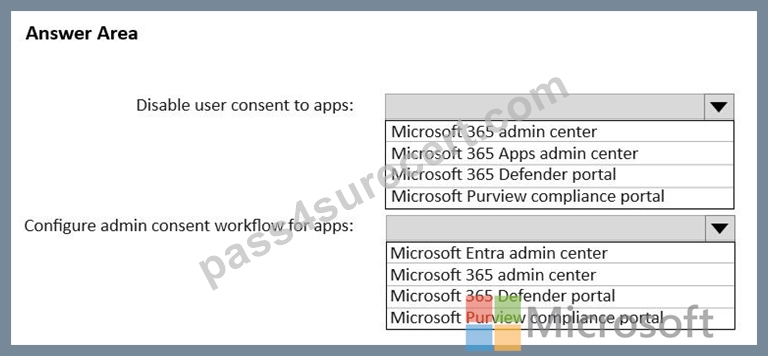
Answer:
Explanation: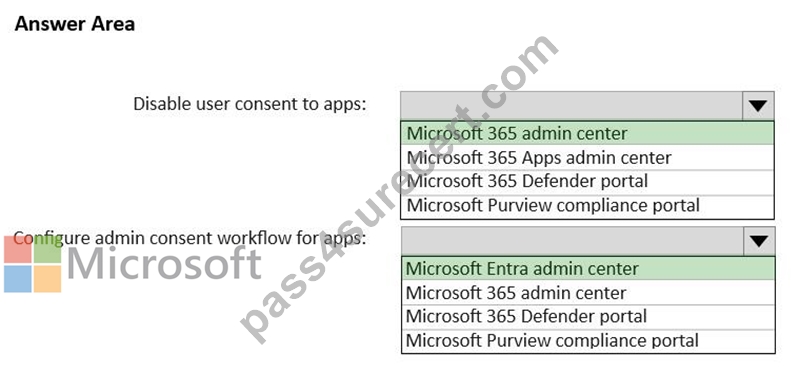
NEW QUESTION # 151
You have an Azure Active Directory (Azure AD) tenant that has Security defaults disabled.
You are creating a conditional access policy as shown in the following exhibit.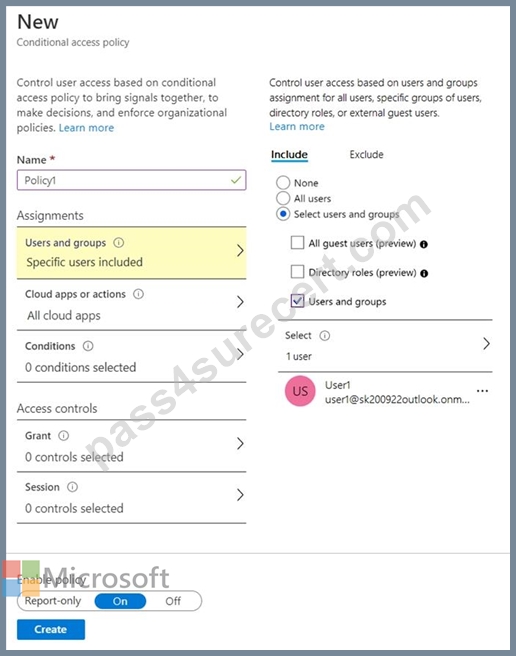
Use the drop-down menus to select the answer choice that completes each statement based on the information presented in the graphic.
NOTE: Each correct selection is worth one point.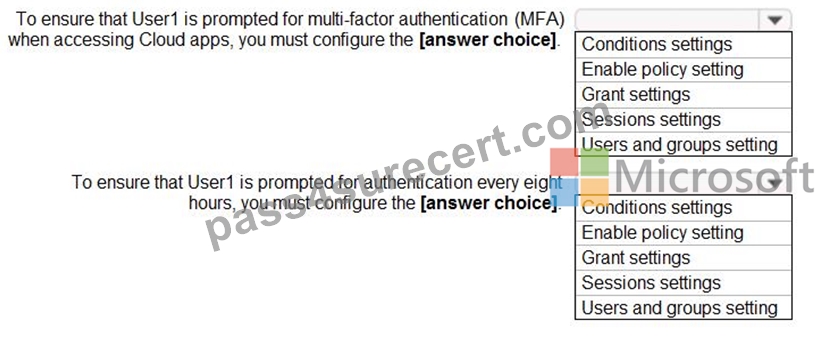
Answer:
Explanation: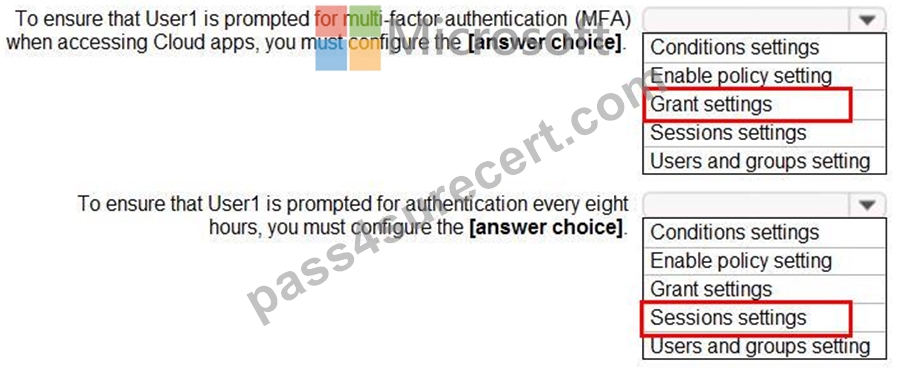
Reference:
https://docs.microsoft.com/en-us/azure/active-directory/conditional-access/howto-conditional-access-policy-all-users-mfa
NEW QUESTION # 152
You have a Microsoft Entra tenant that contains the groups shown in the following table.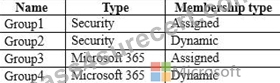
You need to implement Privileged Identity Management (PIM) for the groups.
Which groups can be managed by using PIM?
- A. Group1 and Group3 only
- B. Group1 only
- C. Group3 and Group4 only
- D. Group1 and Group2 only
- E. Group1, Group2, Group3, and Group4
Answer: A
Explanation:
Groups in Microsoft Entra ID can be classified as either role-assignable or non-role-assignable.
Additionally, any group can be enabled or not enabled for use with Microsoft Entra Privileged Identity Management (PIM) for Groups. These are independent properties of the group. Any Microsoft Entra security group and any Microsoft 365 group (except dynamic groups and groups synchronized from on-premises environment) can be enabled in PIM for Groups. The group doesn't have to be role-assignable group to be enabled in PIM for Groups.
https://learn.microsoft.com/en-us/entra/id-governance/privileged-identity-management/concept- pim-for-groups
NEW QUESTION # 153
You have a Microsoft Entra tenant that contains a terms of use (ToU) named Terms1. You create a Conditional Access policy named Policy1 to deploy Terms1. You need to configure Policy1 to require users to accept Terms1. Which settings should you configure for Policy1?
- A. Conditions
- B. Grant
- C. Target resources
- D. Session
Answer: A
NEW QUESTION # 154
You have a Microsoft 36S tenant.
You create a named location named HighRiskCountries that contains a list of high-risk countries.
You need to limit the amount of time a user can stay authenticated when connecting from a high-risk country.
What should you configure in a conditional access policy? To answer, select the appropriate options in the answer area.
NOTE: Each correct selection is worth one point.
Answer:
Explanation:
Explanation: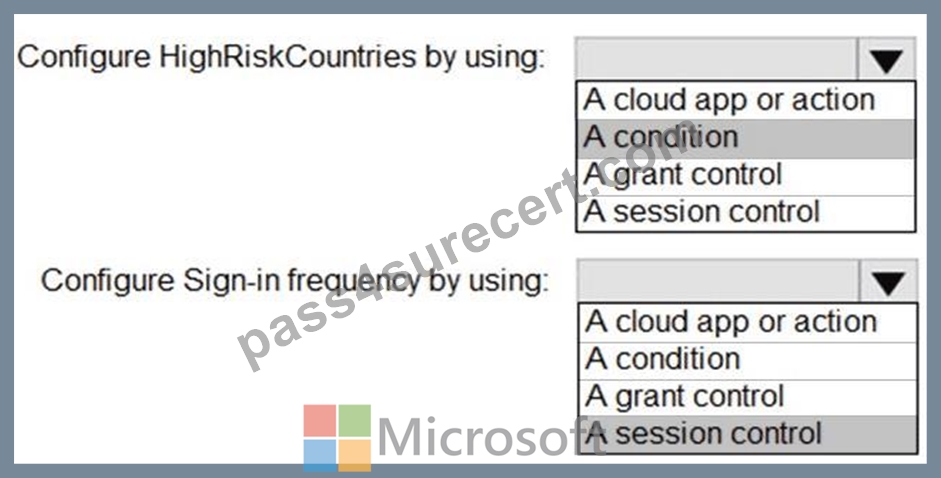
Reference:
https://docs.microsoft.com/en-us/azure/active-directory/conditional-access/location-condition
https://docs.microsoft.com/en-us/azure/active-directory/conditional-access/concept-conditional-access-session
NEW QUESTION # 155
Note: This question is part of a series of questions that present the same scenario. Each question in the series contains a unique solution that might meet the stated goals. Some question sets might have more than one correct solution, while others might not have a correct solution.
After you answer a question in this section, you will NOT be able to return to it. As a result, these questions will not appear in the review screen.
You have a Microsoft 365 tenant.
You have 100 IT administrators who are organized into 10 departments.
You create the access review shown in the exhibit. (Click the Exhibit tab.)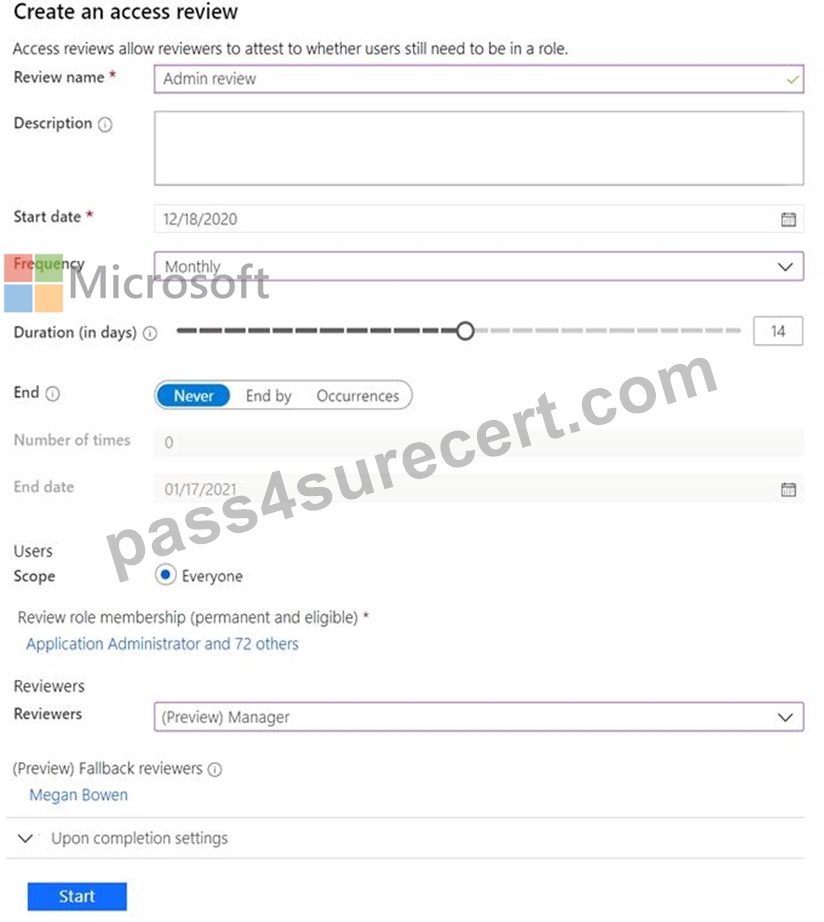
You discover that all access review requests are received by Megan Bowen.
You need to ensure that the manager of each department receives the access reviews of their respective department.
Solution: You create a separate access review for each role.
Does this meet the goal?
- A. Yes
- B. No
Answer: B
Explanation:
D18912E1457D5D1DDCBD40AB3BF70D5D
Reference:
https://docs.microsoft.com/en-us/azure/active-directory/governance/create-access-review
NEW QUESTION # 156
You have an Azure Active Directory (Azure AD) tenant that contains three users named User1, User1, and User3, You create a group named Group1. You add User2 and User3 to Group1.
You configure a role in Azure AD Privileged identity Management (PIM) as shown in the application administrator exhibit. (Click the application Administrator tab.)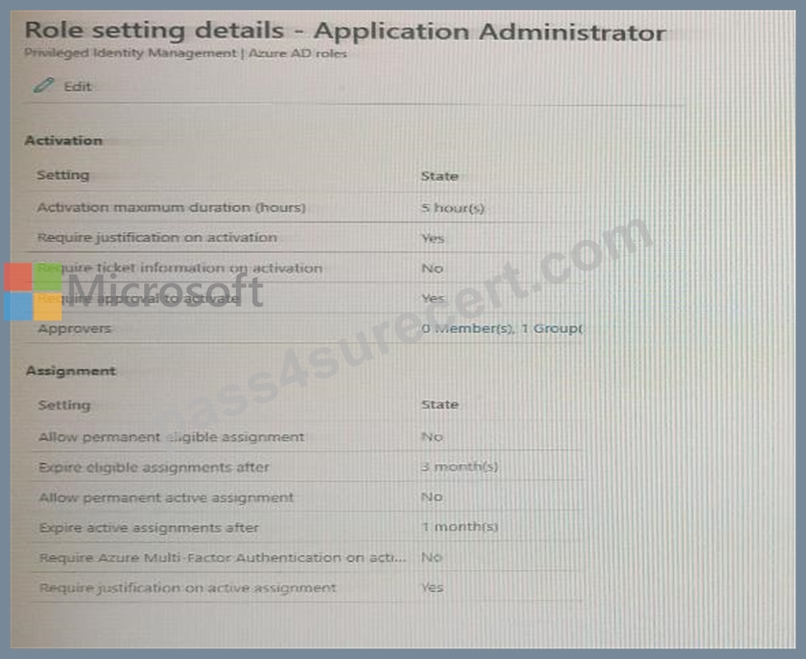
Group1 is configured as the approver for the application administrator role.
You configure User2to be eligible for the application administrator role.
For User1, you add an assignment to the Application administrator role as shown in the Assignment exhibit.
(Click Assignment tab)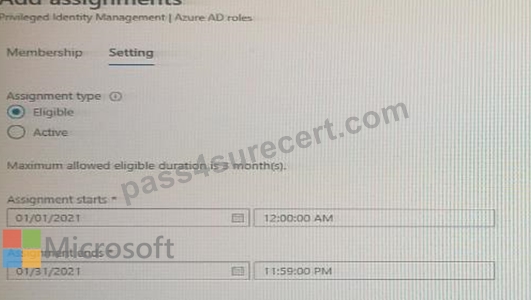
For each of the following statement, select Yes if the statement is true, Otherwise, select No.
NOTE: Each correct selection is worth one point.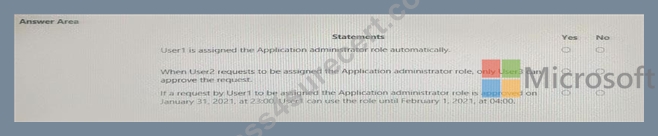
Answer:
Explanation: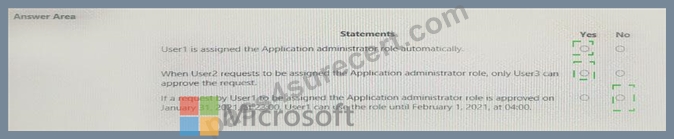
NEW QUESTION # 157
You have a Microsoft 365 E5 subscription.
You need to ensure that users can only access resources in the subscription from a device that has the Global Secure Access client connected.
What should you do first?
- A. Enable tagging to enforce tenant restrictions.
- B. Create a named location.
- C. Create a remote network.
- D. Enable Global Secure Access signaling.
Answer: C
NEW QUESTION # 158
You have an Azure Active Directory (Azure AD) tenant that has the default App registrations settings. The tenant contains the users shown in the following table.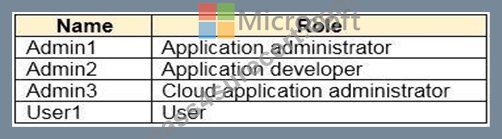
You purchase two cloud apps named App1 and App2. The global administrator registers App1 in Azure AD.
You need to identify who can assign users to App1, and who can register App2 in Azure AD.
What should you identify? To answer, select the appropriate options in the answer area.
NOTE:Each correct selection is worth one point.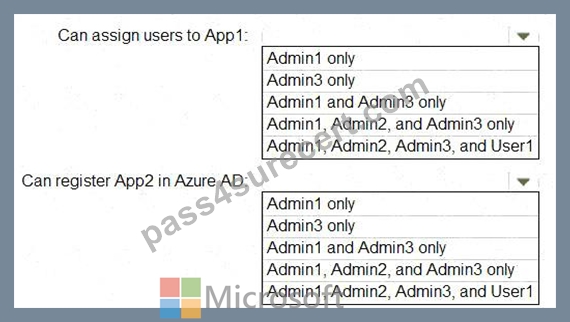
Answer:
Explanation: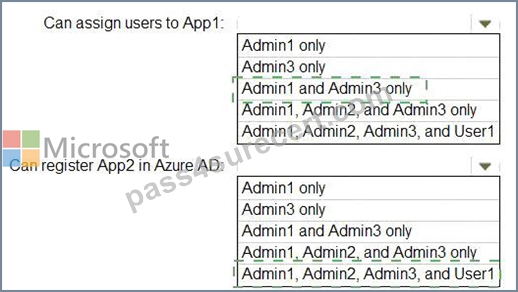
Explanation: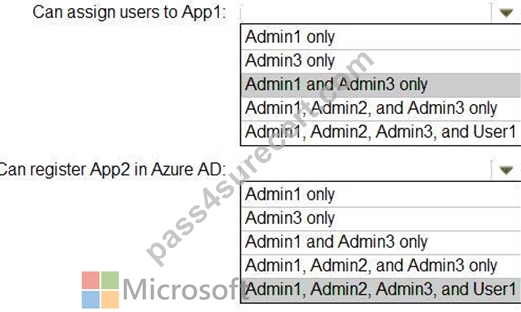
Reference:
https://docs.microsoft.com/en-us/azure/active-directory/manage-apps/add-application-portal-assign-users
https://docs.microsoft.com/en-us/azure/active-directory/develop/active-directory-how-applications-are-added
NEW QUESTION # 159
You have an Azure Active Directory (Azure AD) tenant named contoso.com.
You plan to bulk invite Azure AD business-to-business (B2B) collaboration users.
Which two parameters must you include when you create the bulk invite? Each correct answer presents part of the solution NOTE: Each correct selection is worth one point.
- A. redirection URL
- B. email address
- C. password
- D. shared key
- E. username
Answer: A,B
Explanation:
Explanation/Reference:
https://docs.microsoft.com/en-us/azure/active-directory/external-identities/tutorial-bulk-invite
NEW QUESTION # 160
You need to resolve the recent security incident issues.
What should you configure for each incident? To answer, drag the appropriate policy types to the correct issues. Each policy type may be used once, more than once, or not at all. You may need to drag the split bar between panes or scroll to view content.
NOTE: Each correct selection is worth one point.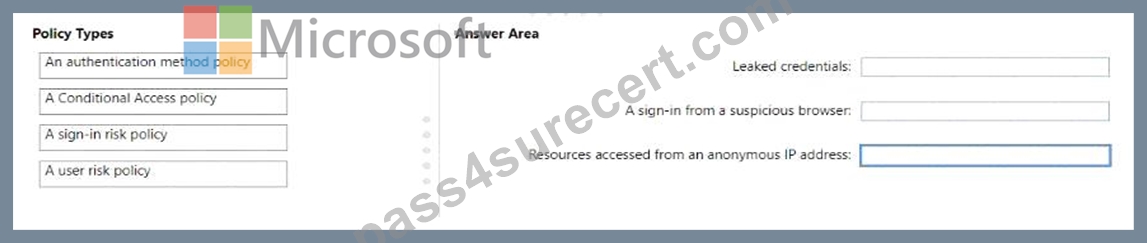
Answer:
Explanation: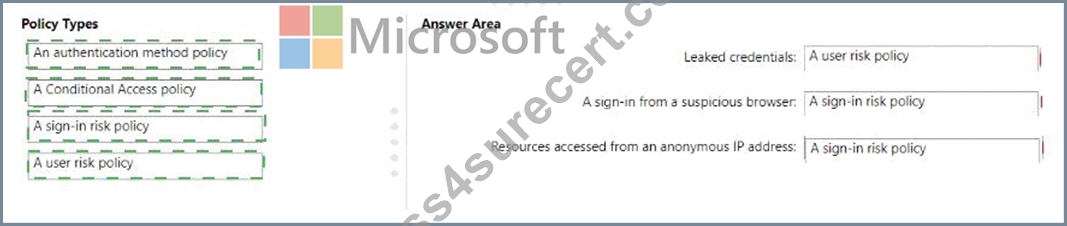
Explanation: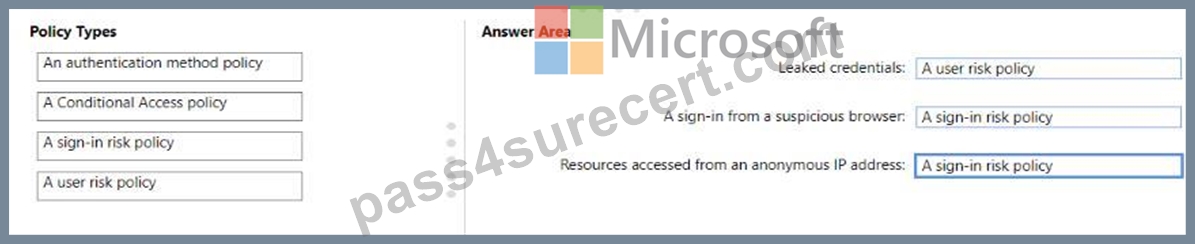
NEW QUESTION # 161
......
SC-300 Dumps Updated Practice Test and 346 unique questions: https://www.pass4surecert.com/Microsoft/SC-300-practice-exam-dumps.html
Latest Microsoft Certified: Identity and Access Administrator Associate SC-300 Actual Free Exam Questions: https://drive.google.com/open?id=1QpesoholKyhctZjT9PHlO2JN9gowfZHb