

Get 100% Success with Latest FCSS in Security Operations FCSS_ADA_AR-6.7 Exam Dumps Nov 15, 2025
The Best FCSS_ADA_AR-6.7 Exam Study Material and Preparation Test Question Dumps
Fortinet FCSS_ADA_AR-6.7 Exam Syllabus Topics:
| Topic | Details |
|---|---|
| Topic 1 |
|
| Topic 2 |
|
| Topic 3 |
|
| Topic 4 |
|
NEW QUESTION # 25
Why can collectors not be defined before the worker upload address is set on the supervisor?
- A. Collectors can only upload data to a worker, and the supervisor is not a worker
- B. Collectors receive the worker upload address during the registration process
- C. To ensure that the service provider has deployed a NFS server
- D. To ensure that the service provider has deployed at least one worker along with a supervisor
Answer: B
NEW QUESTION # 26
Which three statements about collector communication with the FortiSIEM cluster are true? (Choose three.)
- A. Collectors communicate periodically with the supervisor node.
- B. The supervisor periodically checks the health of the collector.
- C. The supervisor does not initiate any connections to the collector node.
- D. Collector upload event data to any node in the worker upload list, but report their health directly to the supervisor node.
- E. The only communication between the collector and the supervisor is during the registration process.
Answer: A,B,D
Explanation:
FortiSIEMcollectorsare responsible forgathering logsfrom devices andforwarding themto the FortiSIEM cluster. Their communication with the cluster follows these key principles:
#Collectors periodically communicate with the supervisor node.
# This allows them toreport status, receive updates, and verify configurations.
#The supervisor periodically checks the health of the collector.
# Thesupervisor monitors the collector's uptime, connectivity, and performance.
#Collectors upload event data to worker nodes but report health to the supervisor.
#Event logs are uploaded to worker nodesas per theworker upload list, ensuring distributed event processing.
#Health status is always reported directly to the supervisorfor centralized monitoring.
NEW QUESTION # 27
When constructing FortiSIEM baseline rules, what would be an effective approach?
- A. Relying solely on machine learning without human input?
- B. Including as many rules as possible for diversity?
- C. Designing rules based on observed and expected network behaviors?
- D. Copying rules from other organizations for best practices?
Answer: C
NEW QUESTION # 28
Which of the following are valid remediation actions in FortiSIEM?
- A. Running a pre-defined script to address an issue?
- B. Sending an email notification to network users?
- C. Isolating a compromised machine from the network?
- D. Increasing the storage capacity of the server?
Answer: A,C
NEW QUESTION # 29
A service provider purchases a licensed EPS of 520. The guaranteed EPS allocated to three customers is 50,
100, and 150 respectively. At the end of every three-minute interval, incoming EPS is calculated at every collector and the value is sent to the central decision-making engine on the supervisor node.
The incoming EPS for the first collector is 25. the incoming EPS for the second collector is 50, and the incoming EPS for the third collector is 75.
Based on the information provided, what is the unused events total calculated by the supervisor?
- A. 75.960
- B. 71.460
- C. 35.960
- D. 76.000
Answer: B
Explanation:
Guaranteed Allocation:50 + 100 + 150 = 300 EPS
Actual (Incoming) Usage:25 + 50 + 75 = 150 EPS# Unused from guarantees = 300 # 150 = 150 EPS Burst Capacity (Licensed minus Guaranteed):520 # 300 = 220 EPS Total Unused Capacity:150 + 220 = 370 EPS As a Percentage of Licensed EPS:370/520 # 71.15% # reported (after conversion/rounding) as ~71.460
NEW QUESTION # 30
Refer to the exhibit.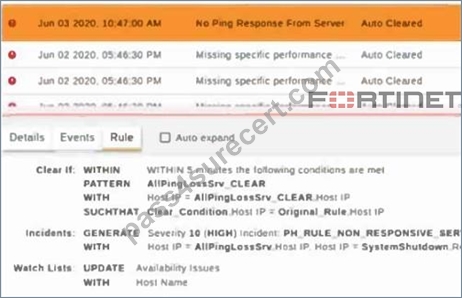
Why was this incident auto cleared?
- A. Within five minutes, the packet loss percentage dropped to a level where the host IP of the original rule matches the host IP of the clear condition pattern
- B. Within five minutes the packet loss percentage dropped to a level where the reporting IP is the same as the host IP
- C. Within five minutes, the packet loss percentage dropped to a level where the reporting IP is same as the source IP
- D. The original rule did not trigger within five minutes
Answer: A
Explanation:
From the "Clear If" condition in the exhibit:
*WITHIN 5 minutes, the system checks if the pattern AllPingLossSrv_CLEAR occurs.
*The Host IP of the clear condition must match the Host IP of the original rule (Clear_Condition.Host IP = Original_Rule.Host IP).
*If this condition is met, the system automatically clears the incident because it indicates that network connectivity has been restored (packet loss has dropped).
Thus, the incident was auto-cleared because the system detected that the issue was resolved within the defined 5-minute window, meeting the conditions for auto-clearance.
NEW QUESTION # 31
A service provider purchased a 500-EPS license and configured a new collector with 100 EPS for customer A, and another collector with 200 EPS for customer B.
How much is in the remaining EPS pool for future customers and for MSSP itself?
- A. 0
- B. 1
- C. 2
- D. 3
Answer: C
Explanation:
Total EPS License Purchased: 500 EPS
Allocated EPS:
*Customer A: 100 EPS
*Customer B: 200 EPS
Remaining EPS Pool:
500 − (100 + 200) = 200 EPS
NEW QUESTION # 32
Refer to the exhibit.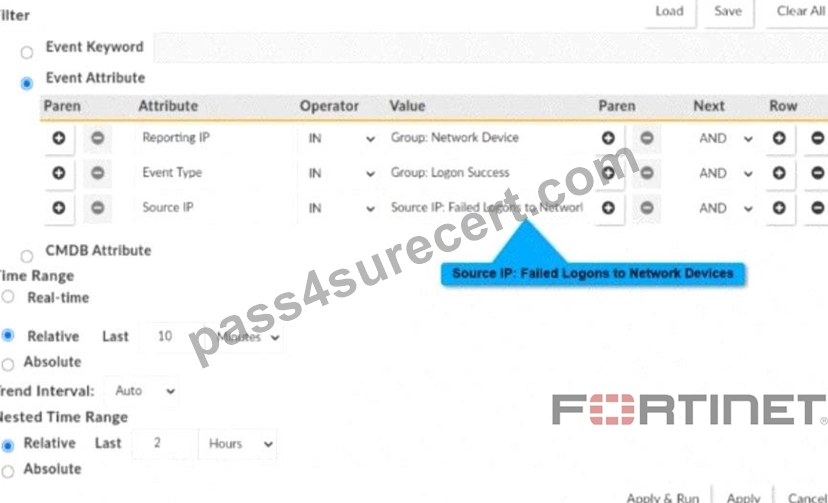
Consider a nested event query where both inner and outer queries are event queries.
Reporting IPis selected from the CMDB groupNetwork Device, Event Typeis selected from the CMDB groupLogon Success,andSource IPis selected from the reportFailed Logons to Network Devices.
An administrator is about to execute the nested query. The report time ranges must be set before execution.
TheNested Time Rangewill be applied to which attributes?
- A. The nested time range will be configured for the Source IP attribute.
- B. The nested time range will be configured for the Event Type attribute.
- C. The nested time range will be configured for the Reporting IP and Event Type attributes.
- D. The nested time range will be configured for the Reporting IP attribute.
Answer: A
Explanation:
In a nested event query, the inner query executes first, and its results feed into the outer query. Since the Source IP comes from the report "Failed Logons to Network Devices", which is part of the inner query, the nested time range applies to it. The other attributes, Reporting IP and Event Type, belong to the outer query and are not affected by the nested time range.
NEW QUESTION # 33
Refer to the exhibit.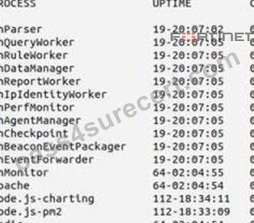
Which device would run the processes shown in the exhibit?
- A. Worker
- B. Collector
- C. Linux Agent
- D. Supervisor
Answer: A
NEW QUESTION # 34
Refer to the exhibit.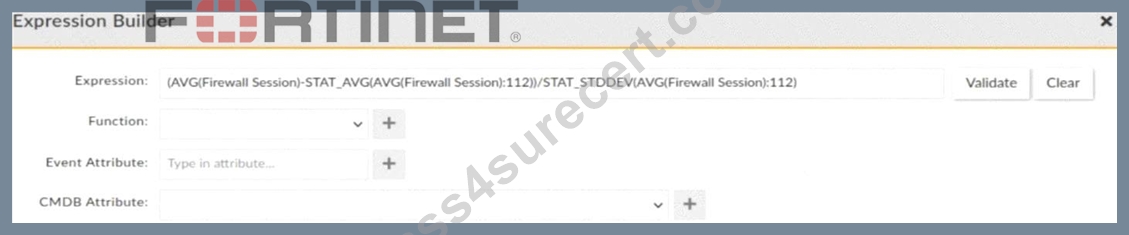
If the Z-score for this rule is greater than or equal to three, what does this mean?
- A. The rate of firewall connection is optimum.
- B. The rate of firewall connection is above the current average value.
- C. The rate firewall connection is above the historical average value.
- D. The rate of firewall connection is below historical average value.
Answer: C
Explanation:
The Z-score formula in the expression builder calculates how many standard deviations the current value is from the historical average. The formula used is:
AVG(Firewall Session)represents the current firewall session rate.
STAT_AVG(AVG(Firewall Session);112)represents the historical average over a 112-time unit window.
STAT_STDDEV(AVG(Firewall Session);112)represents the historical standard deviation over the same period.
AZ-score # 3indicates that the current firewall session rate issignificantly higherthan the historical average (3 standard deviations above the mean), signaling ananomaly.
NEW QUESTION # 35
Refer to the exhibit.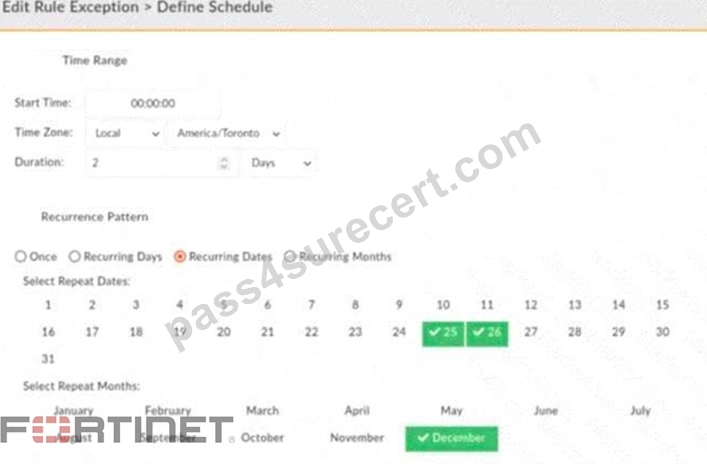
An administrator applies the rule exception shown in the exhibit.
How does this configuration impact the incident generation for that rule?
- A. Events will not be processed by the rule during the specified period.
- B. Incidents will not be generated during the specified period.
- C. Incidents will be generated without triggering an email alert during the specified period.
- D. Incidents will be generated only during the specified period.
Answer: B
Explanation:
From the exhibit, the rule exception is set for:
# Time Range: Starts at 00:00:00
# Duration: 2 days
# Recurrence Pattern: December 25th and December 26th
This means that during these two days (every year in December), the rule will not trigger incidents.
Rule exceptions temporarily suppress incident generation during the specified period.
Events are still processed, but no incidents are generated.
NEW QUESTION # 36
Refer to the exhibit.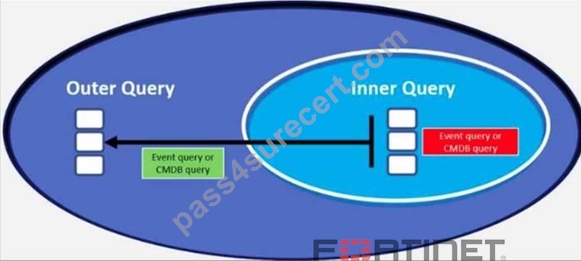
Which scenario is not a supported nested query scenario?
- A. The outer query is the event query, and the inner query is the event query.
- B. The outer query is the CMDB query, and the inner query is the CMDB query.
- C. The outer query is the event query, and the inner query is the CMDB query.
- D. The outer query is the CMDB query, and the inner query is the event query.
Answer: B
Explanation:
FortiSIEM does not allow CMDB queries to be nested within other CMDB queries. CMDB data is static information, and nesting would not add value or function properly in query execution.
NEW QUESTION # 37
Refer to the exhibit.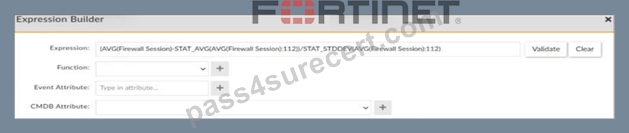
If the Z-score for this rule is greater than or equal to three, what does this mean?
- A. The rate of firewall connection is optimum.
- B. The rate of firewall connection is above the current average value.
- C. The rate of firewall connection is above the historical average value.
- D. The rate of firewall connection is below historical average value.
Answer: C
NEW QUESTION # 38
When automating remediation in FortiSIEM, what should be carefully considered?
- A. The aesthetic layout of the FortiSIEM dashboard?
- B. The potential impact of the automated action on business operations?
- C. The frequency of software updates?
- D. The number of users currently logged in?
Answer: B
NEW QUESTION # 39
Why are FortiSIEM baseline and profile reports crucial?
- A. They provide aesthetic visuals for presentations?
- B. They dictate user access policies within the system?
- C. They offer insights into standard and anomalous behaviors within the network?
- D. They allow for automated software updates?
Answer: C
NEW QUESTION # 40
Refer to the exhibit.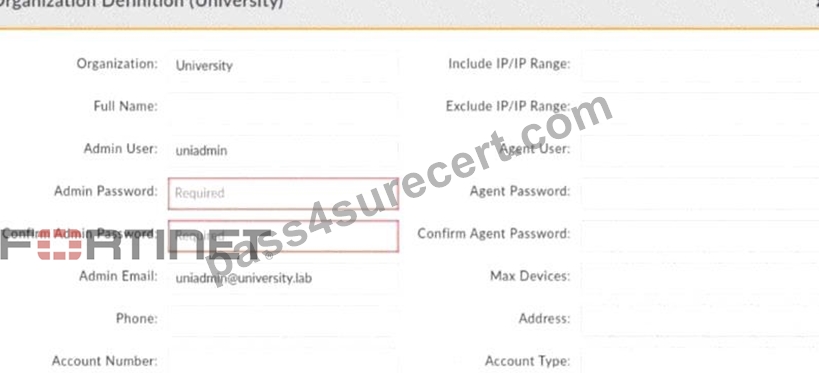
Which three fields from the organization destination are required while registering a collector? (Choose three.)
- A. Admin User
- B. Admin Password
- C. Agent Password
- D. Organization
- E. Account Number
Answer: A,B,D
Explanation:
The admin password is a mandatory field, as indicated in the exhibit ("Required" in red). It is needed for authentication and administrative access.
The organization name ("University") is necessary to associate the collector with the correct organization.
The Admin User (uniadmin) is a required field for defining the administrator of the collector.
NEW QUESTION # 41
In a customer network that includes a collector, which device performs device discoveries?
- A. Worker
- B. Collector
- C. Supervisor
- D. Agent
Answer: C
Explanation:
In aFortiSIEM deployment,device discoveryis handled by theSupervisor, even when aCollectoris present.
# TheSupervisor initiates active scansusing protocols such asSNMP, WMI, SSH, and API queriesto discover devices in the network.
#Collectors do not perform discovery; they primarilycollect and forward logsfrom designated devices to the Supervisor.
#Workers handle event processing, not discovery.
NEW QUESTION # 42
Refer to the exhibit.
What are three possible reasons why theAgent StatusdisplaysRunning Inactive? (Choose three.)
- A. The template was not assigned
- B. The agent was registered incorrectly
- C. The template was removed
- D. The agent is temporarily down
- E. The collector was not assigned to the agent
Answer: A,B,D
Explanation:
In FortiSIEM, an agent's status of "Running Inactive" indicates that the agent is installed and running but not actively sending data or has encountered a misconfiguration. The following reasons can cause this status:
1. The agent was registered incorrectly
If an agent was not registered properly, it might not establish a proper connection with the FortiSIEM system, resulting in an inactive status.
2. The agent is temporarily down
If the agent goes offline (e.g., due to system shutdown, network issues, or agent crash), it will show as inactive.
3. The template was not assigned
Agents require a template to function correctly. If no template is assigned, the agent cannot collect or process events, leading to an inactive state.
NEW QUESTION # 43
How can you empower SOC by deploying FortiSOAR? (Choose three.)
- A. Collaborative knowledge sharing
- B. Aggregate logs from distributed systems
- C. Baseline user and traffic behavior
- D. Reduce human error
- E. Address analyst skills gap
Answer: A,D,E
NEW QUESTION # 44
......
Get Ready to Pass the FCSS_ADA_AR-6.7 exam Right Now Using Our FCSS in Security Operations Exam Package: https://www.pass4surecert.com/Fortinet/FCSS_ADA_AR-6.7-practice-exam-dumps.html
Enhance Your Career With Available Preparation Guide for FCSS_ADA_AR-6.7 Exam: https://drive.google.com/open?id=1umaFwrOUtGKZK8U8bBC22mMxQFL4CURC