

[Aug-2026] HPE6-A85 Free Sample Questions to Practice One Year Update
Download HPE6-A85 exam with HP HPE6-A85 Real Exam Questions
HPE6-A85 (Aruba Campus Access Associate) certification exam is designed for those who want to validate their knowledge and skills in configuring and managing Aruba campus wireless and wired networks. Aruba Certified Campus Access Associate Exam certification is offered by Hewlett Packard Enterprise (HPE) and is a valuable credential for IT professionals seeking to advance their career in network administration.
HP HPE6-A85 (Aruba Campus Access Associate) Certification Exam is designed for individuals who have a fundamental understanding of wireless networking technologies and solutions. Aruba Certified Campus Access Associate Exam certification exam is ideal for network administrators, engineers, and technicians who are responsible for designing, implementing, and managing Aruba wireless networks. HPE6-A85 exam covers a wide range of topics, including network fundamentals, wireless LAN design and deployment, ArubaOS features and functionality, and troubleshooting wireless networks.
HPE6-A85 certification is recognized globally and is a valuable credential in the IT industry. It demonstrates that the holder has the knowledge and skills required to configure and manage Aruba WLANs and mobility solutions. Aruba Certified Campus Access Associate Exam certification can help professionals advance their careers in network administration and open up new opportunities for them in the IT industry.
NEW QUESTION # 11
A network administrator with existing IAP-315 access points is interested in Aruba Central and needs to know which license is required for specific features Please match the required license per feature (Matches may be used more than once.)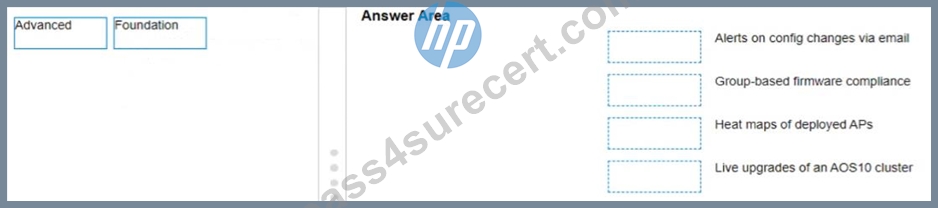
Answer:
Explanation: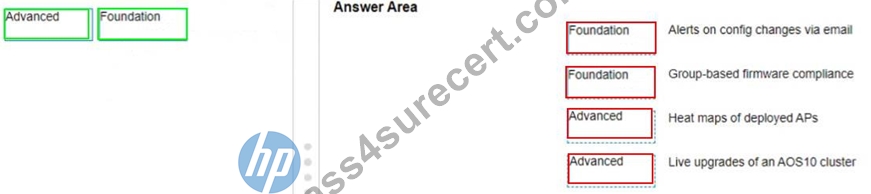
NEW QUESTION # 12
A network technician is troubleshooting one new AP at a branch office that will not receive Its configuration from Aruba Central The other APs at the branch are working as expected The output of the 'show ap debug cloud-server command' shows that the "cloud conflg received" Is FALSE.
After confirming the new AP has internet access, what would you check next?
- A. Verify the AP has a license assigned
- B. Disable and enable activate to trigger provisioning refresh
- C. Disable and enable Aruba Central to trigger configuration refresh
- D. Verify the AP can ping the device on arubanetworks.com
Answer: B
Explanation:
When an Aruba AP is not receiving its configuration from Aruba Central, and other APs at the location are functioning normally, a common troubleshooting step is to disable and then re-enable the activation process on the AP. This action can trigger a provisioning refresh, prompting the AP to attempt to retrieve its configuration from Aruba Central again. This step is often effective in resolving communication or provisioning issues between the AP and the management platform.
NEW QUESTION # 13
When using Aruba Central what can identify recommended steps to resolve network health issues and allows you to share detailed information with support personnel?
- A. Alerts and Events
- B. OAlOps
- C. Audit Trail
- D. Overview Dashboard
Answer: B
Explanation:
OAlOps is a feature of Aruba Central that uses artificial intelligence and machine learning to identify recommended steps to resolve network health issues and allows you to share detailed information with support personnel. OAlOps provides insights into network performance, root cause analysis, anomaly detection, proactive alerts, and automated remediation actions. OAlOps also integrates with Aruba User Experience Insight (UXI) sensors to measure and improve user experience across wired and wireless networks.
References: https://www.arubanetworks.com/assets/ds/DS_ArubaCentral.pdf
NEW QUESTION # 14
What does WPA3-Personal use as the source to generate a different Pairwise Master Key (PMK) each time a station connects to the wireless network?
- A. Opportunistic Wireless Encryption (OWE)
- B. Key Encryption Key (KEK)
- C. Session-specific information (MACs and nonces)
- D. Simultaneous Authentication of Equals (SAE)
Answer: C
Explanation:
Explanation
The source that WPA3-Personal uses to generate a different Pairwise Master Key (PMK) each time a station connects to the wireless network is session-specific information (MACs and nonces). WPA3-Personal uses Simultaneous Authentication of Equals (SAE) to replace PSK authentication in WPA2-Personal. SAE is a secure key establishment protocol that uses a Diffie-Hellman key exchange to derive a shared secret between two parties without revealing it to an eavesdropper. SAE involves the following steps:
The station and the access point exchange Commit messages that contain their MAC addresses and random numbers called nonces.
The station and the access point use their own passwords and the received MAC addresses and nonces to calculate a shared secret called SAE Password Element (PE).
The station and the access point use their own PE and the received MAC addresses and nonces to calculate a shared secret called SAE Key Seed (KS).
The station and the access point use their own KS and the received MAC addresses and nonces to calculate a shared secret called SAE Key Confirmation Key (KCK).
The station and the access point use their own KCK and the received MAC addresses and nonces to calculate a confirmation value called SAE Confirm.
The station and the access point exchange Confirm messages that contain their SAE Confirm values.
The station and the access point verify that the received SAE Confirm values match their own calculated values. If they match, the authentication is successful and the station and the access point have established a shared secret called SAE PMK.
The SAE PMK is different for each session because it depends on the MAC addresses and nonces that are exchanged in each authentication process. The SAE PMK is used as an input for the 4-way handshake that generates the Pairwise Temporal Key (PTK) for encrypting data frames.
The other options are not sources that WPA3-Personal uses to generate a different PMK each time a station connects to the wireless network because:
Opportunistic Wireless Encryption (OWE): OWE is a feature that provides encryption for open networks without requiring authentication or passwords. OWE uses a similar key establishment protocol as SAE, but it does not generate a PMK. Instead, it generates a Pairwise Secret (PS) that is used as an input for the 4-way handshake that generates the PTK.
Simultaneous Authentication of Equals (SAE): SAE is not a source, but a protocol that uses session-specific information as a source to generate a different PMK each time a station connects to the wireless network.
Key Encryption Key (KEK): KEK is not a source, but an output of the 4-way handshake that generates the PTK. KEK is used to encrypt group keys that are distributed by the access point.
References: https://www.wi-fi.org/discover-wi-fi/wi-fi-certified-6e
https://www.wi-fi.org/file/wi-fi-alliance-unlicensed-spectrum-in-the-us
https://www.cisco.com/c/en/us/products/collateral/wireless/catalyst-9100ax-access-points/wpa3-dep-guide-og.ht
https://info.support.huawei.com/info-finder/encyclopedia/en/WPA3.html
https://rp.os3.nl/2019-2020/p99/presentation.pdf
NEW QUESTION # 15
Which device configuration group types can a user define in Aruba Central during group creation?
(Select two.)
- A. Default group
- B. Security group
- C. Template group
- D. ESP group
- E. Ul group
Answer: B,C
Explanation:
In Aruba Central during group creation, users can define various configuration groups to manage settings for multiple devices. A Security group allows you to apply consistent security settings across devices, and a Template group enables you to apply pre-defined configurations to devices. These groups help streamline the deployment and management of network devices in Aruba Central.
NEW QUESTION # 16
Which statement about manual switch provisioning with Aruba Central is correct?
- A. Manual provisioning does not require DHCP and does not require DNS
- B. Manual provisioning does not require DHCP and requires DNS
- C. Manual provisioning requires DHCP and does not require DNS
- D. Manual provisioning requires DHCP and requires DNS
Answer: C
Explanation:
Manual switch provisioning in Aruba Central can be done without relying on DNS services, but it does require DHCP to assign IP addresses to the switches. DHCP is essential for the switches to obtain an IP address, which is necessary for them to communicate within the network and with Aruba Central for management and configuration purposes. DNS, on the other hand, is not strictly required for manual provisioning as direct IP addresses or other methods can be used to connect to Aruba Central or other management interfaces.
NEW QUESTION # 17
You put in a few show commands on switches EDGE1 and CORE1 to attempt to gather information to troubleshoot the issue Use the show command output images to determine the reason for the EDGE1 uplink being down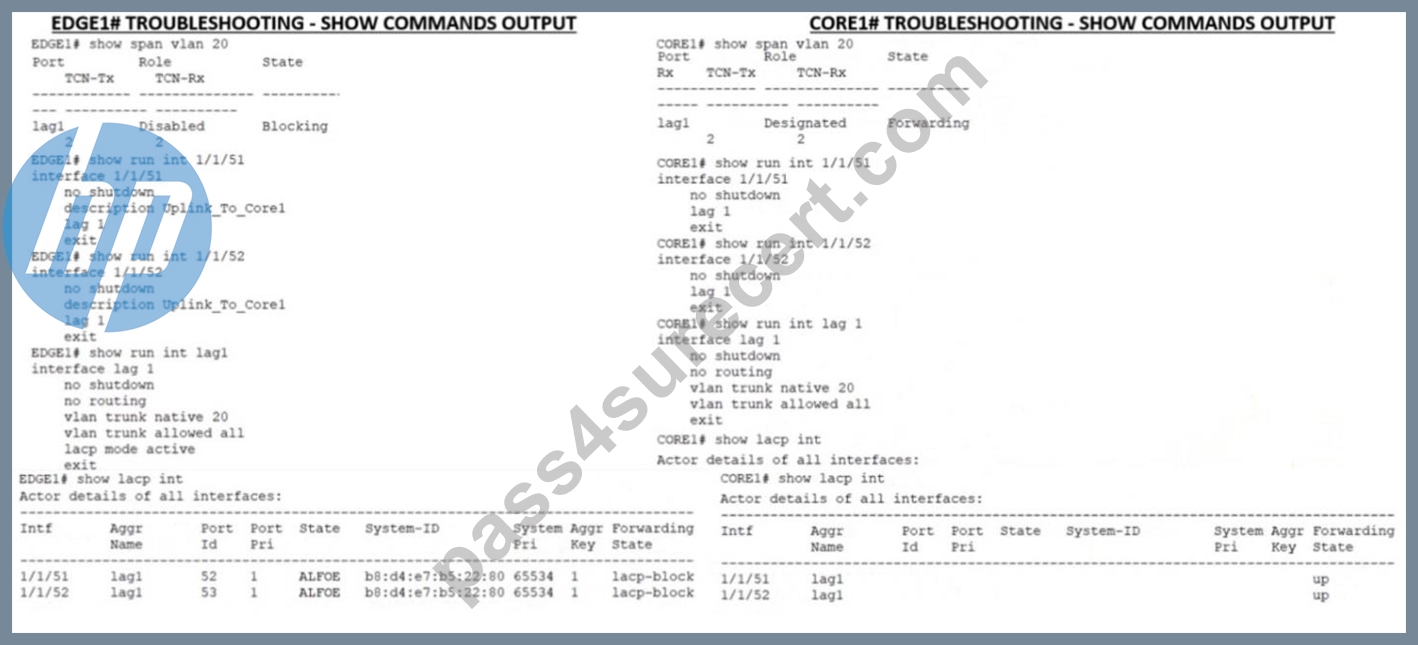
- A. The Core is connected to the incorrect physical interlaces
- B. LACP is not configured on the Core uplink
- C. The physical interfaces are not members of the correct LAG.
- D. Spanning-Tree block state is preventing the Core uplink from having connectivity to the edge
Answer: B
Explanation:
Explanation
LACP is a protocol that allows multiple physical links to be aggregated into a single logical link for increased bandwidth and redundancy. LACP must be configured on both ends of the link for it to work properly. In this case, EDGE1 has LACP configured on its uplink port-channel 1, but CORE1 does not have LACP configured on its corresponding port-channel 1. This causes a mismatch and prevents the link from coming up.
References:https://www.arubanetworks.com/techdocs/ArubaOS_86_Web_Help/Content/arubaos-solutions/1-ove
NEW QUESTION # 18
What happens when the signal from an AP weakens by being absorbed as it moves through an object?
- A. Signal to Noise Ratio (SNR) increases
- B. Aruba Central dynamically moves clients to neighboring APs
- C. Signal to Noise Ratio (SNR) decreases
- D. APs will use bonded channels to decrease latency to clients
Answer: C
Explanation:
Signal to noise ratio (SNR) is a measure that compares the level of a desired signal to the level of background noise. SNR is defined as the ratio of signal power to the noise power, often expressed in decibels (dB). A high SNR means that the signal is clear and easy to detect or interpret, while a low SNR means that the signal is corrupted or obscured by noise and may be difficult to distinguish or recover1. When the signal from an AP Access Point. AP is a device that allows wireless devices to connect to a wired network using Wi-Fi, or related standards. weakens by being absorbed as it moves through an object, such as a wall or a furniture, the signal power decreases. This reduces the SNR and affects the quality of the wireless connection. The noise power may also increase due to interference from other sources, such as other APs or devices operating in the same frequency band2. Therefore, the correct answer is that SNR decreases when the signal from an AP weakens by being absorbed as it moves through an object.
NEW QUESTION # 19
What is the correct command to add a static route to a class-c-network 10.2.10.0 via a gateway of
172.16.1.1?
- A. ip-route 10.2.10.0/24 172.16.1.1
- B. ip route 10.2.10.0/24.172.16.11
- C. ip route 10.2.10.0.255.255.255.0 172.16.1.1 description aruba
- D. ip route-static 10.2 10.0.255.255.255.0 172.16.1.1
Answer: A
Explanation:
The correct command to add a static route to a class-c-network 10.2.10.0 via a gateway of 172.16.1.1 is ip-route 10.2.10.0/24 172.16.1.1. This command specifies the destination network address (10.2.10.0) and prefix length (/24) and the next-hop address (172.16.1 .1) for reaching that network from the switch.
The other commands are either incorrect syntax or incorrect parameters for adding a static route.
References: https://www.arubanetworks.com/techdocs/AOS-CX_10_04/NOSCG/Content/cx-noscg/ip- routing/sta
NEW QUESTION # 20
What does the status of "ALFOE" mean when checking LACP with "show lacp interfaces'"?
- A. The interface on the local switch is configured as static-LAG
- B. LACP is not configured on the peer side
- C. LACP is working fine with no problems
- D. LACP is in a synchronizing process
Answer: C
Explanation:
The status of "ALFOE" means that LACP Link Aggregation Control Protocol (LACP) is a network protocol that provides dynamic negotiation of link aggregation between two devices. LACP allows multiple physical links to be combined into a single logical link for increased bandwidth, redundancy, and load balancing. LACP is defined in IEEE 802.3ad standard. is working fine with no problems when checking LACP with "show lacp interfaces".
The status of "ALFOE" is an acronym that stands for:
- A: Active - The interface is actively sending LACP packets to negotiate link aggregation with the peer device.
- L: Link Up - The interface has physical connectivity with the peer device.
- F: Aggregatable - The interface can be aggregated with other interfaces into a single logical link.
- O: Synchronized - The interface has successfully negotiated link aggregation parameters with the peer device and can transmit or receive traffic on the logical link.
- E: Collecting/Distributing - The interface is collecting incoming traffic from the peer device and distributing outgoing traffic to the peer device on the logical link.
The other options are not correct because:
- The interface on the local switch is configured as static-LAG: This option is false because static- LAG does not use LACP to negotiate link aggregation. Static-LAG requires manual configuration of link aggregation parameters on both devices and does not have any status indicators.
- LACP is not configured on the peer side: This option is false because if LACP is not configured on the peer side, the status of the interface would be "ALF? instead of "ALFOE". This means that the interface would not be synchronized or collecting/distributing with the peer device.
- LACP is in a synchronizing process: This option is false because if LACP is in a synchronizing process, the status of the interface would be "ALF-O" instead of "ALFOE". This means that the interface would not be collecting/distributing with the peer device.
NEW QUESTION # 21
When using Aruba Central what can identify recommended steps to resolve network health issues and allows you to share detailed information with support personnel?
- A. Alerts and Events
- B. OAlOps
- C. Audit Trail
- D. Overview Dashboard
Answer: B
Explanation:
Explanation
OAlOps is a feature of Aruba Central that uses artificial intelligence and machine learning to identify recommended steps to resolve network health issues and allows you to share detailed information with support personnel. OAlOps provides insights into network performance, root cause analysis, anomaly detection, proactive alerts, and automated remediation actions.OAlOps also integrates with Aruba User Experience Insight (UXI) sensors to measure and improve user experience across wired and wireless networks.
References:https://www.arubanetworks.com/assets/ds/DS_ArubaCentral.pdf
NEW QUESTION # 22
A hospital uses a lot of mobile equipment for the diagnosis and documentation of patient data What Is the ideal access switch for this large hospital with distribution racks of over 400 ports in a single VSF stack?
- A. OCX 6400
- B. CX 6300
- C. OCX 6100
- D. OCX 6200
Answer: B
Explanation:
The ideal access switch for a large hospital with distribution racks of over 400 ports in a single VSF stack is the CX 6300. This switch provides the following benefits:
The CX 6300 supports up to 48 ports per switch and up to 10 switches per VSF stack, allowing for a total of 480 ports in a single stack. This meets the requirement of having over 400 ports in a single VSF stack.
The CX 6300 supports high-performance switching with up to 960 Gbps of switching capacity and up to 714 Mpps of forwarding rate. This meets the requirement of having high throughput and low latency for mobile equipment and patient data.
The CX 6300 supports advanced features such as dynamic segmentation, policy-based routing, and role-based access control. These features enhance the security and flexibility of the network by applying different policies and roles to different types of devices and users.
The CX 6300 supports Aruba NetEdit, a network configuration and orchestration tool that simplifies the management and automation of the network. This reduces the complexity and human errors involved in network configuration and maintenance.
The other options are not ideal because:
OCX 6400: This switch is designed for data center applications and does not support VSF stacking. It also does not support dynamic segmentation or policy-based routing, which are useful for network security and flexibility.
OCX 6200: This switch is designed for small to medium-sized businesses and does not support VSF stacking. It also has lower switching capacity and forwarding rate than the CX 6300, which may affect the performance of the network.
OCX 6100: This switch is designed for edge applications and does not support VSF stacking. It also has lower switching capacity and forwarding rate than the CX 6300, which may affect the performance of the network.
NEW QUESTION # 23
Which are valid steps in troubleshooting Aruba Wireless Access Point connection issues? (Choose three)
- A. Ensure that the AP is in compliance with the latest firmware updates.
- B. Reset the AP to factory default settings.
- C. Check the power settings on the physical switch port connected to the AP.
- D. Verify network cable integrity from the AP to the switch.
Answer: A,C,D
NEW QUESTION # 24
How does a single Aruba CX 6300M switch configuration use L3 connectivity to establish routing traffic between switch virtual interfaces 120 and 130?
- A. Create static routes between SVI 120 and 130.
- B. Routing is enabled by default with Aruba 6300M.
- C. Delete 'no routing' from the SVI interfaces.
- D. Route leaking must be configured in default VRF.
Answer: B
NEW QUESTION # 25
What is an advantage of using Layer 2 MAC authentication?
- A. No setup is required on the client.
- B. It matches user names to MAC address.
- C. MAC identifiers are hard to spoof.
- D. MAC allow lists are easily maintained over time.
Answer: A
Explanation:
The advantage of Layer 2 MAC authentication is that it does not require any setup or configuration on the client device. The network devices (like switches or access points) perform the authentication automatically based on the MAC address of the device when it tries to connect to the network.
NEW QUESTION # 26
Which of the following is a primary security feature supported by Aruba switches?
- A. All are correct.
- B. Web content filtering.
- C. Role-based access control.
- D. Built-in intrusion prevention system.
Answer: C
NEW QUESTION # 27
A client connects to an Aruba AP in tunnel mode and is assigned to a VLAN based on the client's MAC address.
Which client VLAN assignment was configured?
- A. Native VLAN
- B. Mixed
- C. Dynamic
- D. Static
Answer: C
Explanation:
When a client connects to an Aruba AP in tunnel mode and is assigned to a VLAN based on the client's MAC address, this indicates a Dynamic VLAN assignment. The VLAN is determined dynamically at the time of authentication based on the client's credentials or attributes, such as its MAC address.
NEW QUESTION # 28
A network technician is verifying that a customer successfully connected to the guest network after completing the captive portal. The network technician looks at the access tracker in ClearPass.
Which role should be seen when looking at the OUTPUT tab for the customer's session?
- A. Guest logon
- B. Guest authenticated
- C. Captive portal redirect
- D. Captive portal login
Answer: B
Explanation:
In the access tracker of ClearPass, after a customer successfully connects to a guest network through a captive portal, the OUTPUT tab should show a role indicating that the user is authenticated, such as "Guest authenticated." This role confirms that the user has passed the authentication process and has been granted access.
NEW QUESTION # 29
What does WPA3-Personal use as the source to generate a different Pairwise Master Key (PMK) each time a station connects to the wireless network?
- A. Opportunistic Wireless Encryption (OWE)
- B. Key Encryption Key (KEK)
- C. Simultaneous Authentication of Equals (SAE)
- D. Session-specific information (MACs and nonces)
Answer: C
NEW QUESTION # 30
A network technician has successfully connected to the employee SSID via 802 1X Which RADIUS message should you look for to ensure a successful connection?
- A. Authorized
- B. Access-Accept
- C. Success
- D. Authenticated
Answer: B
Explanation:
The RADIUS message that you should look for to ensure a successful connection via 802.1X is Access- Accept. This message indicates that the RADIUS server has authenticated and authorized the supplicant (the device that wants to access the network) and has granted it access to the network resources. The Access- Accept message may also contain additional attributes such as VLAN ID, session timeout, or filter ID that specify how the authenticator (the device that controls access to the network, such as a switch) should treat the supplicant's traffic.
The other options are not RADIUS messages because:
* Authorized: This is not a RADIUS message, but a state that indicates that a port on an authenticator is allowed to pass traffic from a supplicant after successful authentication and authorization.
* Success: This is not a RADIUS message, but a status that indicates that an EAP Extensible Authentication Protocol (EAP) is an authentication framework that provides support for multiple authentication methods, such as passwords, certificates, tokens, or biometrics. EAP is used in wireless networks and point-to-point connections to provide secure authentication between a supplicant (a device that wants to access the network) and an authentication server (a device that verifies the credentials of the supplicant). exchange has completed successfully between a supplicant and an authentication server.
* Authenticated: This is not a RADIUS message, but a state that indicates that a port on an authenticator has received an EAP-Success message from an authentication server after successful authentication of a supplicant.
References: https://en.wikipedia.org/wiki/RADIUS#Access-Accept https://www.cisco.com/c/en/us/support
/docs/security-vpn/remote-authentication-dial-user-service-radius/13838-10.html https://en.wikipedia.org/wiki
/IEEE_802.1X#Port-based_network_access_control https://en.wikipedia.org/wiki
/Extensible_Authentication_Protocol#EAP_exchange
NEW QUESTION # 31
List the WPA 4-Way Handshake functions in the correct order.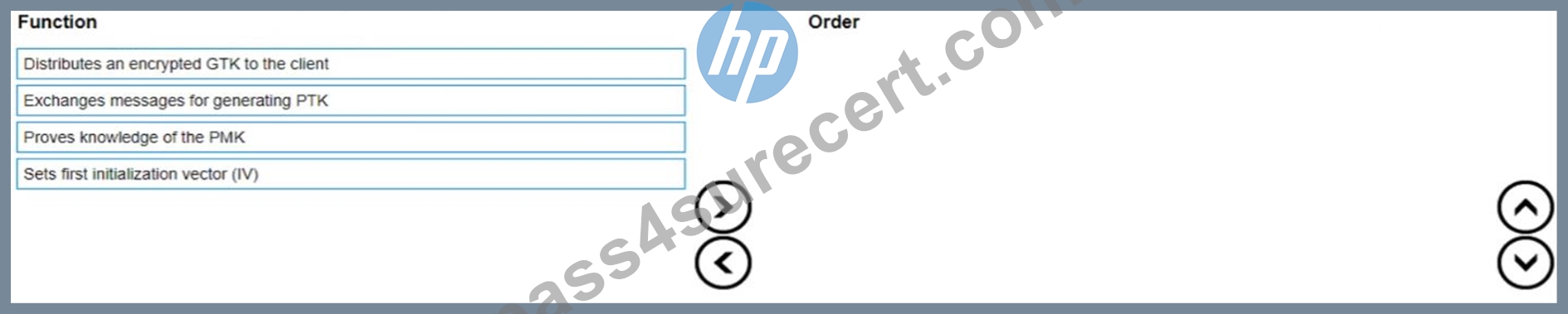
Answer:
Explanation: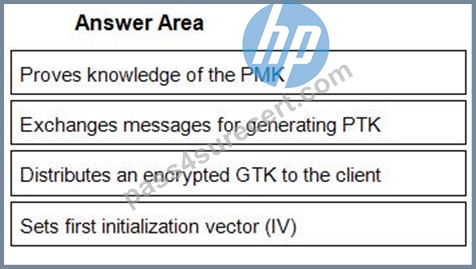
1 - Proves knowledge of the PMK
2 - Exchanges messages for generating PTK
3 - Distributes an encrypted GTK to the client
4 - Sets first initialization vector (IV)
NEW QUESTION # 32
When using the OSPF dynamic routing protocol on an Aruba CX switch, what must match on the neighboring devices to exchange routes?
- A. DR configuration
- B. BDR configuration
- C. ECMP method
- D. Hello timers
Answer: D
Explanation:
OSPF Open Shortest Path First. OSPF is a link-state routing protocol that uses a hierarchical structure to create a routing topology for IP networks. OSPF routers exchange routing information with their neighbors using Hello packets, which are sent periodically on each interface. To establish an adjacency Adjacency is a relationship formed between selected neighboring routers for the purpose of exchanging routing information., OSPF routers must agree on several parameters, including Hello timers, which specify how often Hello packets are sent on an interface. If the Hello timers do not match between neighboring routers, they will not form an adjacency and will not exchange routes. References:https://www.arubanetworks.com/techdocs
/ArubaOS_86_Web_Help/Content/arubaos-solutions/osfp/osfp.htm
NEW QUESTION # 33
What describes Clearpass OnGuard? (Select two.)
- A. It is an intuitive portal for users to securely configure their devices.
- B. OnGuard is an agent, running on client systems.
- C. Onguard assings an unique identity to each device.
- D. It is used for the self-registration of guest devices.
- E. OnGuard is doing posture checks on client systems.
Answer: B,E
Explanation:
ClearPass OnGuard is a component of the ClearPass Policy Manager that performs health and security posture checks on devices to ensure they meet the organization's compliance requirements before allowing access to the network. It operates as an agent on client systems to perform these checks.
NEW QUESTION # 34
When using the OSPF dynamic routing protocol on an Aruba CX switch, what must match on the neighboring devices to exchange routes?
- A. DR configuration
- B. BDR configuration
- C. ECMP method
- D. Hello timers
Answer: D
Explanation:
OSPF Open Shortest Path First. OSPF is a link-state routing protocol that uses a hierarchical structure to create a routing topology for IP networks. OSPF routers exchange routing information with their neighbors using Hello packets, which are sent periodically on each interface. To establish an adjacency Adjacency is a relationship formed between selected neighboring routers for the purpose of exchanging routing information., OSPF routers must agree on several parameters, including Hello timers, which specify how often Hello packets are sent on an interface. If the Hello timers do not match between neighboring routers, they will not form an adjacency and will not exchange routes.
References: https://www.arubanetworks.com/techdocs/ArubaOS_86_Web_Help/Content/arubaos- solutions/osfp/
NEW QUESTION # 35
A network technician is using HPE Aruba Networking Central to troubleshoot network issues.
Which dashboard can be used to view and acknowledge issues when beginning the troubleshooting process?
- A. the Reports dashboard
- B. the Alerts and Events dashboard
- C. the Tools dashboard
- D. the Audit Trail dashboard
Answer: B
Explanation:
The Alerts and Events dashboard displays all types of alerts and events generated for events pertaining to device provisioning, configuration, and user management. You can use the Config icon to configure alerts and notifications for different alert categories and severities. You can also view the alerts and events in the List view and Summary view.
NEW QUESTION # 36
......
Real exam questions are provided for ACA Campus Access Associate tests, which can make sure you 100% pass: https://www.pass4surecert.com/HP/HPE6-A85-practice-exam-dumps.html
HPE6-A85 Exam with Guarantee Updated 134 Questions: https://drive.google.com/open?id=1D_0RDUA-7UD2mc99jocaOsZKV3mKW-Jk