

aPHRi Premium Exam Engine - Download Free PDF Questions
Instant Download aPHRi Free Updated Test Dumps
NEW QUESTION # 13
An organization's mission is the:
- A. Shared beliefs of the people in the organization
- B. Values of internal and external stakeholders
- C. Plan of action to achieve the goals of the organization
- D. Fundamental purpose of the organization
Answer: D
Explanation:
Comprehensive and Detailed in Depth Explanation:
An organization's mission statement defines its fundamental purpose-why it exists and what it aims to achieve in the long term. It provides a clear direction for the organization's activities and aligns employees with its core objectives.
* Option A (Plan of action to achieve the goals of the organization):This describes a strategy or operational plan, not the mission.
* Option B (Fundamental purpose of the organization):Correct, as the mission articulates the organization's reason for being.
* Option C (Shared beliefs of the people in the organization):This refers to organizational culture, not the mission.
NEW QUESTION # 14
Which reporting technique is best used for displaying the distribution of a single numerical variable over a range of values?
- A. Pie charts, which are useful for showing parts of a whole
- B. Line graphs, which display trends over periods of time
- C. Scatter plots, which display correlations between two variables
- D. Histograms, which are ideal for displaying the distribution of a numerical variable
Answer: D
Explanation:
Histograms are ideal for displaying the distribution of a numerical variable because they show the frequency of data points within specified ranges. This helps in understanding the spread and concentration of values.
NEW QUESTION # 15
What is the key requirement for companies under workplace health and safety laws regarding employee training?
- A. Encouraging self-paced online training modules.
- B. Providing comprehensive health and safety training to all employees.
- C. Offering optional safety training sessions.
- D. Limiting training to new hires only.
Answer: B
Explanation:
Companies are required to provide comprehensive health and safety training to all employees under workplace health and safety laws. This ensures that all staff members are knowledgeable about potential hazards and the correct procedures to follow, promoting a safer work environment.
NEW QUESTION # 16
Match the job analysis method to the correct description.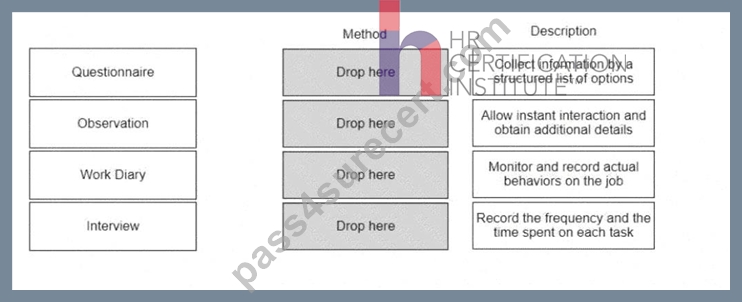
Answer:
Explanation: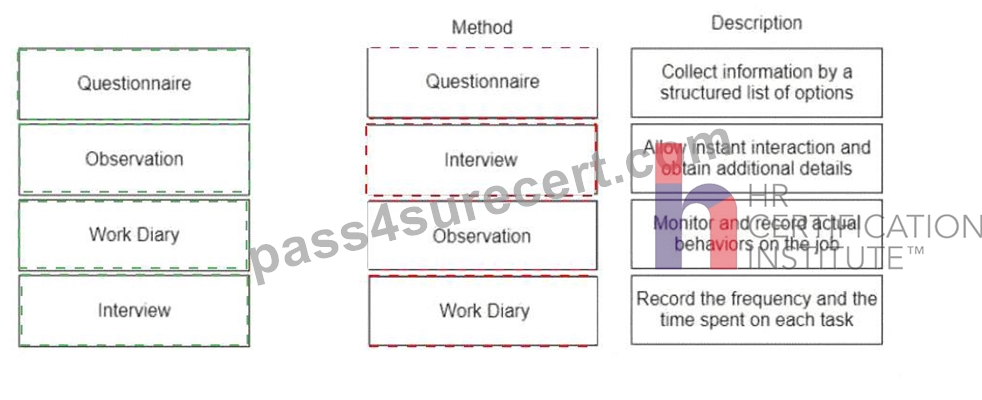
Explanation:
Here is the correct matching for each job analysis method with its corresponding description:
* Questionnaire # Collect information by a structured list of options
* Observation # Monitor and record actual behaviors on the job
* Work Diary # Record the frequency and the time spent on each task
* Interview # Allow instant interaction and obtain additional details
Step-by-Step Explanation
* Questionnaire: A questionnaire is a structured method where employees provide information by selecting from a list of predefined options. This method is efficient for gathering large amounts of data across multiple employees and job roles.
* Observation: Observation involves directly watching employees as they perform their duties to capture and record their actual behavior on the job. This method is useful for understanding real-time tasks and workflows.
* Work Diary: A work diary requires employees to record their activities, noting the time spent and frequency of each task. This method provides detailed insights into the distribution of work activities and how employees allocate their time.
* Interview: The interview method allows for direct interaction with employees, enabling the interviewer to ask follow-up questions and gather additional details. This method is ideal for gaining in-depth information and clarifying responses.
NEW QUESTION # 17
An organization that pays employees based on a flat rate will typically provide compensation:
- A. At the same rate for the same work.
- B. At an appropriate rate for employment skills
- C. Based on seniority
- D. Based on performance
Answer: A
Explanation:
Definition of Flat Rate Compensation:
* Flat rate compensation involves paying employees a uniform rate for the same type of work, regardless of seniority, performance, or additional factors.
Why Same Rate for Same Work is Correct:
* This system ensures consistency and simplicity in compensation, often applied in standardized roles where tasks are uniform and performance differentiation is minimal.
Eliminating Incorrect Options:
* A. Based on seniority: Seniority-based pay typically involves incremental increases over time.
* B. Based on performance: Flat rate pay is not performance-based.
* D. At an appropriate rate for employment skills: Flat rate pay disregards skill variations.
International HR References:
* ILO Equal Remuneration Convention (No. 100): Advocates for equal pay for equal work, aligning with flat rate principles.
NEW QUESTION # 18
During a routine safety audit, it is discovered that several employees are not following the established safety protocols. What should management do first to improve compliance?
- A. Implement a more relaxed safety protocol.
- B. Provide additional training and communicate the importance of safety protocols.
- C. Penalize employees who do not follow the protocols.
- D. Ignore non-compliance if no incidents occur.
Answer: B
Explanation:
Providing additional training and communicating the importance of safety protocols should be management's first step to improve compliance when employees are not following established protocols. This approach helps to reinforce the significance of the protocols and ensures that employees understand how to follow them correctly.
NEW QUESTION # 19
A primary purpose of internet policies is to:
- A. Reduce frequency of communication in the organization
- B. Ensure the employees have secure access
- C. Create a structure for disciplinary procedures
- D. Protect information shared within and outside of the organization
Answer: D
Explanation:
Comprehensive and Detailed in Depth Explanation:
Internet policies outline acceptable use of the organization's internet resources, including email, browsing, and file sharing. A primary purpose is to protect information shared within and outside the organization by preventing data breaches, ensuring confidentiality, and mitigating risks like malware or unauthorized disclosures.
* Option A (Ensure the employees have secure access):While secure access is important, it is a technical aspect, not the primary purpose of the policy.
* Option B (Reduce frequency of communication in the organization):Internet policies do not aim to reduce communication; they regulate it.
* Option C (Create a structure for disciplinary procedures):This is a secondary outcome, not the primary purpose.
NEW QUESTION # 20
Fill in the blank: Regular __________ are essential to ensure compliance with workplace safety regulations.
- A. Safety audits.
- B. Employee satisfaction surveys.
- C. Annual performance reviews.
- D. Casual check-ins with employees.
Answer: A
Explanation:
Regular safety audits are essential to ensure compliance with workplace safety regulations. These audits help identify potential hazards and ensure that safety measures are being properly implemented and followed.
NEW QUESTION # 21
Which benefit helps employees save money on healthcare expenses by allowing them to set aside pre-tax funds?
Response:
- A. Health Savings Account (HSA)
- B. Life Insurance
- C. Disability Insurance
- D. Vision Coverage
Answer: A
NEW QUESTION # 22
What is the first step in developing a comprehensive workplace emergency procedure plan?
- A. Reviewing past incident reports.
- B. Purchasing insurance for the business.
- C. Allocating budget for emergency supplies.
- D. Conducting a risk assessment to identify potential hazards.
Answer: D
Explanation:
Conducting a risk assessment to identify potential hazards is the first step in developing a comprehensive workplace emergency procedure plan. This step involves analyzing the workplace to determine potential emergencies that could occur, such as fires, floods, or other disasters.
NEW QUESTION # 23
Fill in the blank: Regular __________ can help reinforce the importance of diversity in the workplace.
- A. Team-building exercises.
- B. Diversity training sessions.
- C. Quarterly financial audits.
- D. Annual performance reviews.
Answer: B
Explanation:
Regular diversity training sessions can help reinforce the importance of diversity in the workplace. These sessions educate employees about diversity, inclusion, and cultural competence, fostering a more inclusive work environment.
NEW QUESTION # 24
Place the commonly used steps in the employment termination process in order.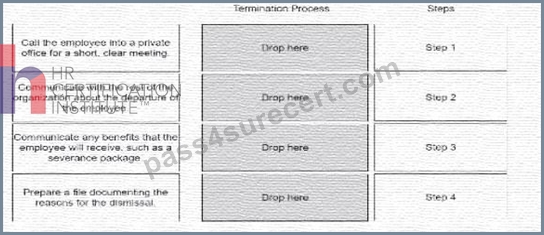
Answer:
Explanation: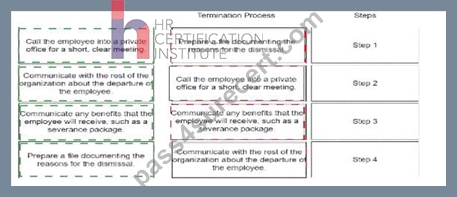
Explanation: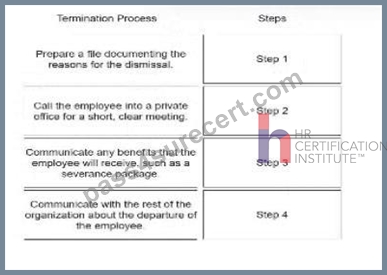
Ordered Employment Termination Process:
* Prepare a file documenting the reasons for the dismissal # Step 1
* Explanation:Documentation is the foundation of any termination process. It ensures that the reasons for termination are clear, consistent, and legally compliant. Proper records help protect the organization from potential legal challenges and ensure fairness.
Reference: SHRM's "Guide to Documenting Employee Performance Issues" (2022).
Call the employee into a private office for a short, clear meeting # Step 2 Explanation:A private meeting is essential to communicate the termination decision respectfully and clearly.
This ensures confidentiality and professionalism, allowing the employee to process the information in a dignified manner.
Reference: SHRM, "How to Conduct a Termination Meeting" (2021).
Communicate any benefits that the employee will receive, such as a severance package # Step 3 Explanation:Clearly communicating severance, benefits, or final paycheck details demonstrates fairness and reduces post-termination misunderstandings. It also supports compliance with labor laws and ensures a smoother transition.
Reference: "Severance Pay Best Practices," International Labour Organization (ILO) (2023).
Communicate with the rest of the organization about the departure of the employee # Step 4 Explanation:Informing the organization appropriately helps maintain workplace morale and transparency. The announcement should respect the departing employee's privacy while addressing any operational impacts.
Reference: CIPD's "Managing Organizational Changes and Communication" (2022).
Final Matching Summary:
Step 1: Prepare a file documenting the reasons for the dismissal.
Step 2: Call the employee into a private office for a short, clear meeting.
Step 3: Communicate any benefits that the employee will receive, such as a severance package.
Step 4: Communicate with the rest of the organization about the departure of the employee.
References:
Society for Human Resource Management (SHRM), "Guide to Documenting Employee Performance Issues" (2022).
SHRM, "How to Conduct a Termination Meeting" (2021).
International Labour Organization (ILO), "Severance Pay Best Practices" (2023).
Chartered Institute of Personnel and Development (CIPD), "Managing Organizational Changes and Communication" (2022).
Harvard Business Review, "Steps to Ethical Termination Practices" (2020).
NEW QUESTION # 25
Which practice involves ensuring that employees understand and adhere to the company''s values and ethical standards?
- A. Communicating ethics
- B. Conducting audits
- C. Financial reporting
- D. Market analysis
Answer: A
Explanation:
Communicating ethics involves ensuring that employees understand and adhere to the company,s values and ethical standards. This practice is fundamental in building a culture of integrity and accountability within the organization.
NEW QUESTION # 26
__________ is a critical purpose of HRIS that ensures accurate tracking and management of employee performance, attendance, and other key metrics.
- A. Providing real-time data analytics and reporting capabilities for HR metrics
- B. Monitoring employee performance through regular appraisals
- C. Tracking employee attendance and leave management
- D. Facilitating team collaboration and project management activities
Answer: A
Explanation:
Providing real-time data analytics and reporting capabilities is a critical purpose of HRIS. This functionality allows HR professionals to track and manage key metrics like performance and attendance accurately and promptly.
NEW QUESTION # 27
Fill in the blank: Regular __________ are necessary to test and improve workplace emergency procedures.
- A. Monthly team meetings.
- B. Emergency drills.
- C. Social events.
- D. Performance reviews.
Answer: B
Explanation:
Regular emergency drills are necessary to test and improve workplace emergency procedures. These drills allow employees to practice their responses to emergencies, helping to identify any weaknesses in the plan and ensuring everyone knows what to do in a real situation.
NEW QUESTION # 28
Which of the following elements is essential when structuring an employment offer to ensure clarity and transparency?
- A. Clear job responsibilities and compensation
- B. Casual dress code
- C. Relocation assistance
- D. Flexible work hours
Answer: A
Explanation:
Clear job responsibilities and compensation are essential when structuring an employment offer to ensure the candidate understands what is expected and what they will receive in return.
NEW QUESTION # 29
An international corporation aims to improve its succession planning process. Describe the steps an HR manager should take to identify and develop potential leaders within the company.
- A. Limit career development opportunities to high-level positions.
- B. Use only internal assessments to identify leaders.
- C. Rely on external recruitment to fill leadership positions.
- D. Conduct talent assessments to identify high-potential employees.
Answer: D
Explanation:
Conducting talent assessments to identify high-potential employees allows the HR manager to focus development efforts on individuals who have the potential to grow into leadership roles, enhancing the effectiveness of succession planning.
NEW QUESTION # 30
Which of the following initiatives will most likely ensure that employees' skill continue to be relevant to business trends? (Two options.)
- A. Knowledge sharing
- B. Online training
- C. Team bonding
- D. Salary increases
- E. Career planning
Answer: A,B
Explanation:
* Online Training:
* Provides employees with access to updated skills and knowledge aligned with business trends.
* Scalable and customizable to individual and organizational needs.
* Knowledge Sharing:
* Encourages collaboration and dissemination of industry trends and innovations among employees, ensuring continuous learning and adaptability.
* Explanation of Other Options:
* A. Team bonding: Improves teamwork but does not address skill relevance.
* C. Career planning: Focuses on long-term growth rather than immediate skill relevance.
* D. Salary increases: Motivates employees but does not ensure skill improvement.
NEW QUESTION # 31
Which element is essential to include in an emergency evacuation plan to ensure employee safety?
- A. Assigning tasks for a new project.
- B. Informing employees about their job responsibilities.
- C. Developing a new marketing strategy.
- D. Clearly marked evacuation routes and exits.
Answer: D
Explanation:
Clearly marked evacuation routes and exits are essential to include in an emergency evacuation plan to ensure employee safety. These routes help employees quickly and safely leave the building during an emergency, reducing the risk of injury or confusion.
NEW QUESTION # 32
Which of the following is the primary purpose of conducting a workplace investigation?
- A. Ensure a confidential assessment
- B. Ensure a healthy organizational culture
- C. Provide training for development
- D. Provide facts for decision-making
Answer: D
Explanation:
Comprehensive and Detailed in Depth Explanation:
A workplace investigation is conducted to address allegations of misconduct, policy violations, or other issues (e.g., harassment, theft). The primary purpose is to gather facts and evidence to enable informed decision- making, such as determining whether disciplinary action is warranted or if policies need adjustment. This ensures fairness and compliance with legal standards.
* Option A (Provide training for development): Training may result from investigation findings, but it is not the primary purpose.
* Option B (Provide facts for decision-making): Correct, as the investigation's main goal is to collect objective data for decisions.
* Option C (Ensure a confidential assessment): Confidentiality is important, but it is a procedural aspect, not the primary purpose.
Reference: aPHRi knowledge domain - Employee Relations: Conducting workplace investigations to support decision-making and compliance.===========
NEW QUESTION # 33
Which recruitment source relies on recommendations from current employees to find potential candidates for job openings?
- A. Job fairs and career events
- B. Online job boards
- C. Social media campaigns
- D. Employee referral programs
Answer: D
Explanation:
Employee referral programs rely on recommendations from current employees to find potential candidates for job openings. This method can be highly effective as employees often refer individuals who they believe will fit well with the company culture and job requirements.
NEW QUESTION # 34
Which of the following best describes a primary aspect of a grievance procedure?
- A. Leads to a positive resolution for the employee
- B. Protection of the employer
- C. Initiated by the employer
- D. Protection of the employee
Answer: D
Explanation:
Comprehensive and Detailed in Depth Explanation:
A grievance procedure is a formal process for employees to raise concerns or complaints about workplace issues, such as unfair treatment, policy violations, or working conditions. The primary aspect of a grievance procedure is to protect the employee by providing a structured, fair mechanism to address their concerns, ensuring they are heard and treated equitably, often with legal protections against retaliation. This aligns with the aPHRi focus on employee relations, which emphasizes maintaining a fair and transparent workplace.
* Option A (Leads to a positive resolution for the employee):While the goal of a grievance procedure is to resolve issues, a positive outcome for the employee is not guaranteed. The resolution may favor the employer or be neutral, depending on the facts.
* Option B (Initiated by the employer):Grievance procedures are typically initiated by the employee, not the employer, as they are designed to address employee concerns.
* Option C (Protection of the employer):While a grievance procedure may indirectly protect the employer by resolving issues before they escalate (e.g., into lawsuits), its primary purpose is to safeguard the employee's rights.
NEW QUESTION # 35
An organization notices a decline in employee morale. What initial step should management take to address this issue?
- A. Implement an open-door policy for grievances.
- B. Schedule a company-wide town hall meeting.
- C. Conduct a thorough employee satisfaction survey.
- D. Announce new employee benefits in a newsletter.
Answer: C
Explanation:
Conducting a thorough employee satisfaction survey is the initial step management should take when noticing a decline in employee morale. This survey can uncover specific issues and provide data-driven insights to inform targeted interventions.
NEW QUESTION # 36
Which of the following should be included in an anti-harassment policy?
- A. Tips for employees to resolve the harassment on their own
- B. Name and title of HR representative
- C. A statement of potential confidentiality
- D. A clear explanation of prohibited conduct
Answer: D
Explanation:
Comprehensive and Detailed in Depth Explanation:
An anti-harassment policy is a critical document that outlines the organization's commitment to a harassment- free workplace. It must include a clear explanation of prohibited conduct (e.g., sexual harassment, bullying) to ensure employees understand what behaviors are unacceptable and to provide a basis for enforcement.
* Option A (Name and title of HR representative): While contact information may be included, it is not a core component of the policy itself.
* Option B (A statement of potential confidentiality): Confidentiality is important, but it is a procedural detail, not the main focus.
* Option C (A clear explanation of prohibited conduct): Correct, as this is a fundamental element of an anti-harassment policy.
Reference: aPHRi knowledge domain - Employee Relations: Developing anti-harassment policies, including defining prohibited conduct.===========
NEW QUESTION # 37
......
Free aPHRi Exam Braindumps HRCI Pratice Exam: https://www.pass4surecert.com/HRCI/aPHRi-practice-exam-dumps.html
Valid aPHRi FREE EXAM DUMPS QUESTIONS & ANSWERS: https://drive.google.com/open?id=1TJDtT5CwJaZhYcMNC_mivkwmQZsd0LWs