

100% Pass Guaranteed Free H12-821_V1.0 Exam Dumps Oct 01, 2025
Verified & Latest H12-821_V1.0 Dump Q&As with Correct Answers
NEW QUESTION # 58
Which of the following statements regarding the BGP error display of a router is false?
- A. Error Type indicates that the BGP error is caused by the neighbor relationship error.
- B. The neighbor address of this router is 10.1.1.2.
- C. The error may be caused by the incorrect peer AS number.
- D. The error occurred at 11:40:39 on March 22, 2010.
Answer: D
Explanation:
The provided BGP error display shows the error timestamp as 12:40:39 on March 22, 2010. The error message confirms a mismatch in the peer AS number, as indicated in the "Incorrect remote AS" error info.
This eliminates options related to other causes, and the timestamp in Option A is incorrect .
NEW QUESTION # 59
Similar to the OSPF DR, the IS-IS DIS needs to be elected on a broadcast network. However, the OSPF DR is preemptive by default, whereas the IS-IS DIS is not preemptive by default.
- A. FALSE
- B. TRUE
Answer: B
Explanation:
DIS and DR Election
* The IS-IS Designated Intermediate System (DIS) is responsible for generating and updating pseudonode LSPs on a broadcast network.
* Unlike OSPF DR, the IS-IS DIS does not preempt by default. This behavior avoids unnecessary flapping in the network due to frequent DIS re-elections.
HCIP-Datacom-Core Reference
* The characteristics of DIS and DR behavior are explained in IS-IS network operation chapters.
NEW QUESTION # 60
Which of the following statements regarding different LSA types is false?
- A. LS Update packets contain complete LSA information.
- B. LS Ack packets contain complete LSA information.
- C. DD packets contain only LSA summary information, including LS Type, LS ID, Advertising Router, and LS Sequence Number.
- D. LS Request packets contain only LS Type, LS ID, and Advertising Router.
Answer: B
Explanation:
LS Ack (Link State Acknowledgment) packets are used to acknowledge received LSAs and do not contain complete LSA information. Instead, they contain only the headers of LSAs being acknowledged. This contrasts with LS Update packets, which carry full LSA details. The misunderstanding of LS Ack functionality makes this statement false .
NEW QUESTION # 61
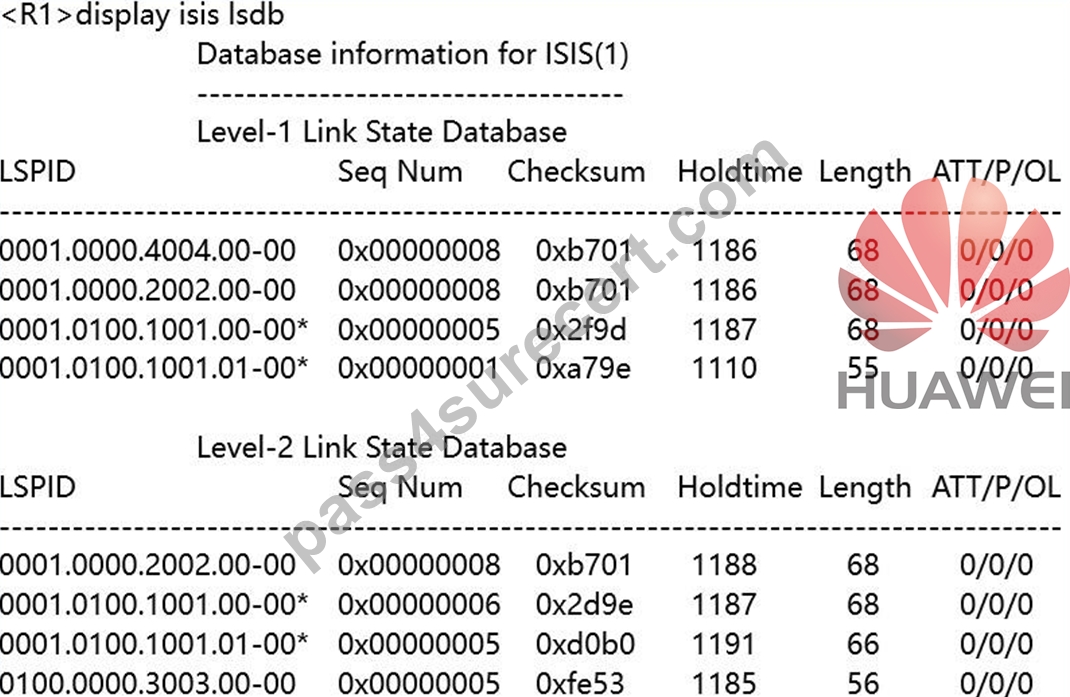
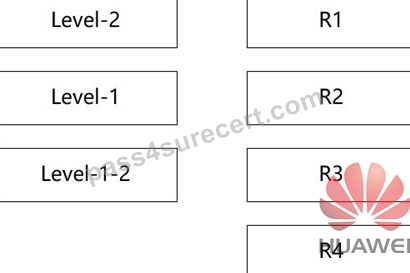
All routers in a network run IS-IS and are all in Area 49.0001. The LSDB of R1 is as shown in the figure. Based on this, the Level of the four routers can be determined.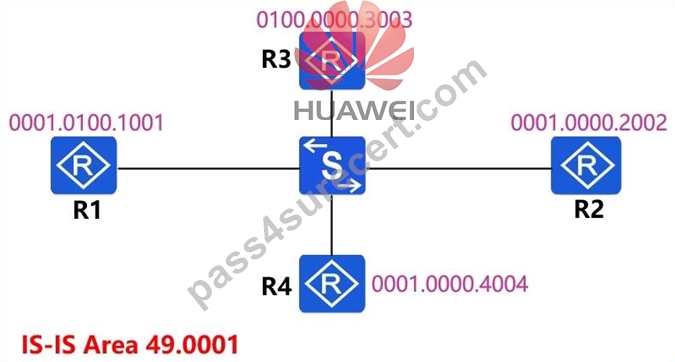
Answer:
Explanation: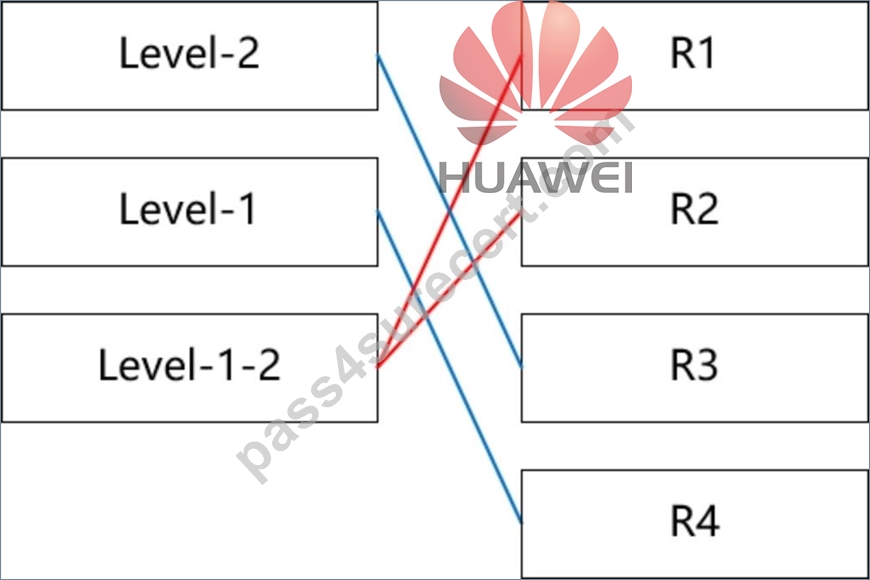
NEW QUESTION # 62
An IP prefix list is a common matching tool used in routing policies. Which of the following cannot be configured as matching conditions in an IP prefix list on a Huawei router?
- A. Index
- B. Port number
- C. Mask
- D. Action
Answer: B
Explanation:
IP Prefix List Matching Conditions
* An IP prefix list matches based on:
* Mask: Specifies the subnet mask length.
* Action: Specifies whether to permit or deny.
* Index: Orders the rules within the prefix list.
* Port numbers are not applicable as matching conditions in an IP prefix list.
HCIP-Datacom-Core Reference
* IP prefix list configurations are detailed in the routing policy and route filtering chapters.
NEW QUESTION # 63
What parameters can a DHCP6 server assign to a DHCPv6 client?
- A. Gateway address
- B. SNTP server address
- C. IPV6 address/prefix
- D. DNS server address
Answer: B,C,D
Explanation:
* Understanding DHCPv6:
* DHCPv6 (Dynamic Host Configuration Protocol for IPv6) is used to assign configuration parameters to IPv6 clients.
* It supports both stateful and stateless modes:
* Stateful: Assigns IPv6 addresses and other configuration parameters.
* Stateless: Assigns only configuration parameters (e.g., DNS server) without providing IPv6 addresses.
NEW QUESTION # 64
Which of the following descriptions about roaming is wrong? (Multiple choice)
- A. When roaming, the STA associated with the new AP sends an association request, and contains the information of the original associated AP.
- B. When roaming, the STA associated with the new AP sends a re-association request, and contains the information of the original associated AP.
- C. The working channels of the two APs before and after roaming must be the same
- D. The working channels of the two APs before and after immersion can be different
Answer: A,C
NEW QUESTION # 65
In the IS-IS broadcast network, which multicast MAC address does the Level-2 router use as the destination address for sending lH?
- A. 0100-5E00-0002
- B. 0180-c200-0015
- C. 0180-c200-0014
- D. 0180-c200-0016
Answer: B
NEW QUESTION # 66
The IGMP protocol runs between an IP host and its directly connected multicast router to maintain multicast group membership.
- A. FALSE
- B. TRUE
Answer: B
NEW QUESTION # 67
In network A, the two DRother devices will not establish an adjacency relationship, and their status will remain in 2-way.
- A. FALSE
- B. TRUE
Answer: B
NEW QUESTION # 68
In the BGP protocol, which of the following BGP attributes can be used to mark routes with certain common characteristics so that other BGP routers can identify them?
- A. Community
- B. MED
- C. Origin
- D. AS-path
Answer: A
NEW QUESTION # 69
Which of the following description about the content contained in the update message is wrong?
- A. Update includes the path attribute
- B. Update contains local autonomous system messages
- C. Update contains information about revoking routing prefixes
- D. Update contains reachable routing information
Answer: B
NEW QUESTION # 70
Which of the following statements about BFD operating modes are true?
- A. Asynchronous mode does not support the Echo function.
- B. Asynchronous mode is the primary BFD operating mode.
- C. In demand mode, once a BFD session is set up, the system no longer periodically sends BFD Control packets.
- D. In asynchronous mode, two systems periodically exchange BFD Control packets at the negotiated interval. If one system does not receive any BFD Control packets from the other within the detection time, the BFD session is declared down.
Answer: B,C,D
Explanation:
In asynchronous mode, BFD control packets are exchanged periodically to detect faults.
In demand mode, once the session is established, BFD stops sending periodic control packets and relies on external mechanisms to verify connectivity.
Asynchronous mode is the most commonly used mode. However, the Echo function is supported in asynchronous mode, making Option B incorrect .
NEW QUESTION # 71
Which of the following statements is false, based on the following IGMP information on an interface of RTA?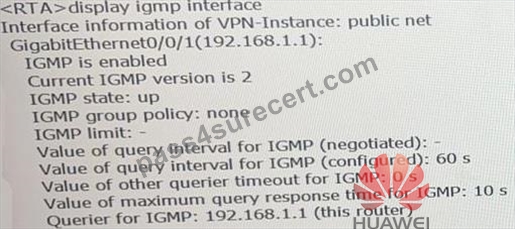
- A. The IGMP version is IGMPV2.
- B. The interval for sending group-specific Query messages is 60s.
- C. The IP address of the interface is 192.168.1.1.
- D. The maximum time for response to Query messages is 10s.
Answer: D
NEW QUESTION # 72
Which of the following values can be set for the security level of the security zone customized by the USG series firewall? (Multiple choice)
- A. 0
- B. 1
- C. 2
- D. 3
Answer: A,B
NEW QUESTION # 73
Which of the following are the mechanisms supported by both IGMPv2 and IGMPv3? (Multiple choice)
- A. Specify source query
- B. Members leave
- C. Querier Election
- D. Specific Group Queries
Answer: B,C,D
NEW QUESTION # 74
Which of the following is used as the destination port for single-hop BFD?
- A. UDP port 3784
- B. UDP port 4784
- C. TCP port 3784
- D. TCP port 4784
Answer: A
Explanation:
Comprehensive and Detailed Step-by-Step Explanation:
* Single-Hop BFD:
* Single-hop BFD is used for detecting link failures in directly connected devices.
* It uses UDP port 3784 for communication.
* Multi-Hop BFD:
* For multi-hop scenarios, BFD uses UDP port 4784 to ensure end-to-end connectivity.
Incorrect Options:
* TCP ports 3784 and 4784 (C and D): BFD does not use TCP.
References:
* HCIA-Datacom Study Guide, Chapter: BFD Ports and Functions
* Huawei BFD Configuration Details
NEW QUESTION # 75
As shown in the figure, R1 imports the direct route 10.1.1.0/24 to OSPF. An engineer enables bidirectional route re-advertisement on R2 and R3, and configures the following commands on R3. After the network becomes stable, which of the following is the Pre value of the route 10.1.1.0/24 in the routing table of R4?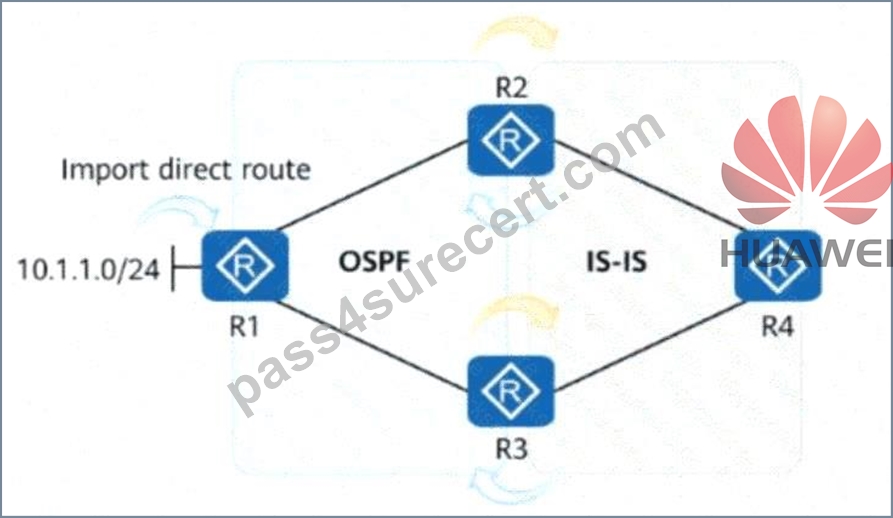
[R3]acl 2000
[R3-acl-basic-2000] rule permit source 10.1.1.0 0
[R3-acl-basic-2000] quit
[R3]route-policy hcip permit node 10
[R3-route-policy-10] if-match acl 2000
[R3-route-policy-10] apply preference 14
[R3-route-policy-10] quit
[R3]ospf 1
[R3-ospf-1] preference ase route-policy hcip
- A. 0
- B. 1
- C. 2
- D. 3
Answer: A
Explanation:
Let's analyze the process step-by-step:
* R1 redistributes the direct route 10.1.1.0/24 into OSPF.
* This OSPF route reaches R2 and R3.
* R2 and R3 are in an environment that uses IS-IS towards R4.
* Both R2 and R3 re-advertise this OSPF route into IS-IS toward R4 (bidirectional route redistribution).
* On R3, a route-policy named hcip is applied to control ASE (Autonomous System External) route preference.
* The ACL matches the route 10.1.1.0/24.
* The route-policy sets the preference of this ASE route to 14.
* In Huawei VRP, if a route-policy applied via preference ase route-policy matches a route, it modifies the preference value of the redistributed route when it is advertised.
By default:
* OSPF ASE routes have a preference of 150.
* But in this case, due to the policy applied, the preference is explicitly changed to 14 on R3 before re- advertising to R4.
So, R4 will install the route 10.1.1.0/24 from R3 with preference 14, assuming R2 doesn't provide a better preference.
Reference from Huawei HCIP-Datacom-Core Technology Study Guide:
"You can control the preference of OSPF ASE routes by using a route-policy and applying it with the command preference ase route-policy. When the policy matches, the specified preference is used instead of the default (150)." (Chapter: OSPF Advanced Features - Section: Route Control and Inter-AS Route Redistribution)
NEW QUESTION # 76
On an STP network, only the designated port processes inferior BPDUs. On an RSTP network, a port with any role processes inferior BPDUs.
- A. FALSE
- B. TRUE
Answer: B
Explanation:
STP and RSTP Behavior:
STP: Only the designated port processes inferior BPDUs. Inferior BPDUs are received from downstream switches and typically indicate topology changes.
RSTP: All ports, regardless of role (root, designated, or alternate), process inferior BPDUs to ensure faster convergence.
Behavior Difference:
RSTP improves convergence by allowing any port to process inferior BPDUs, unlike STP, which restricts this function to designated ports.
NEW QUESTION # 77
In the Init state of the OSPF-enabled router, the destination address for sending Hello packets is ___
Answer:
Explanation:
224.0.0.5
NEW QUESTION # 78
Please pair the following hardware modules with the corresponding functions.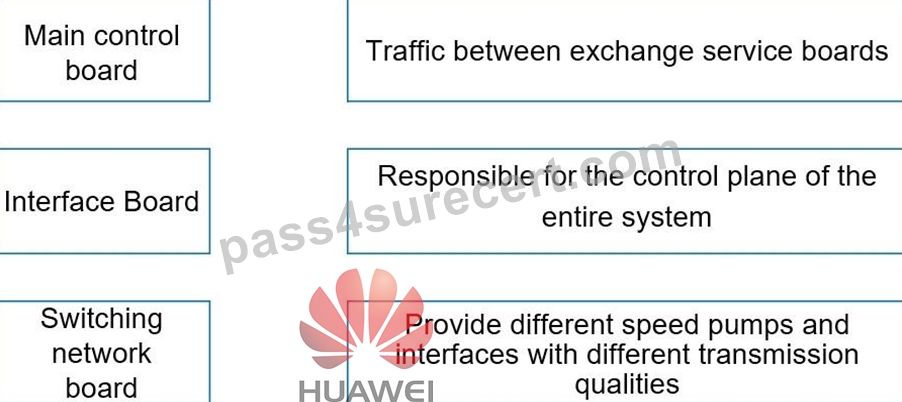
Answer:
Explanation: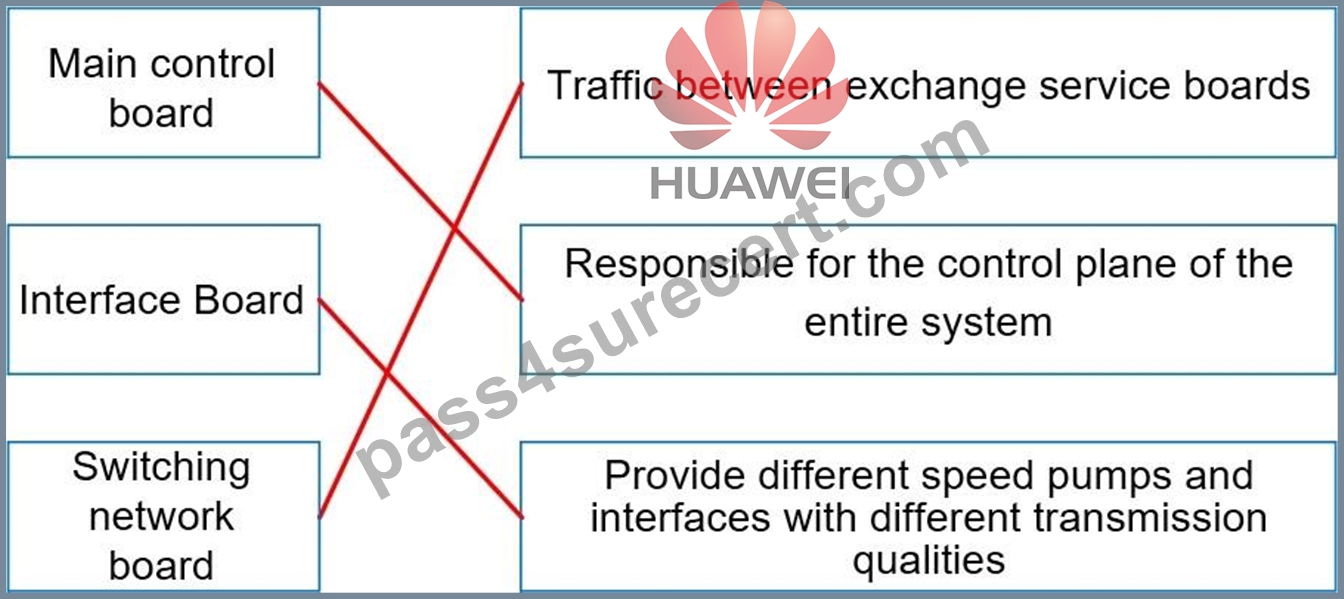
NEW QUESTION # 79
Which of the following statements about the application of BFD is correct? (Multiple choice)
- A. BFD multi-hop detection means that BFD can detect any path between two systems. These paths may span many hops or may overlap in some parts.
- B. BFD single-hop detection refers to the IP connectivity detection of two directly connected systems
- C. The linkage between BFD and OSPF is to associate BFD and OSPF, and then notify OSPF through BFD's rapid detection of link failures, thereby speeding up OSPF 's response to network topology changes.
- D. The one-arm echo function refers to the loopback operation of BFD packets to detect the connectivity of the forwarding link
Answer: A,B,C,D
NEW QUESTION # 80
In a route-policy, which of the following BGP attributes can be used in apply clauses?
- A. MED
- B. AS_Path
- C. Local-Preference
- D. Tag
Answer: A,B,C
NEW QUESTION # 81
......
Latest H12-821_V1.0 dumps - Instant Download PDF: https://www.pass4surecert.com/Huawei/H12-821_V1.0-practice-exam-dumps.html
Updated Verified H12-821_V1.0 Downloadable Printable Exam Dumps: https://drive.google.com/open?id=19S892dWEn_xFwoa0scBMiK3910iwP187